Windsurfing and kitesurfing in Fuerteventura: Sotavento, Corralejo and the trade wind
Sotavento and Corralejo, Fuerteventura//Activities/7 min read
On the leeward beach of Sotavento the best windsurfers in the world race in force 10. The wind, the dunes of Corralejo, when to go and the rules on the water.
 Written with by Eduardo Peire
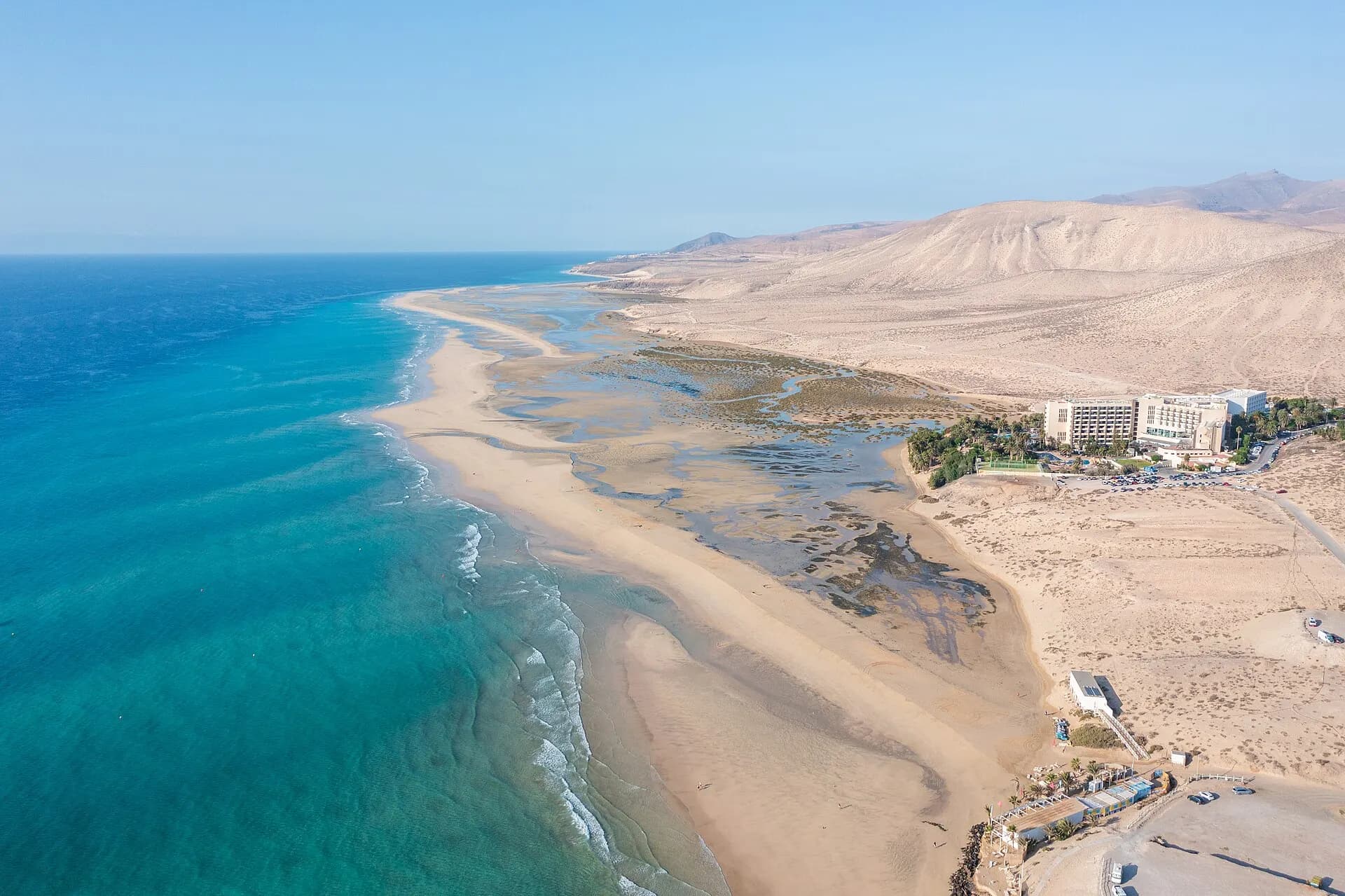
Windsurfing and kitesurfing in Fuerteventura run on the trade wind, which pours down the Atlantic side of the Canary Islands for most of the summer. On Sotavento, the long beach on the south-east side of the Jandía peninsula, the best windsurfers in the world have met almost every year since 1986. In 2026 the Fuerteventura World Cup reached its 38th edition, from 17 July to 1 August, and during the Slalom X races that decided two world titles the organisers reported winds of more than 50 knots.
Sotavento means leeward, the sheltered side. The sheltered side is where the world's fastest windsurfers come to race in force 10.
The Fuerteventura World Cup at Sotavento
The World Cup began in 1986, launched by a windsurfing pioneer together with the town hall of Pájara, the municipality that holds Sotavento, and the town hall and the island's government still help pay for it. Its official site calls it one of only two Grand Slams of the professional windsurfing tour in 2026. The venue is Playa Barca, part of the Sotavento beaches, where a sandbar holds back a tidal lagoon that the sea fills at high tide and leaves as wet sand at low tide.
This beach has done more than host. According to the organisers, modern freestyle, the windsurfing discipline of loops, spins and jumps scored by judges, was first tried as a trial event at the World Cup here in 1997 and is now a full part of the tour. In 2003 Sotavento held the first obstacle slalom of the professional tour, then called Super X. It is now Slalom X: a course of buoys with a floating obstacle that the riders jump over at full speed. The organisers compare it to motocross, which is fair.
In July 2026 the conditions were extreme even by the standards of the place. On 19 July the organisers reported waves up to two metres and a storm-force wind blowing cross-offshore, conditions they said were rarely seen even there. The next day Sarah-Quita Offringa, from Aruba, won her 17th freestyle world title in a tie-break against Maaike Huvermann of the Netherlands, who had needed a single heat win to take her first. On 25 July Justine Lemeteyer of France took the women's Slalom X title by winning all four races of the last day. On 26 July, after eleven races in winds the organisers described as force 10, Matteo Iachino of Italy took the men's title with a second place in the final race, holding off Pierre Mortefon of France, the champion of the year before.
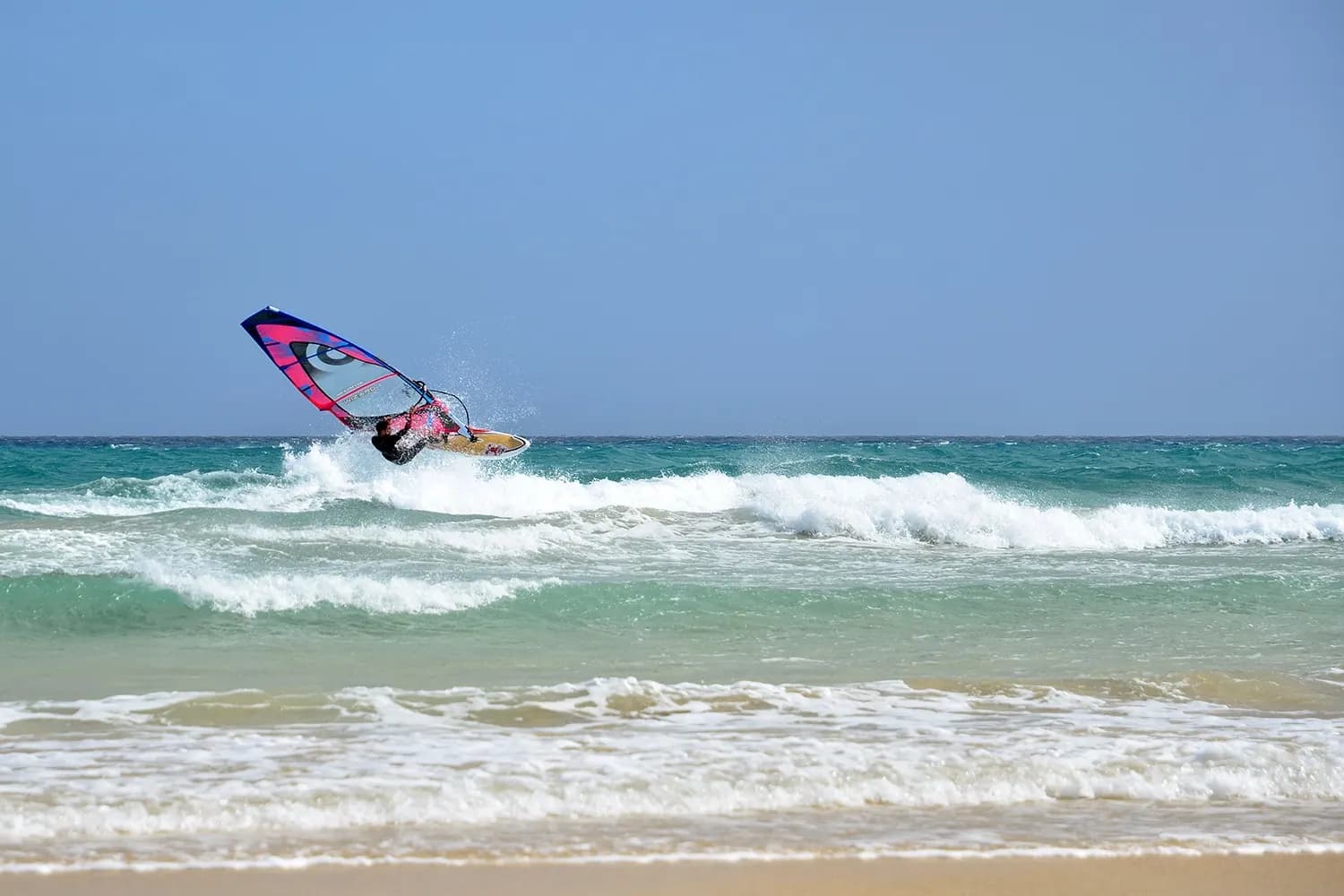
Then the windsurfers packed up and the wingfoilers came in. They stand on a board that rides on a hydrofoil above the water and hold a wing in their hands, with no mast and no lines. The wingfoil world tour ended its 2026 season at Sotavento, where its last world titles were settled, and the Danish rider Benjamin Castenskiold won the event to keep his surf-freestyle crown.
The trade wind, and why offshore matters
The wind is the trade wind, the alisio, which blows from the north-east across the Canaries. AEMET, the Spanish weather agency, puts it over the islands about 90% of the time in summer and 50 to 60% in winter. The official tourism site of the Canary Islands says the wind at Sotavento is stronger and more consistent in spring and summer and can reach 50 knots. On the Beaufort scale that is a storm.
At Sotavento the trade wind blows cross-offshore, as the organisers put it on the opening day of the 2026 World Cup: it comes off the land at an angle and goes out to sea. That is what keeps the water flat close in, and it is also why this is no place to break something on your own. A rider who loses a kite or snaps a mast in an offshore wind drifts out towards the open Atlantic, not back to the sand.
Corralejo, the dunes and the islet across the water
At the other end of the island, the town of Corralejo looks across the strait of La Bocaina to the islet of Lobos and to Lanzarote. South of the town lie the dunes. A royal decree of 1982 made them a natural park, together with Lobos, covering 2,482 hectares. Today they are two protected areas, the natural park of Corralejo and the islet of Lobos.
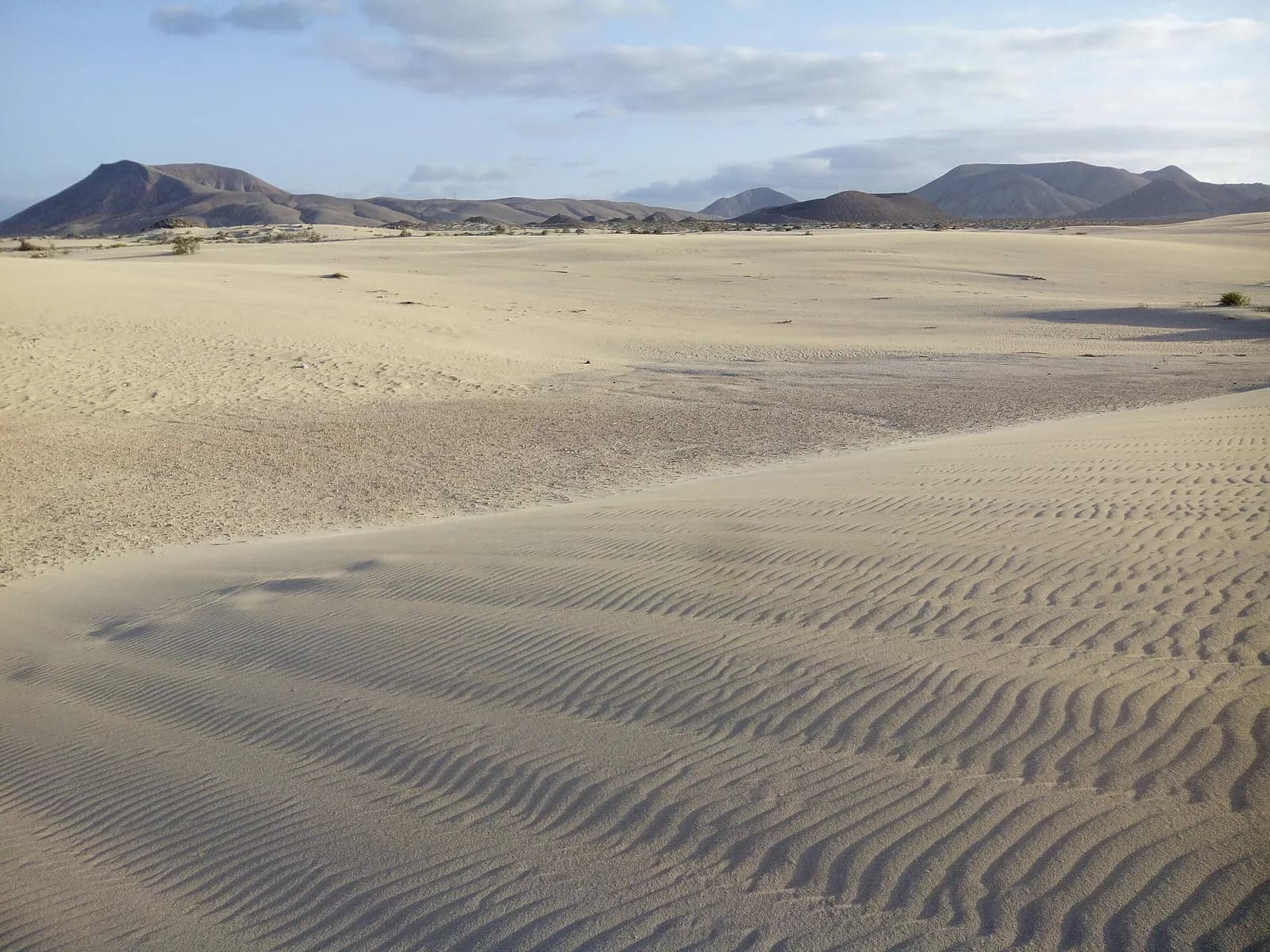
Visitors are often told that this white sand blew over from the Sahara. Geologists say otherwise. A study of the old dune fields of Fuerteventura, published in Quaternary Research, found that they are made of carbonate sand from the shallow sea floor around the island: broken shells and the remains of other sea creatures, blown ashore. The Sahara is there, but only as dust. The reddish layers that separate one generation of dunes from the next are mostly Saharan dust, laid down when the sand stopped moving.
The north is for waves as well as wind. The official tourism site sends kitesurfers and windsurfers of every level to Flag Beach, in Corralejo and facing Lobos, where the waves break with many peaks in different directions and the best months are spring and summer. Nearby, El Burro beach has a short wave that breaks to the left, which suits kitesurfers who want to jump, a car park and no services. A break on the outskirts of Corralejo with the improbable name of Bristol Shooting Gallery is, in the same site's words, only for seasoned windsurfers: it works best in winter and spring at low tide, and the currents there are strong.
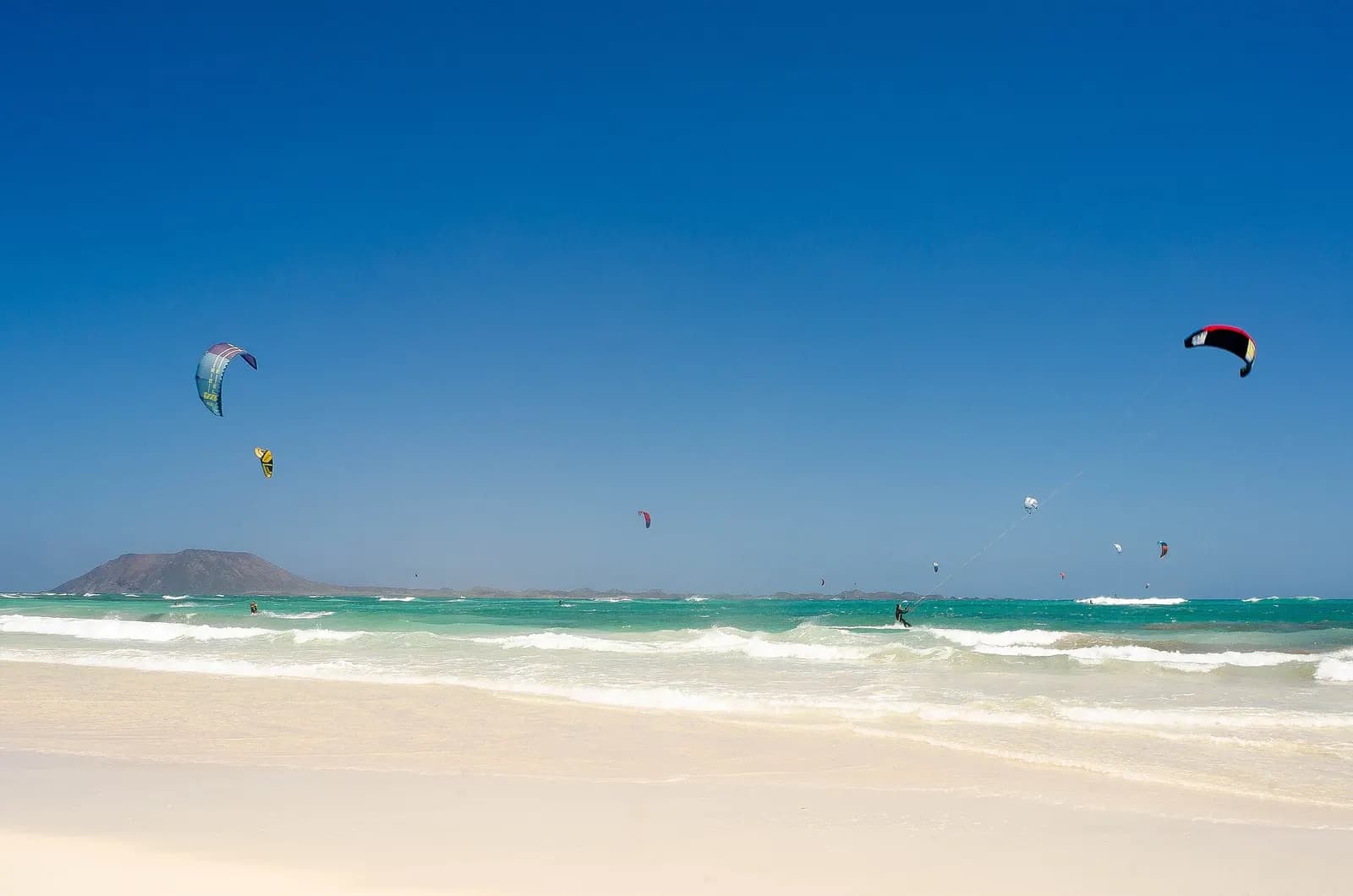
Lobos, across the water, is a natural park of its own: 4.5 square kilometres, 127 metres high and not a single road, according to the island's tourism office, and named after the seals, the lobos marinos, that once lived on its coast. Its visitor rules are set by the Cabildo de Fuerteventura and have changed in recent years, so check them before planning a crossing. The tourism office also lists El Cotillo, on the north-west coast, and La Pared, on the west side of the isthmus of Jandía, among the island's kitesurfing spots. They are worth finding for yourself.
Windsurfing and kitesurfing in Fuerteventura: when to go and what level
Summer brings the steadiest wind and the World Cup. During the event the organisers divide the water at Sotavento into competition zones and zones for everyone else, so a holiday rider can share the beach with the world tour but not its course. Spring is windy too. Winter is less regular, with the trade wind blowing about half the time, and the best season for Bristol Shooting Gallery, the hardest wave of the north, runs through winter and spring.
The tourism site rates Sotavento and Flag Beach as suitable for all levels: beginners at Sotavento start on the calmer parts of the shore, and experts go out where the stronger wind blows. That does not make either place safe for someone learning alone. Beginners should learn with a qualified instructor, never go out in an offshore wind without someone watching from the water, and check the forecast and the tide before each session. Wind that reaches 50 knots is not a lesson.
The rules on the water
Spain's coastal rules are clear and apply here as on any Spanish beach. Under article 73 of the General Coastal Regulation, sailing craft of any kind, boards included, may not enter bathing zones marked with buoys, and they must launch and land through marked channels. Where a beach has no buoys, the first 200 metres of sea count as a bathing zone anyway, 50 metres off the rest of the coast, and nothing may sail faster than three knots inside it. In practice, that means finding the launch channel before you rig. Town halls can add rules of their own, so read the signs on each beach.
The whole island is a biosphere reserve. UNESCO declared it on 27 May 2009, and the reserve covers more sea than land: according to the Spanish Ministry for the Ecological Transition, 166,139 hectares of land and 188,676 hectares of sea. The dunes and the islet are protected areas, and the sand that kites land on is the same sand the park was created to keep. Rig on the beach, stay on the paths through the dunes and take home everything you brought, broken lines included.
Away from the water
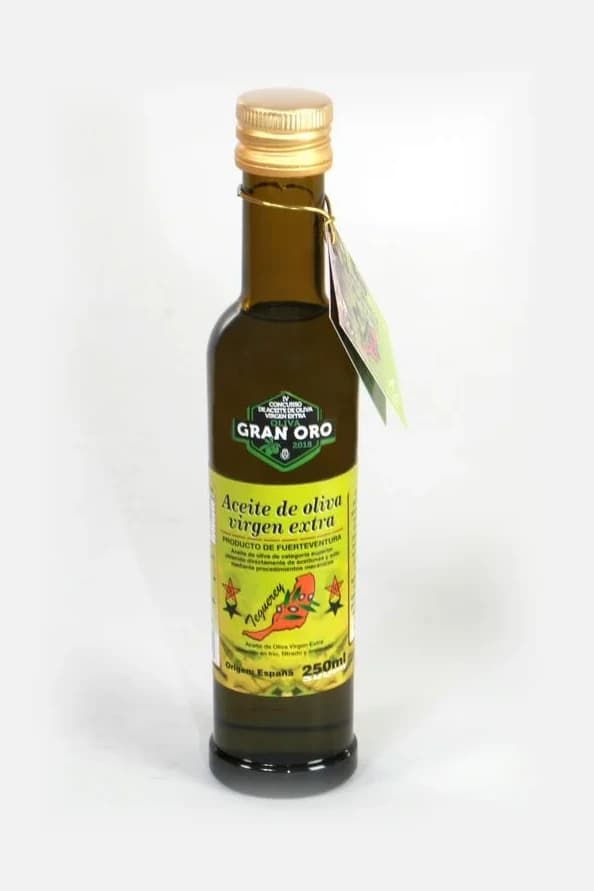
The trade wind does not stop at the beach. Inland, it blows across the plains of Tiscamanita, where Luis Hernández looks after more than 2,500 olive trees and mills the olives on the day they are picked. How anyone grows olives on an island this dry is told in olive oil from a desert island, and the result is the Teguerey oil, from his estate. The rest of the island is in our guide to Fuerteventura, and the island that has tried to live on the wind rather than play in it is at the other end of the archipelago, on El Hierro.
Back at Sotavento, the lagoon fills and empties twice a day whether anyone is racing or not. The leeward beach will keep its name, and the wind will keep ignoring it.
Questions
- When is the best time for windsurfing and kitesurfing in Fuerteventura?
- The trade wind is steadiest in summer: AEMET, the Spanish weather agency, puts it over the Canary Islands about 90% of the time in summer and 50 to 60% in winter. The official tourism site says the wind at Sotavento, in Fuerteventura, is stronger and more consistent in spring and summer. Winter and spring are the season for the hardest waves of the north, which are for experts only.
- When is the Fuerteventura World Cup?
- The Fuerteventura windsurf and wingfoil World Cup is held every summer at Playa Barca, on the Sotavento beaches of the Jandía peninsula, usually from mid-July to early August. The 38th edition ran from 17 July to 1 August 2026, with windsurf freestyle, then Slalom X and then wingfoil. The dates of the next edition are published on the event's official site, fuerteventura-worldcup.org.
- Is Fuerteventura good for beginners in windsurfing and kitesurfing?
- The official tourism site rates Sotavento and Flag Beach, in Fuerteventura, as suitable for all levels, with beginners on the calmer parts of the shore at Sotavento. The wind at Sotavento blows cross-offshore and can reach 50 knots, so learn with a qualified instructor and never go out alone in an offshore wind.
- What are the rules for kites and windsurf boards near Spanish beaches?
- Under article 73 of Spain's General Coastal Regulation, sailing craft may not enter bathing zones marked with buoys and must launch and land through marked channels. Where there are no buoys, the first 200 metres off a beach and 50 metres off the rest of the coast count as a bathing zone, with a speed limit of three knots. Town halls can add local rules.
- Is the sand of the Corralejo dunes from the Sahara?
- Mostly not. A study of Fuerteventura's dune fields published in Quaternary Research in 2018 found that the sand is carbonate from the shallow sea floor around the island, made of broken shells and the remains of other sea creatures. Saharan dust appears mainly in the reddish layers between generations of old dunes.