La Geria, Lanzarote: the vineyards dug into volcanic ash
La Geria, Lanzarote//History/8 min read
A volcano buried a quarter of the island in the 1730s. The farmers dug down through the ash, built a stone wall round every vine and made wine.
 Written with by Eduardo Peire
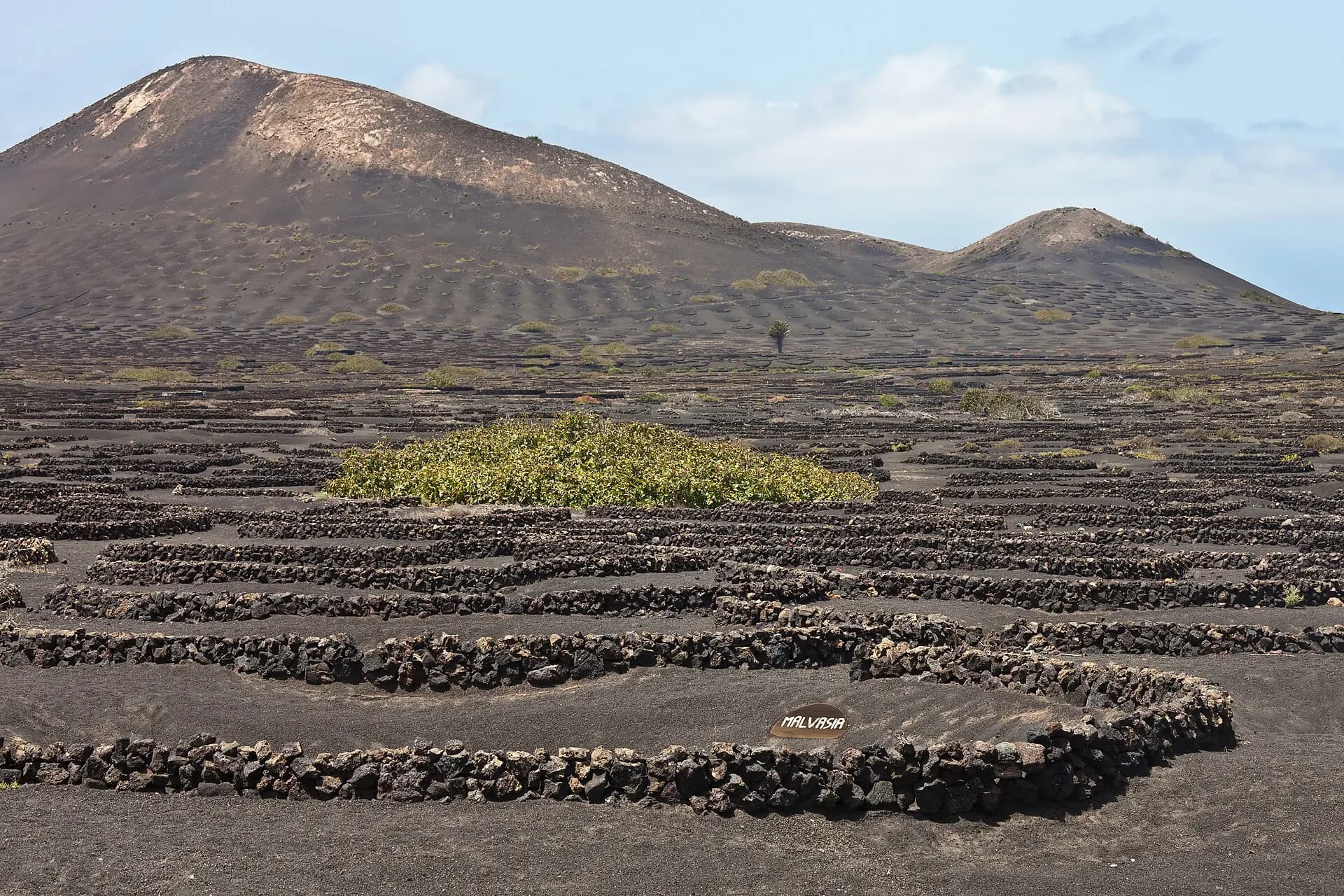
La Geria is a protected wine landscape of about 5,255 hectares in the middle of Lanzarote, where vineyards grow in hollows dug through a thick layer of volcanic ash, each vine sheltered by a low, curved wall of stone. The ash fell during the Timanfaya eruptions of 1730 to 1736, and the vineyards are how the islanders answered it. In 2025 the FAO, the United Nations food and agriculture agency, listed this way of farming as a Globally Important Agricultural Heritage System.
Seen from the road, La Geria looks like the surface of a planet that somebody has decided to garden. Thousands of black craters, each with a half-moon of piled stones on the windward side and a green vine sprawling in the bottom. It is a landscape that exists only for as long as somebody keeps farming it.
What happened at Timanfaya in 1730
On the night of 1 September 1730, the ground opened near Timanfaya, two leagues from Yaiza. The parish priest of Yaiza, Andrés Lorenzo Curbelo, wrote down what followed until the people of the area emigrated in 1731 and 1732. The eruptions continued, with pauses, until 1736. According to Timanfaya National Park, they poured out about one cubic kilometre of lava, covered a quarter of the island and destroyed villages such as Maretas, Santa Catalina and Mazo. A second, smaller eruption followed in 1824.
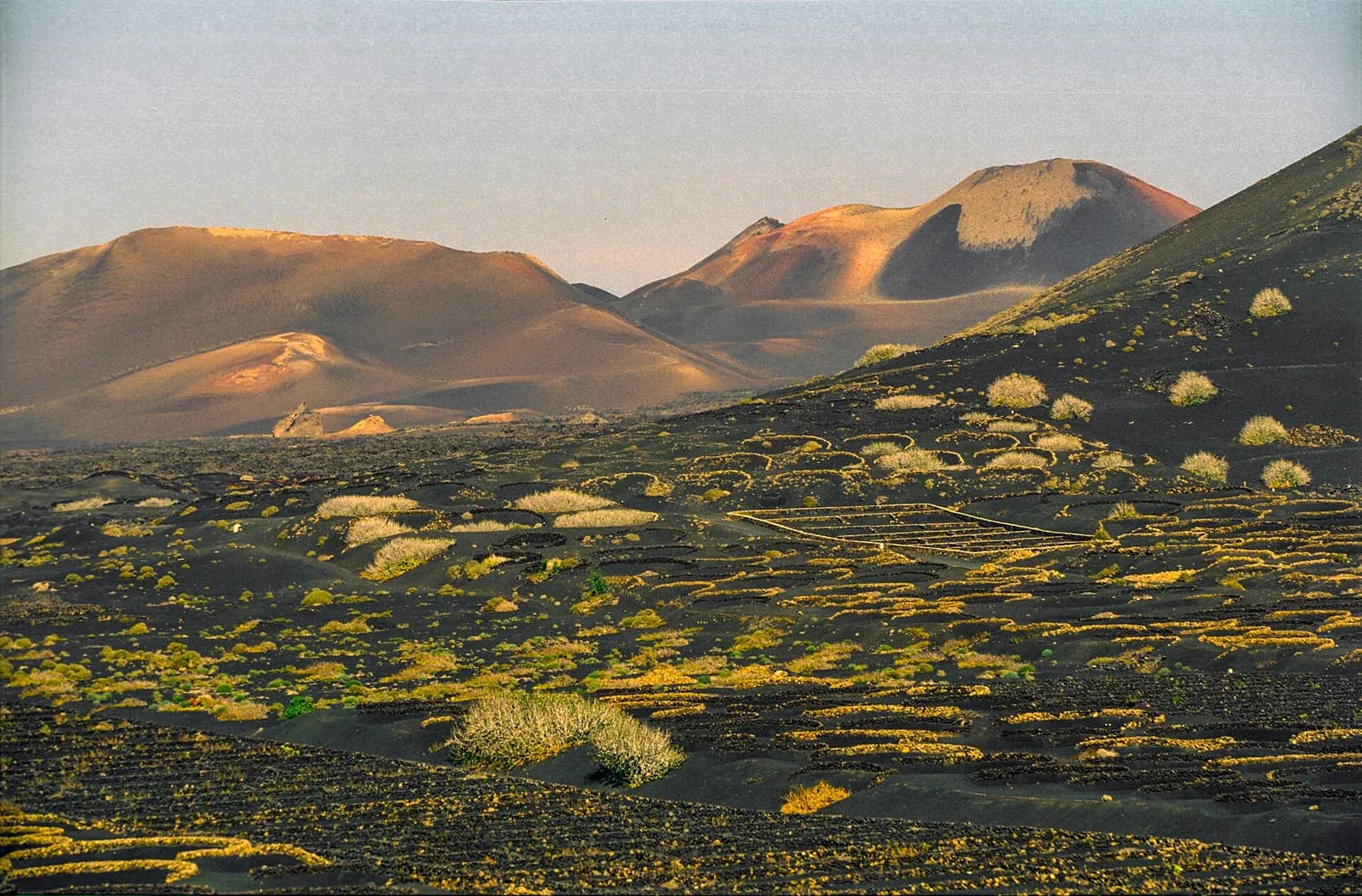
The lava buried fields and villages. Around it, a much larger area was covered in picón or rofe, the black lapilli and ash that fell from the sky, in places several metres deep. It looked like the end of farming on Lanzarote. It turned out to be the start of a different kind.
How a vine grows in a hole in the volcanic ash
The farmers found that the ash was not the enemy. Below it lay the old soil, fertile and red. Above it, the layer of picón worked like a blanket: it let the little rain that falls soak in quickly and then stopped it from evaporating. The black grains also catch the dew. Lanzarote gets less than 150 millimetres of rain a year, according to the regulatory council of the DO Lanzarote, spread over only about 16 days, according to FAO. An open tank of water on the island loses about 1,800 millimetres a year to evaporation. Relative humidity, though, can pass 80 per cent in the early morning. The picón turns that morning damp into water for the roots.
So they dug. In La Geria, where the layer of lapilli reaches up to three metres, each vine sits at the bottom of its own hoyo, a funnel-shaped pit dug down to the old soil, sometimes more than two metres deep, with one to three vines at the bottom. On the side facing the trade winds, which blow from the north-north-east almost all year, they built a zoco, a semicircle of loose volcanic stones about 60 to 70 centimetres high that keeps the wind off the leaves and the ash out of the pit. Because each pit needs room, the vines stand up to four metres apart, and the yield is low. The DO allows a maximum of 7,000 kilos of grapes per hectare; in practice, the council says, a hectare gives between 1,000 and 1,500.
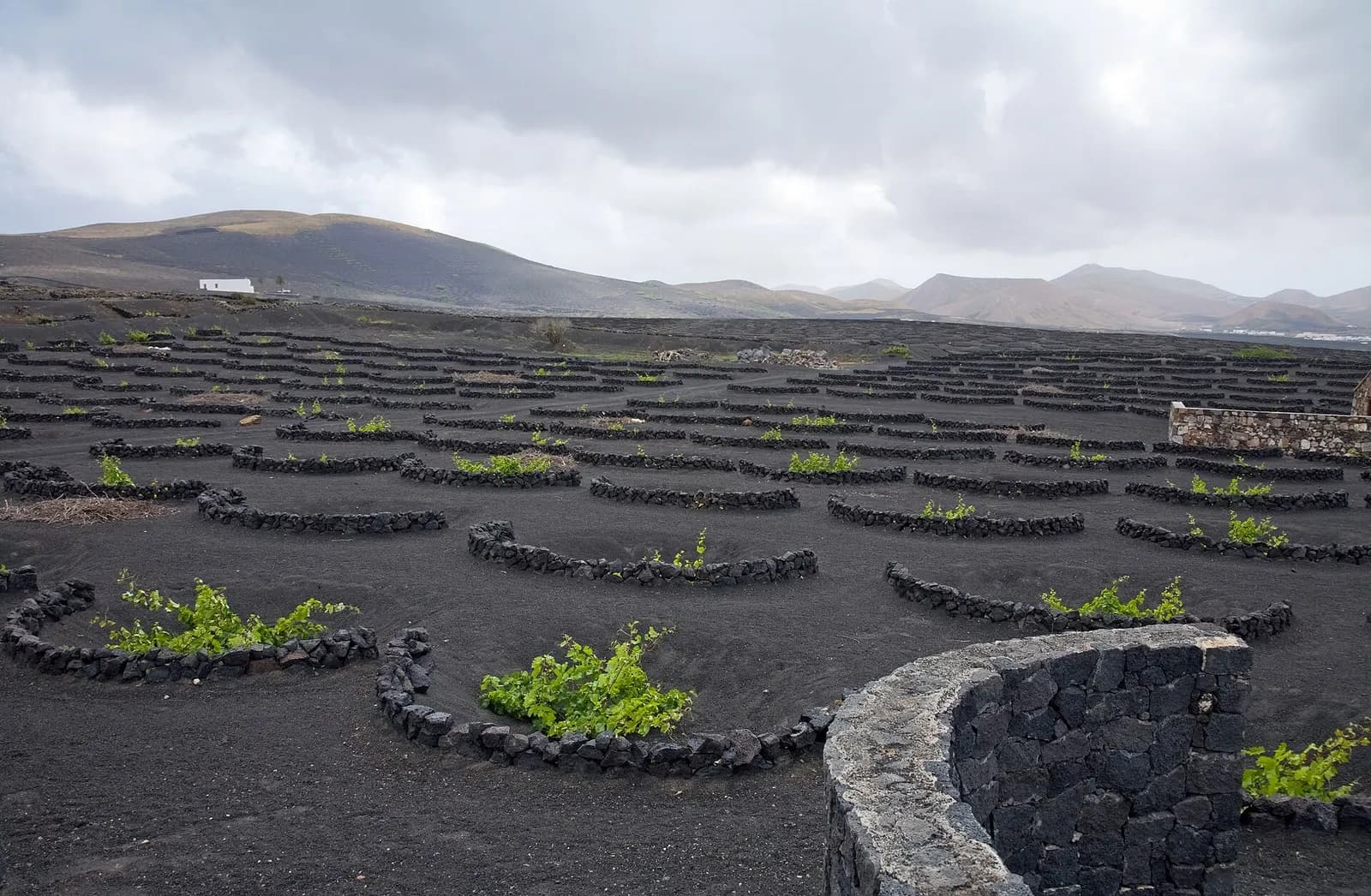
Hardly anyone waters these vineyards. FAO describes the system as largely non-irrigated, which on an island this dry is the whole point. The harvest, the DO says, is done without any kind of machinery. It is hard to imagine a machine that could get into a hoyo.
North of La Geria, where the ash is thinner, the same idea takes other forms: vines in long trenches in Tinajo and Haría, and the enarenado artificial, a layer of picón spread over ordinary fields. On El Jable, a broad plain of pale sea sand, farmers use the sand in the same way.
Malvasía Volcánica, the grape of La Geria
The grape of the hoyos is Malvasía Volcánica, a white variety that the DO Lanzarote calls indigenous and that goes into most of the island's protected wines. The name says Malvasía, a family of grapes grown around the Mediterranean, but the island has kept its own version. FAO, in its description of the heritage system, says genetic analyses have found Lanzarote's grape varieties markedly distinct from their continental relatives, and gives part of the reason: unlike most of Europe, the island never had to graft its vines onto American rootstock. That is the cure Europe adopted after phylloxera, and it comes up again below.
Lanzarote is white wine country. Of the 23 wines tasted to rate the 2025 vintage, 11 were dry whites and 4 semi-sweet whites, against 4 rosés and 4 reds. The DO Lanzarote, which certifies these wines, was recognised by an order of the Canary Islands government of 14 December 1993. It now has 1,821 registered growers and 33 wineries working 1,889 hectares of vineyard in production, according to the figures given at the rating of the 2025 vintage.
Most of those vineyards are here. More than three quarters of the island's vineyard area lies inside the protected landscape of La Geria, according to figures from the Cabildo, the island government.
Why La Geria makes less wine than it used to
The figures of the last few harvests read like a fever chart. In 2023 Lanzarote picked about 3.3 million kilos of grapes. In 2024 it was almost 1.4 million. In 2025, after irregular budding and a dry year, it was about 843,000 kilos, enough for 1,502,656 bottles, about a quarter of what the island picked two years before and not far above the 700,000 or so of 2016. The council still rated the 2025 wines "very good", with 17.5 points. A small harvest is not necessarily a bad one.
Grape prices have followed. In May 2025 the manager of the regulatory council, Nereida Pérez, told RTVC that the price of Malvasía Volcánica had doubled in three years to about 4 euros a kilo, and that the more growers are paid the better, because they are "jardineros de nuestra isla", the gardeners of the island. The phrase fits. A hoyo has to be kept like a garden: the walls are dry stone, the ash moves with the wind, and all the work is done by hand.
The public money has started to follow too. In August 2025 the Cabildo de Lanzarote approved 800,000 euros of aid, 500,000 of them from the Canary Islands government, for growers inside the protected landscape who keep farming in hoyos with picón and commit to do so for three years, as La Voz de Lanzarote reported. By May 2026, the president of the Cabildo said, more than 627,000 euros had gone to 342 growers.
There is a new worry as well. At the end of July 2025 phylloxera, the root aphid that destroyed most of Europe's vineyards in the 19th century, turned up in the north of Tenerife. Until then the Canary Islands had kept their status as free of phylloxera, protected by an order of 1987 that kept vine material out, even from mainland Spain. In August 2025 the Canary Islands government declared the fight against the pest of public interest and banned moving vine plants, cuttings, fresh grapes, machinery and vineyard soil between the islands, as Agronews reported. By then 30 sites had tested positive, most of them on abandoned land, and only two affected plants had turned up in a vineyard in production. For island vines that never needed American rootstock, that ban is now the first line of defence.
The 2026 harvest started early, in the second week of July, when a heatwave ripened the first plots. The president of the regulatory council, Jorge Rodríguez, put the likely total at around 2.5 million kilos. By late August, RTVC reported, Lanzarote's growers had almost finished and had picked three times as many kilos as in 2025, after a season of good rain. One good year does not undo two bad ones, but it helps pay for the walls.
A landscape protected as a farm, not as scenery
La Geria was declared a natural park in 1987 and became a protected landscape in 1994, a category meant for landscapes made by people as much as by nature. It stretches across five municipalities: Tinajo, Yaiza, Tías, San Bartolomé and Teguise.
The FAO recognition of May 2025 went further. It does not cover a view but a way of farming: the natural ash of La Geria, the artificial ash fields of the north and the sand of El Jable, over more than 12,000 hectares, in a network that then counted 95 systems in 28 countries. A listing does not dig any hoyos, but it makes it harder to argue that the hoyos are not worth digging.
When to go to La Geria, and what to look for
The vineyard landscape lies between Uga, on the edge of Yaiza, and Masdache and Mozaga to the north-east. It is easy to drive through La Geria too fast. It deserves longer. Stop where you can see the pattern of the walls from above: the low hills that rise out of the ash give the best view, and the shapes of the hoyos only make sense from there.
Spring brings the bright green of new leaves against the black ash, and summer brings the harvest, which usually starts in July, when most European vineyards are still weeks or months from picking. The wineries along the road sell their own Malvasía, and a glass of it next to the vines that made it explains the landscape better than a paragraph can. Please do not climb into the hoyos or onto the walls for a photo: they are someone's farm, and they fall down.
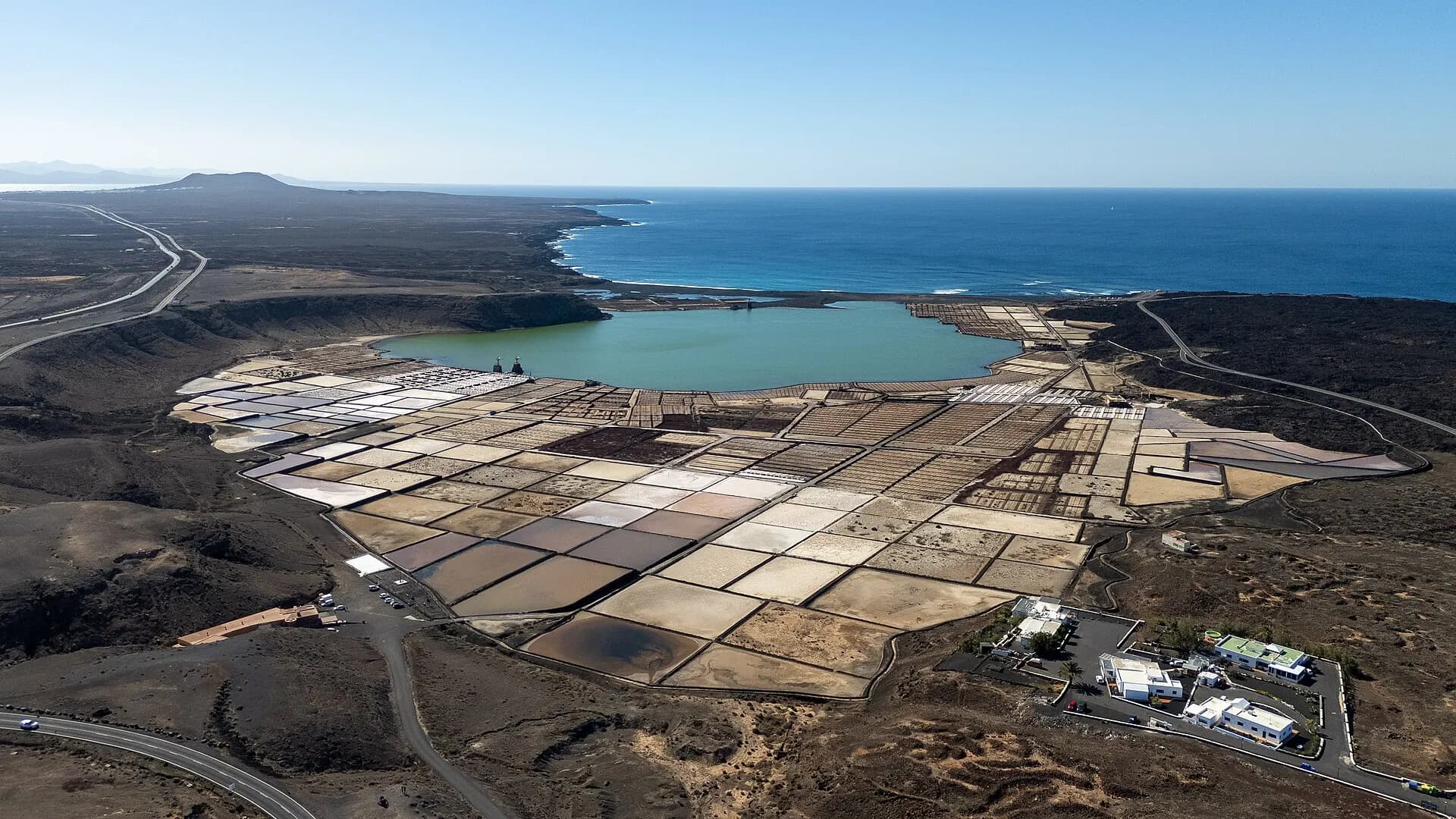
At Mozaga, on the edge of the wine country, César Manrique's Casa Museo del Campesino, begun in 1968, is a homage to the people who learned to farm this island, and it is where the regulatory council rated the 2025 vintage. To see where the ash came from, go west to Timanfaya. To see the other thing Lanzarote makes from its volcano and the sea, go south-west to the salt pans of Janubio, and in the north look for the cactus fields where cochineal is still farmed. The rest is on the Lanzarote page.
The DO puts the average age of Lanzarote's vines at 30 to 50 years. A hoyo has no age limit, as long as somebody keeps digging it out.
Questions
- Why are the vines in La Geria planted in holes?
- In La Geria, on Lanzarote, the old soil lies under a layer of volcanic ash up to three metres deep. Farmers dig a funnel-shaped hollow, or hoyo, down to that soil, sometimes more than two metres deep, and plant one to three vines at the bottom. The ash keeps the little rain from evaporating and catches the morning damp, and a curved stone wall, the zoco, shelters the vines from the trade winds.
- What is Malvasía Volcánica?
- Malvasía Volcánica is the main white grape of Lanzarote and of La Geria, an indigenous variety according to the DO Lanzarote, which uses it in most of its wines. FAO says genetic analyses have found Lanzarote's grape varieties markedly distinct from their continental relatives, partly because the island never had to graft its vines onto American rootstock.
- When was La Geria created?
- The landscape of La Geria comes from the Timanfaya eruptions of 1730 to 1736, which covered the area in volcanic ash. Farmers then dug through the ash to plant vines. La Geria was declared a natural park in 1987 and a protected landscape in 1994, and FAO recognised the farming system in 2025.
- When is the grape harvest in La Geria?
- The grape harvest in La Geria, Lanzarote, starts in July, earlier than in most of Europe, and is done entirely by hand. In 2026 the first wineries began picking in the second week of July, after a heatwave ripened the first plots, and by late August the island had almost finished.
- Why has Lanzarote's wine harvest fallen?
- Lanzarote picked about 3.3 million kilos of grapes in 2023, almost 1.4 million in 2024 and about 843,000 in 2025, after irregular budding and a dry year. The price of Malvasía Volcánica doubled in three years, and in 2025 the Cabildo approved aid for growers who keep farming in hoyos. After a rainy season, 2026 brought about three times as many grapes as 2025.
- Can you visit La Geria?
- Yes. La Geria lies along the road between Uga, near Yaiza, and Masdache and Mozaga, and several wineries along it sell their own wine. The hoyos and walls are working farms, so visitors should stay out of them and look at the pattern from the low hills around.