Salinas de Janubio: how Lanzarote's salt pans make flor de sal
Yaiza, Lanzarote//Products/8 min read
A volcano closed a harbour, a family built salt pans around what was left, and four generations later the salt is still raked by hand.
 Written with by Eduardo Peire
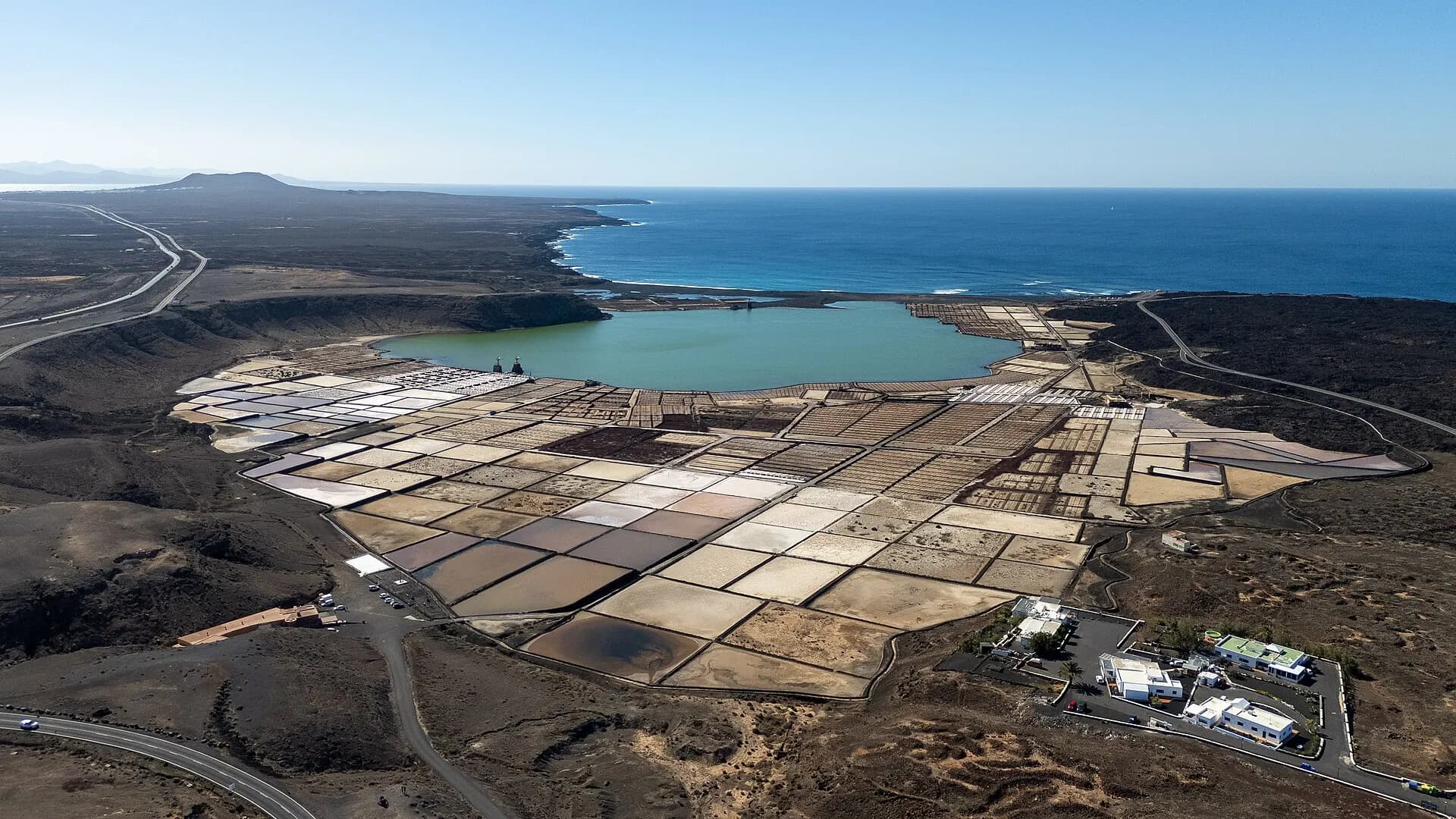
The Salinas de Janubio are salt pans in Yaiza, on the south-west coast of Lanzarote, and the largest salt works in the Canary Islands. Since 1895 the same family has made salt there from Atlantic water, sun and wind, raking it by hand out of a grid of shallow pans beside a lagoon that a volcano cut off from the sea. Two salts come out of Janubio: coarse sea salt, and flor de sal, the thin crust of fine crystals that forms on the surface of the brine.
From the road above, the pans look like a chessboard left out between a green lagoon and black lava. Up close they are a factory with no roof, almost no machines and a production schedule set by the weather. The landscape is protected for its birds. Less usual is that the rules also protect the work: the traditional salt-making is written into the conservation plan as something worth keeping.
How a volcano made the Janubio lagoon
Before 1730 Janubio was a harbour. The Puerto Real de Janubio served the island's trade in the 17th century, according to the salt works' own history. On the night of 1 September 1730 the ground opened near Timanfaya, as the parish priest of Yaiza, Andrés Lorenzo Curbelo, wrote at the time. The eruptions went on, with pauses, until 1736 and buried about a quarter of the island, according to Timanfaya National Park.
The lava did not fill the bay in one go. The Lanzarote and Chinijo Islands UNESCO Global Geopark, which lists the lagoon as one of its geosites, explains that the sea broke down the new lava flows and the current carried the debris along the shore until it sealed the old port. What remains is a lagoon more than a kilometre round and between 2 and 7 metres deep, fed by seawater that seeps in through the barrier.
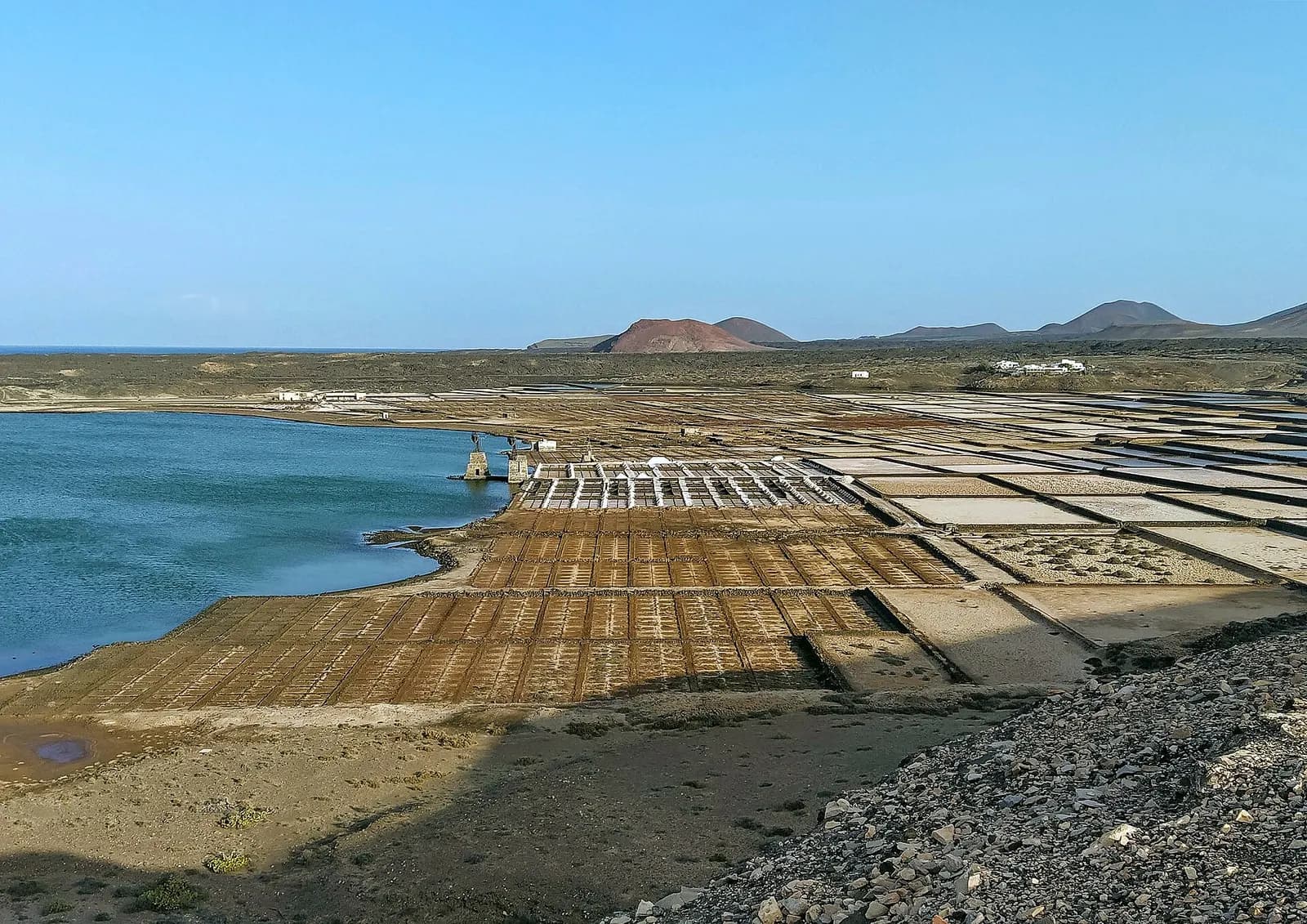
The island lost a harbour and gained, a century and a half later, a salt works. Lanzarote has always had to make do with whatever the volcano left behind.
Who built the Salinas de Janubio
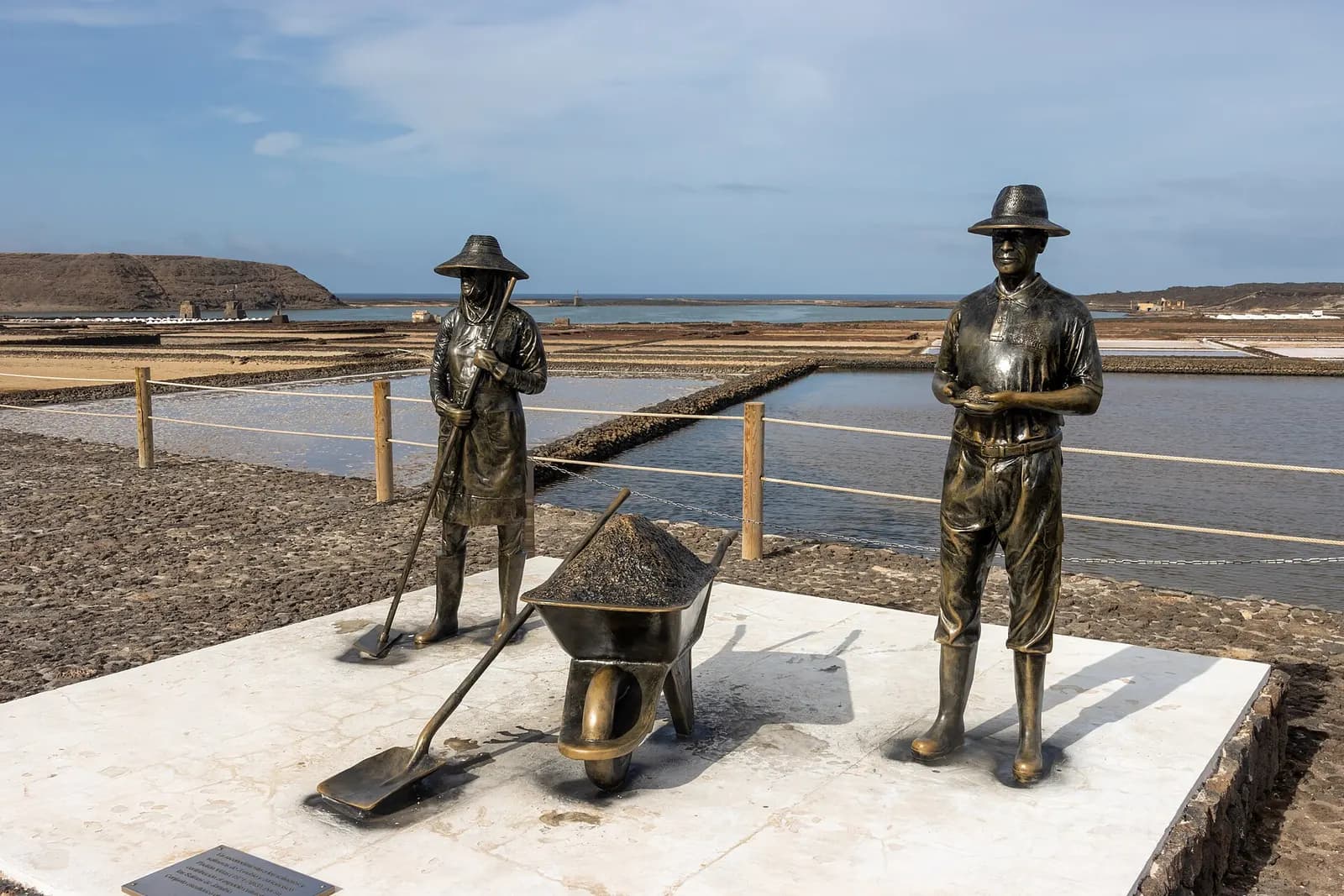
In 1895 Vicente Lleó Benlliure began building pans around the lagoon with his nephew, Jaime Lleó Mira, who finished them around 1945. From 1953 they were run by Francisco Padrón Viñas, a doctor and Jaime's son-in-law. Today the Salinas de Janubio are run by his son, Carlos Padrón Lleó, and his grandson, Carlos Padrón Marrero. The family counts Jaime as its first generation, which makes Carlos Padrón Marrero the fourth.
The family owned the pans. Other people built and worked them. Modesto Perdomo, who started at Janubio in April 1976 and was its foreman for more than forty years, told the travel magazine Hidden Europe in 2018 that his grandfather, Florencio, had sketched out the layout of the pans for Jaime Lleó, and that his father had worked there too. Almost everyone in the villages of Las Breñas, La Hoya, Maciot and Femés worked at the salt works, he said, and they walked in, because there were no cars. By the company's count it once employed more than a hundred people.
Salt was not a gourmet product then. It was how an island without refrigeration kept its fish. Lanzarote once had about 25 salt works along its coast, Perdomo told the magazine, and much of the island's life turned on fishing the Saharan Bank, off the African coast, where the catch was salted to keep it. Janubio salt also went to the Basque tuna fleet. When refrigeration arrived, demand fell and the salt works closed one after another. In 2018 Perdomo counted two left: Los Agujeros, near Guatiza, and Janubio. The salt works now describes its pans as the only ones still in production on the island.
The numbers tell the rest. When Perdomo arrived, the pans produced about 10,000 tonnes a year. By 2018 it was not much more than 2,000 tonnes, made by five people, and only about a tenth of the pans was in use.
How Janubio salt is made, from lagoon to wheelbarrow
The method has barely changed. Unlike most industries, salt-making at Janubio was never mechanised, as the Geopark points out. Water comes from the lagoon. Four windmills once pumped it up; in the 1950s petrol motors replaced them, and an old piston pump built by Ruston of Lincoln, in England, is kept in the Casa del Motor. From the pumps, the water runs along the caño, a channel that rings the salt works and feeds each pan as it is needed.
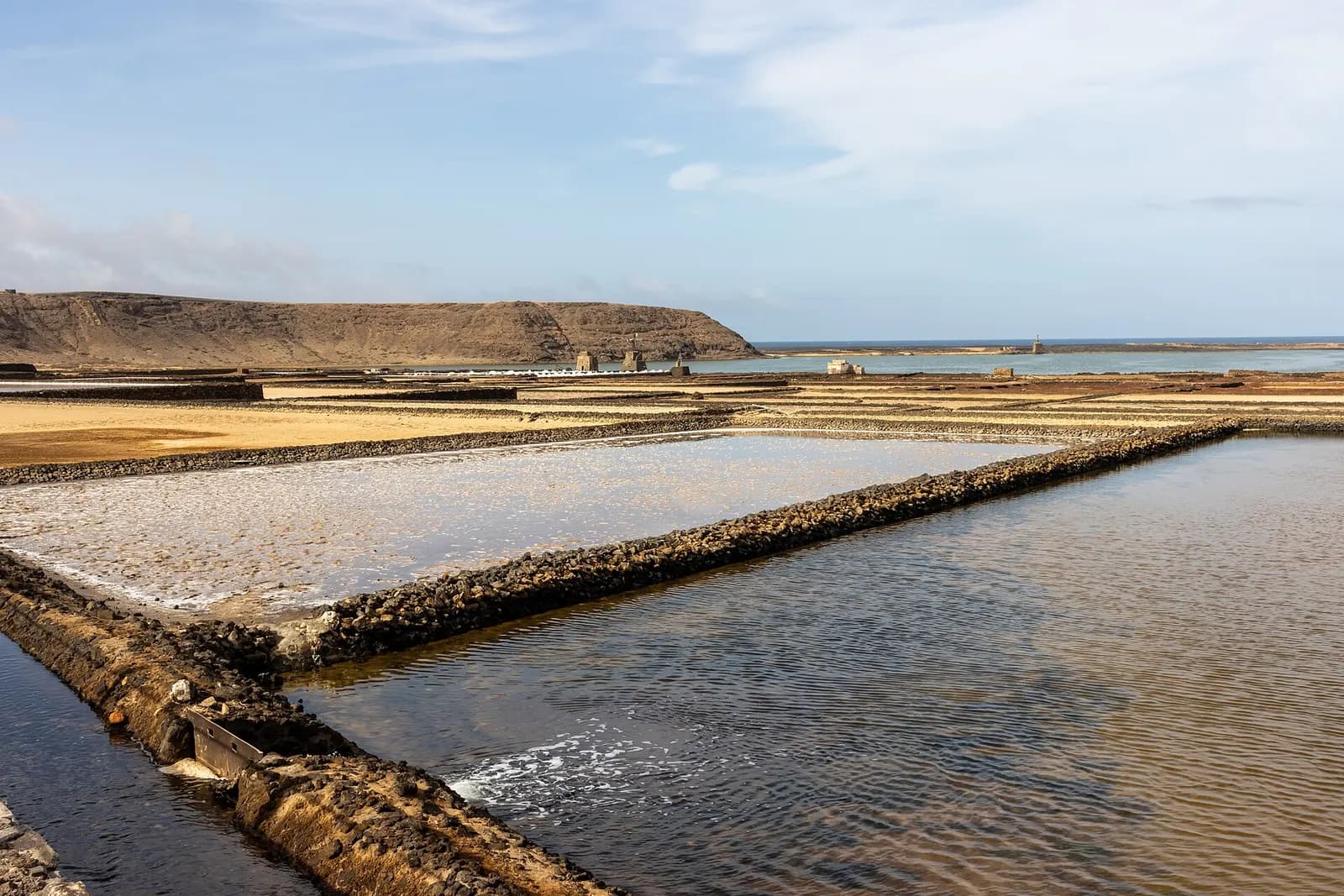
The first pans are the cocederos, where the sun starts to evaporate the water, which, according to Hidden Europe, is warmed but never allowed above 25 degrees. The brine then moves down the slope from one basin to the next, up to five times over 15 to 20 days, until it holds about 300 grams of salt per litre, roughly ten times the salt it started with. Only then does it reach the tajos, the small square pans where the salt crystallises.
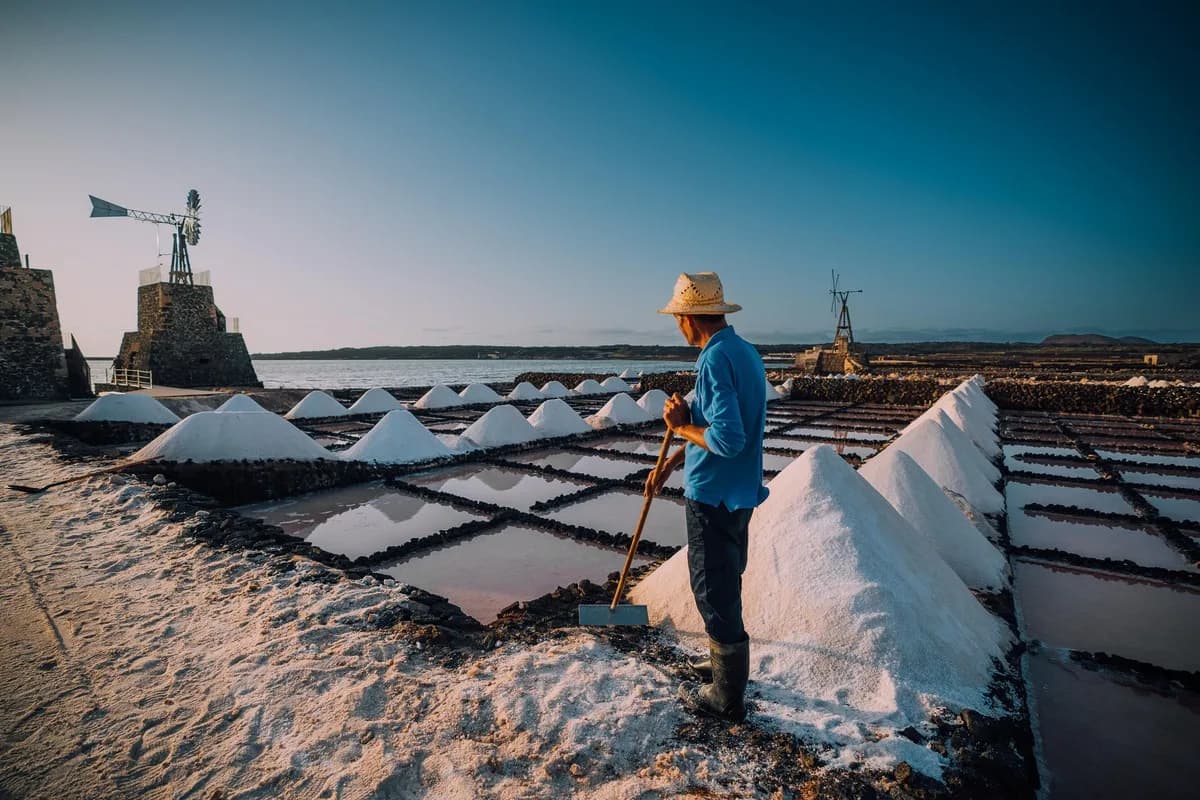
The salt workers break up the crust with a rake, gather the crystals into heaps, shovel them into wheelbarrows and push them out to drain and dry. "It is work for a rake, a shovel and a wheelbarrow," as Perdomo put it. The harvest runs through the hot months, from May to October according to the salt works. The rest of the year goes on cleaning the channels and the floors of the pans and rebuilding the low walls by hand, choosing each stone. It is slow, it depends on the sun and the trade winds, and a wet week costs salt. On Lanzarote, wet weeks are not the main problem.
What is flor de sal, and how is it different from sea salt?
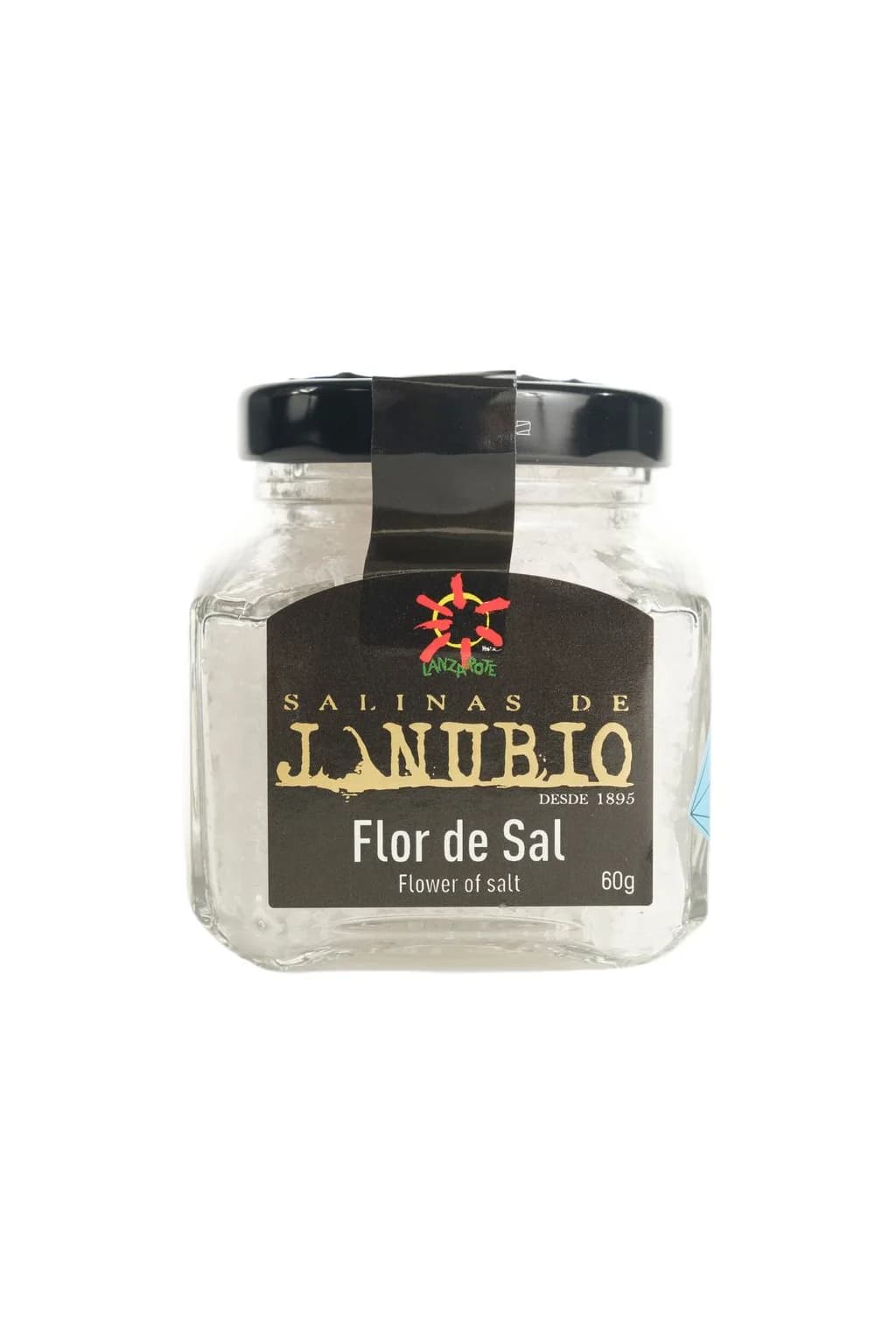
Flor de sal, the same thing the French call fleur de sel, is the thin layer of fine crystals that forms on the surface of the pans. At Janubio it appears with the change of temperature between night and day. The salt workers gather it by hand from the surface. There is little of it, and on the tongue it tastes less salty than coarse salt, which is why it goes on at the end, sprinkled over a finished dish, where the crystals stay crisp instead of dissolving.
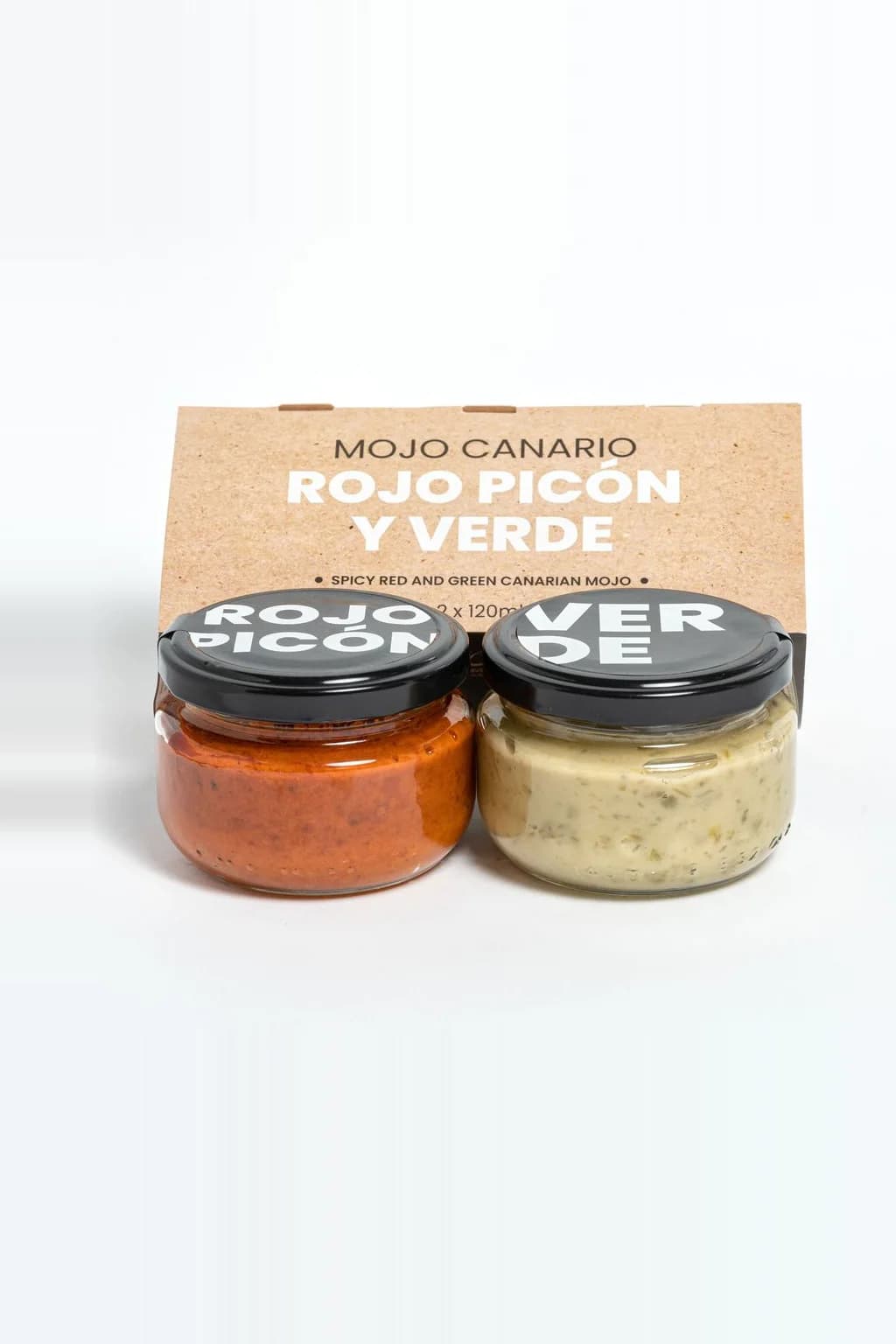
Coarse sea salt is the everyday salt of the pans: for cooking, for curing, and for the pot of papas arrugadas, the small Canarian potatoes boiled in very salty water until their skins wrinkle and turn white. They are eaten with mojo, which has its own story.
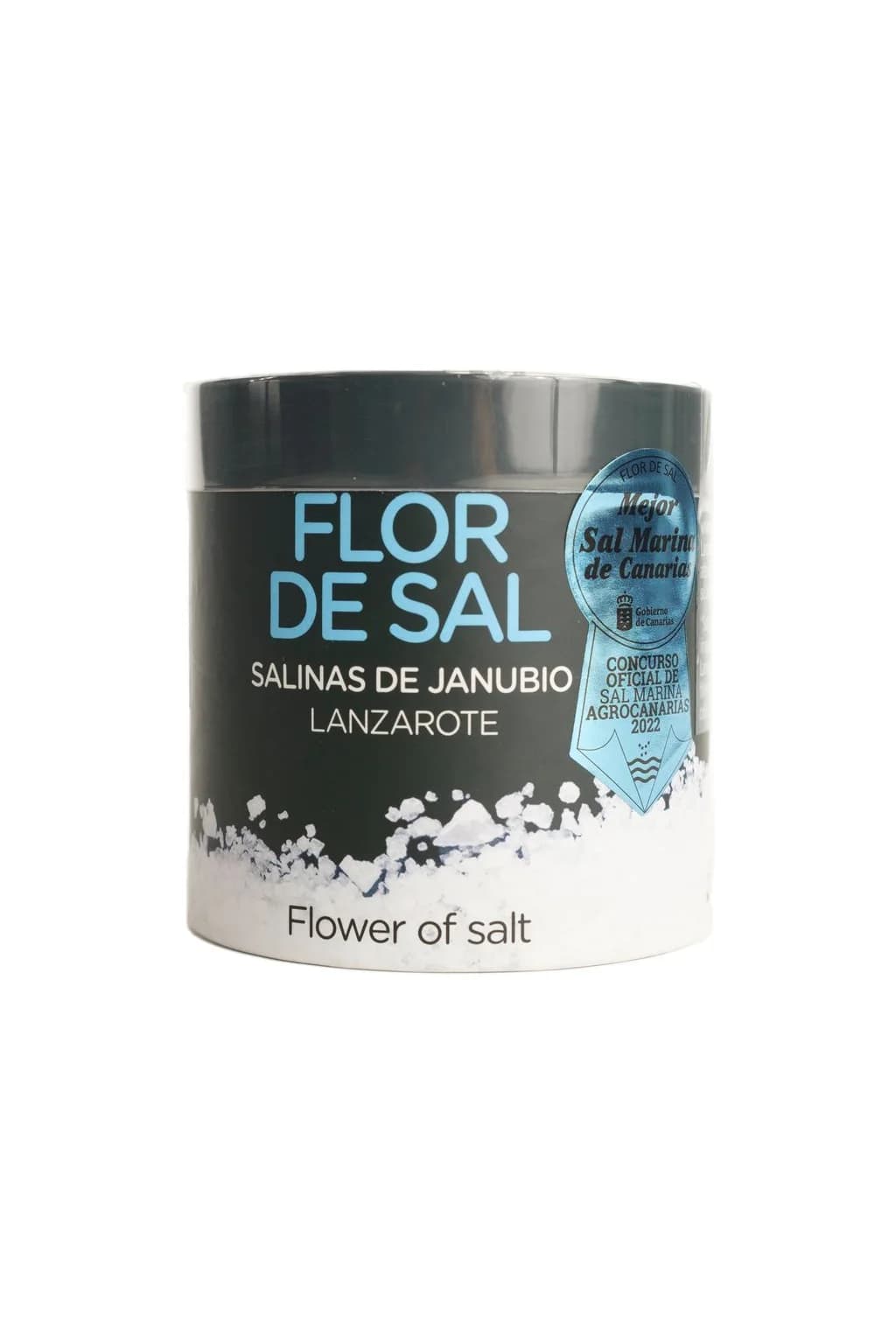
Janubio's salt does well in the official competition of the Canary Islands government, Agrocanarias. In 2022 the islands' public broadcaster reported it as the best sea salt of the Canary Islands, and in 2024 the salt works took a grand gold medal for its virgin sea salt and a gold medal for its flor de sal, as La Voz de Lanzarote reported. The company also had its salt tested by an independent laboratory for microplastics; according to the salt works, none of the five families of plastic it looked for turned up.
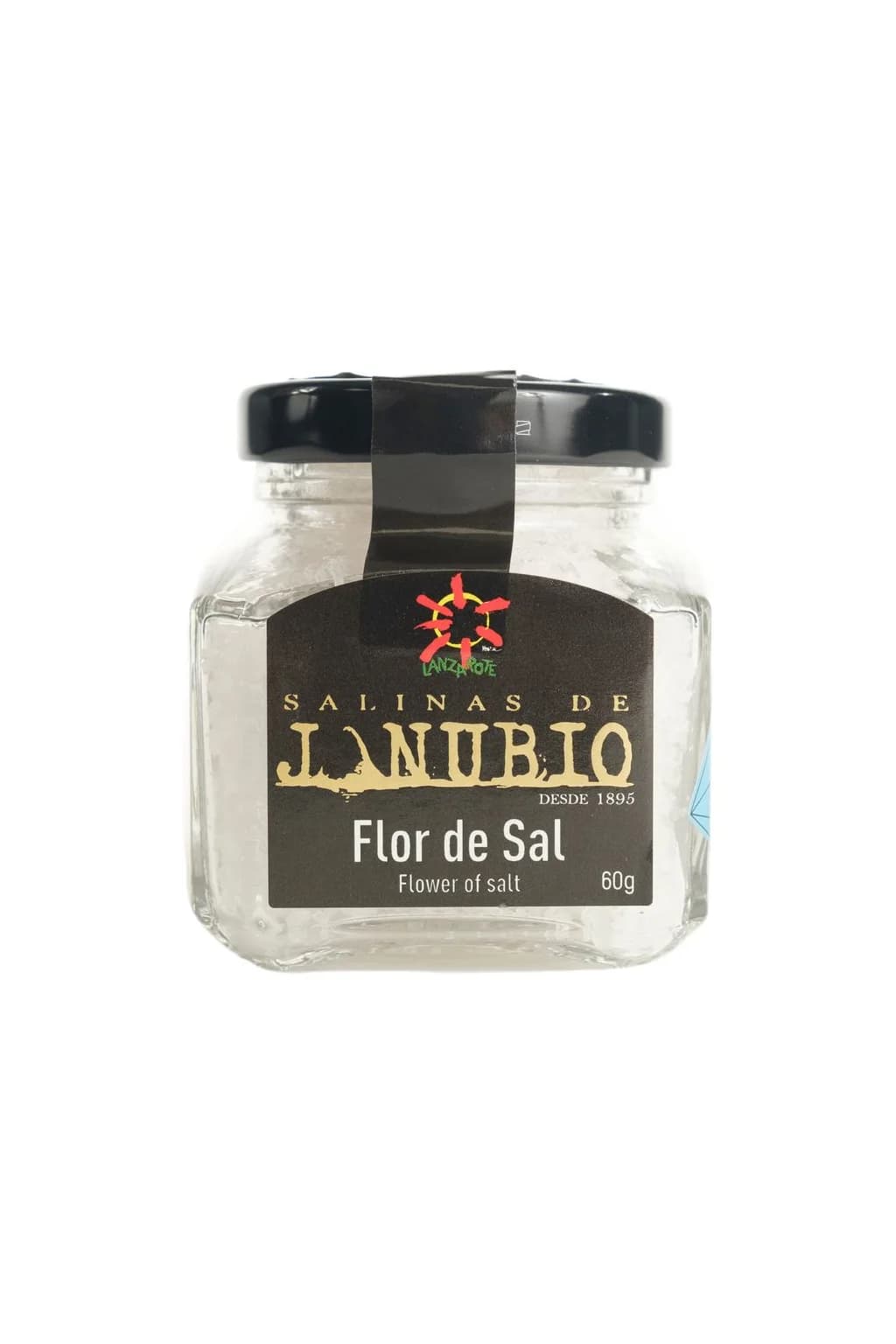
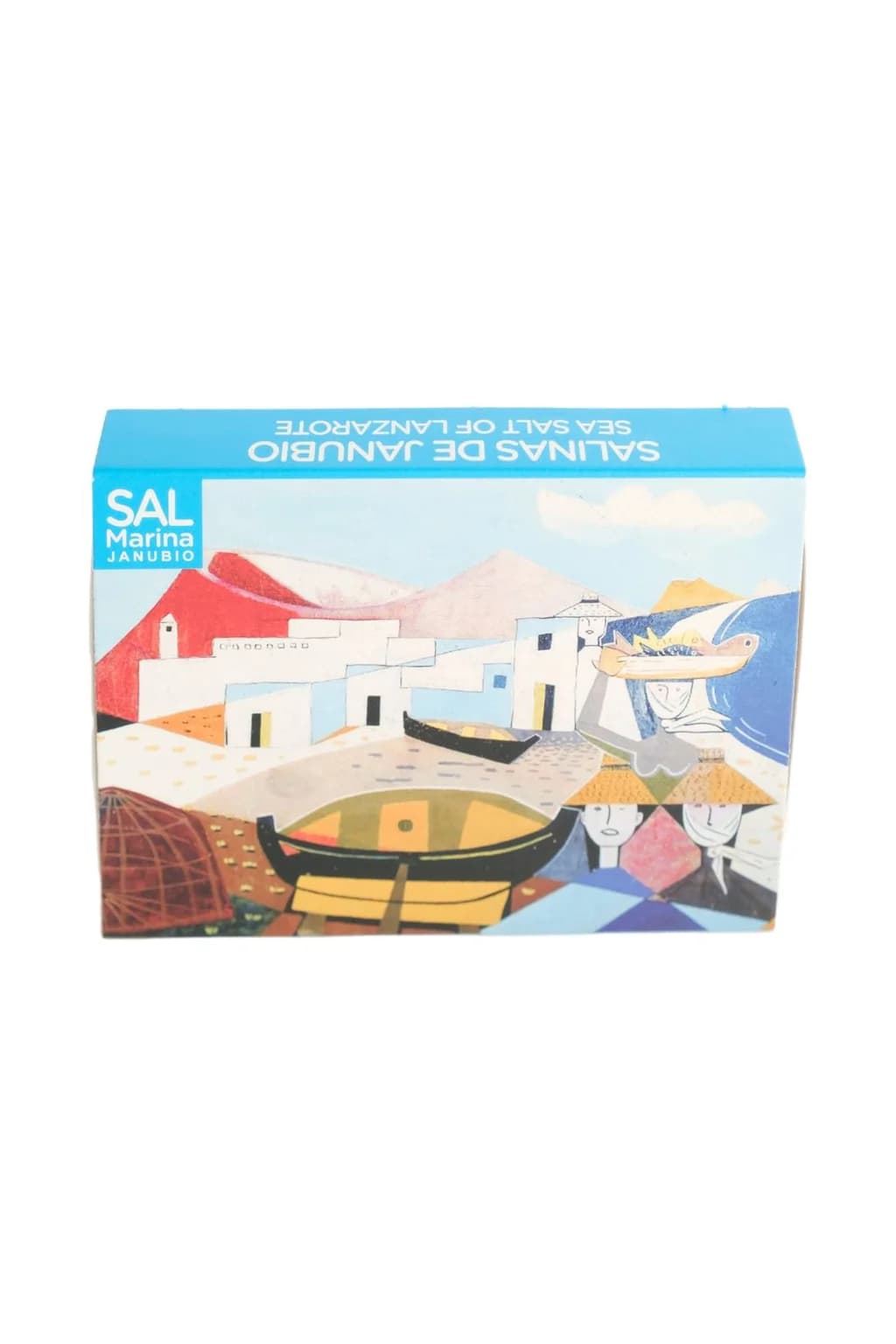
We sell Janubio's flor de sal in 60 g jars and 200 g pots, and its coarse sea salt in small boxes printed with images by César Manrique, the artist who shaped so much of modern Lanzarote.
Why the Janubio lagoon turns pink
Some pans at Janubio are white, some are brown, and some go pink, salmon or almost red. The colour comes from life that likes very salty water: a tiny brine shrimp, Artemia, and the microalga it feeds on, Dunaliella salina, which gives the water its colour.
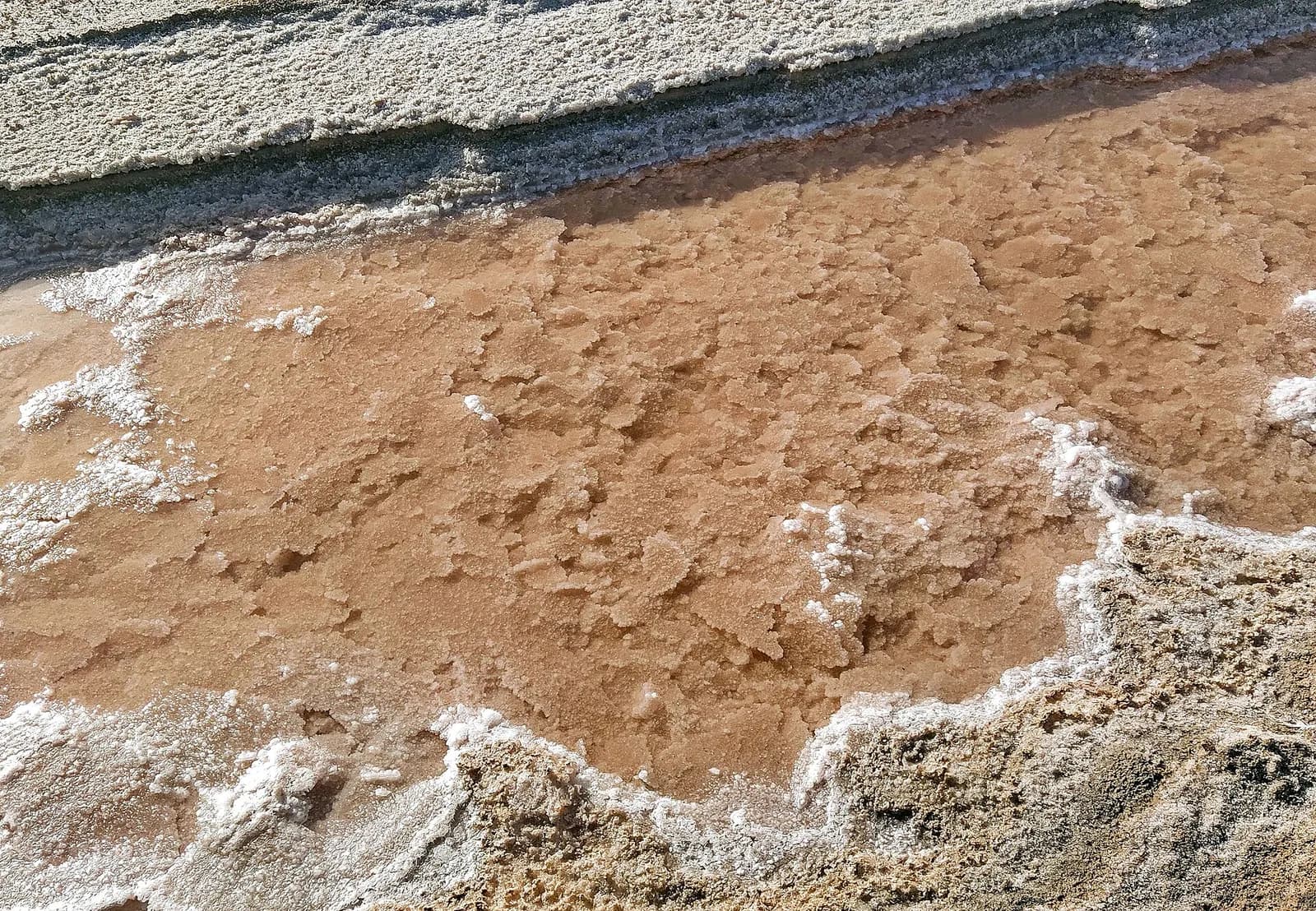
The shrimp in turn feed birds. Janubio is a special protection area for birds under European law and a Site of Scientific Interest of 168.6 hectares, whose conservation rules, published in 2007, protect both the salt-loving habitat and the traditional salt-making that keeps it going. Up to 70 species of migratory birds have been recorded, according to the salt works. Black-winged stilts and Kentish plovers nest here, turnstones and sandpipers stop over, and now and then a few flamingos turn up.
There is a problem, and it is people. In September 2025 the biologist Alberto Ucero told La Voz de Lanzarote that only part of the lagoon is roped off, that the side where many birds nest has no boundary, and that walkers and dogs regularly send them flying. He asked for more signs. Until they arrive, the polite thing is to stay on the paths.
Visiting the Salinas de Janubio
The salt works runs guided visits of about 90 minutes in Spanish and English, booked on its website. They go from the cocederos to the hand harvest, through the family history, the water channels and the mills, and end with a tasting. The visit is not suitable for wheelchairs, and the salt works recommends a cap, sunglasses and comfortable shoes.
For birds, the salt works suggests March and April, and September and October, when the migration is on. For the pans themselves, the light is kinder late in the day, when the low sun picks out every wall and every heap of salt. The pans sit beside a malpaís, a field of rough lava, and the ash a few kilometres inland in which the vines of La Geria are planted comes from the same eruptions. The rest of Lanzarote is worth the drive in any direction.
One more fact for the shopping list. European labelling rules do not require a best-before date on salt. The pans work on a similar timescale: begun in 1895, finished around 1945, still raked by hand.
Questions
- What is flor de sal from Janubio?
- Janubio flor de sal is the thin layer of fine salt crystals that forms on the surface of the pans at the Salinas de Janubio, in Lanzarote, with the change between night and day temperatures. It is gathered by hand, there is little of it and it tastes less salty than coarse sea salt, so it is sprinkled over food at the end.
- Can you visit the Salinas de Janubio?
- Yes. The Salinas de Janubio run guided visits of about 90 minutes in Spanish and English, booked on their website. The visit covers how the salt is made, the family history and the mills, ends with a tasting and is not suitable for wheelchairs.
- Why is the water at the Janubio salt pans pink?
- The pink, salmon or red pans at the Salinas de Janubio get their colour from a tiny brine shrimp, Artemia, and the microalga it feeds on, Dunaliella salina. Both live in very salty water.
- When is salt harvested at Janubio?
- At the Salinas de Janubio in Lanzarote, salt is harvested in the hot months, from May to October according to the salt works. The rest of the year goes on cleaning the channels and the floors of the pans and repairing their stone walls by hand.
- How old are the Salinas de Janubio?
- Building of the Salinas de Janubio began in 1895 and was finished around 1945. The lagoon they surround is older: it was cut off from the sea after the Timanfaya eruptions of 1730 to 1736.
- Is Janubio the only salt works left on Lanzarote?
- According to the salt works itself, yes: the Salinas de Janubio describe themselves as the only salt works still in production on Lanzarote. In 2018 their foreman told the magazine Hidden Europe that two were left, Janubio in Yaiza and Los Agujeros near Guatiza. The island once had about 25, and Janubio is the largest in the Canary Islands.