Almadraba: how Cádiz still catches bluefin tuna in a maze of nets
Barbate, Zahara de los Atunes, Conil and Tarifa, Cádiz//History/10 min read
Four villages near the Strait of Gibraltar still wait for the tuna the way their ancestors did. The fish came back. Now everyone wants a share.
 Written with by Eduardo Peire
The almadraba is a maze of fixed nets anchored off the coast of Cádiz to catch Atlantic bluefin tuna as they swim past on their way through the Strait of Gibraltar into the Mediterranean to spawn. Four still work every spring, off Barbate, Zahara de los Atunes, Conil de la Frontera and Tarifa, from April to June. Tuna has been fished on this coast since before Rome. The almadraba nearly died with the fish in the 2000s, and now that the bluefin has recovered it sits in the middle of a newer argument: who gets to catch them.
The word comes from Andalusian Arabic. The Real Academia Española traces almadraba to almaḍrába, "the place where one strikes or fights", which is a fair description of the last ten minutes of the process.
What is an almadraba and how does it work?
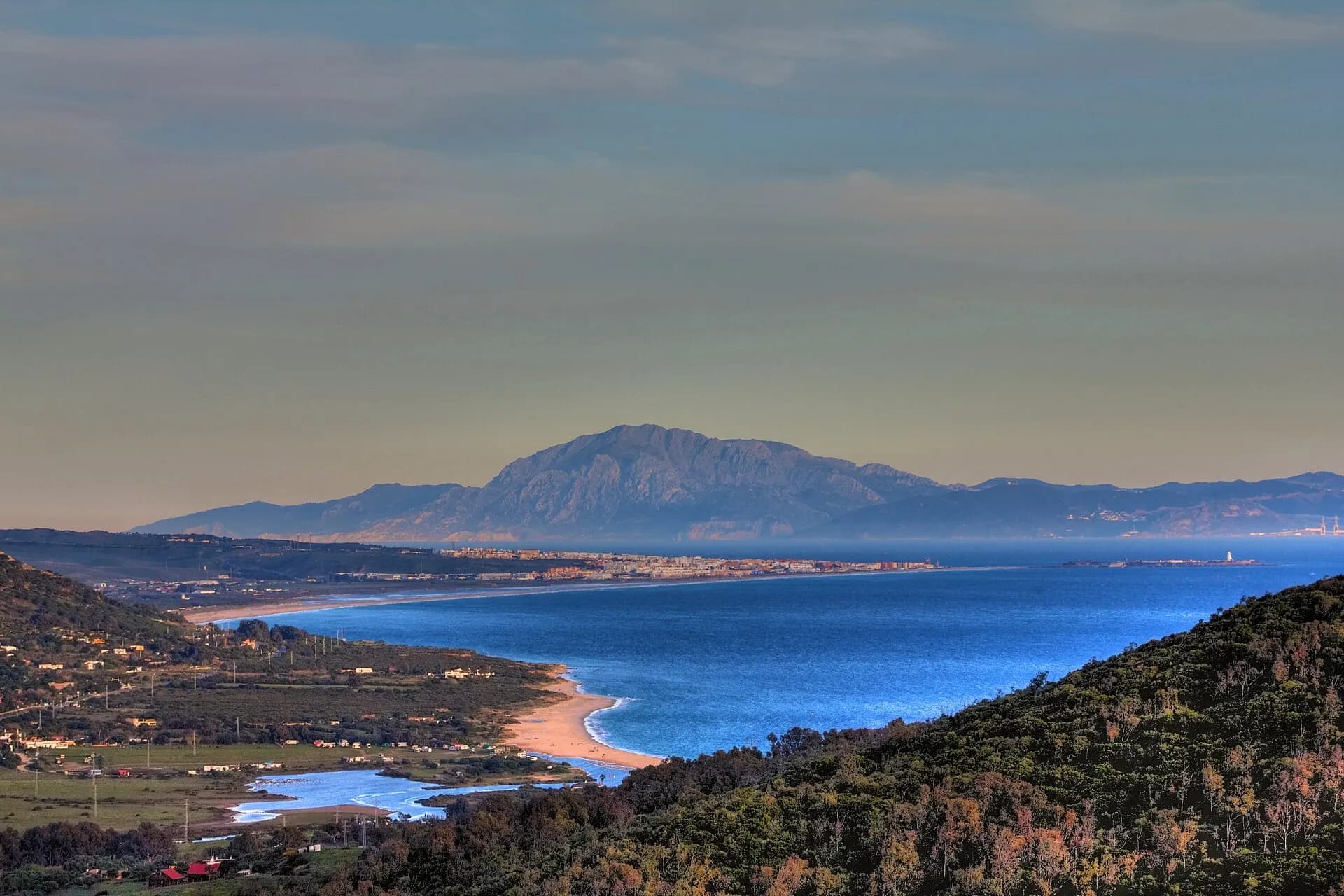
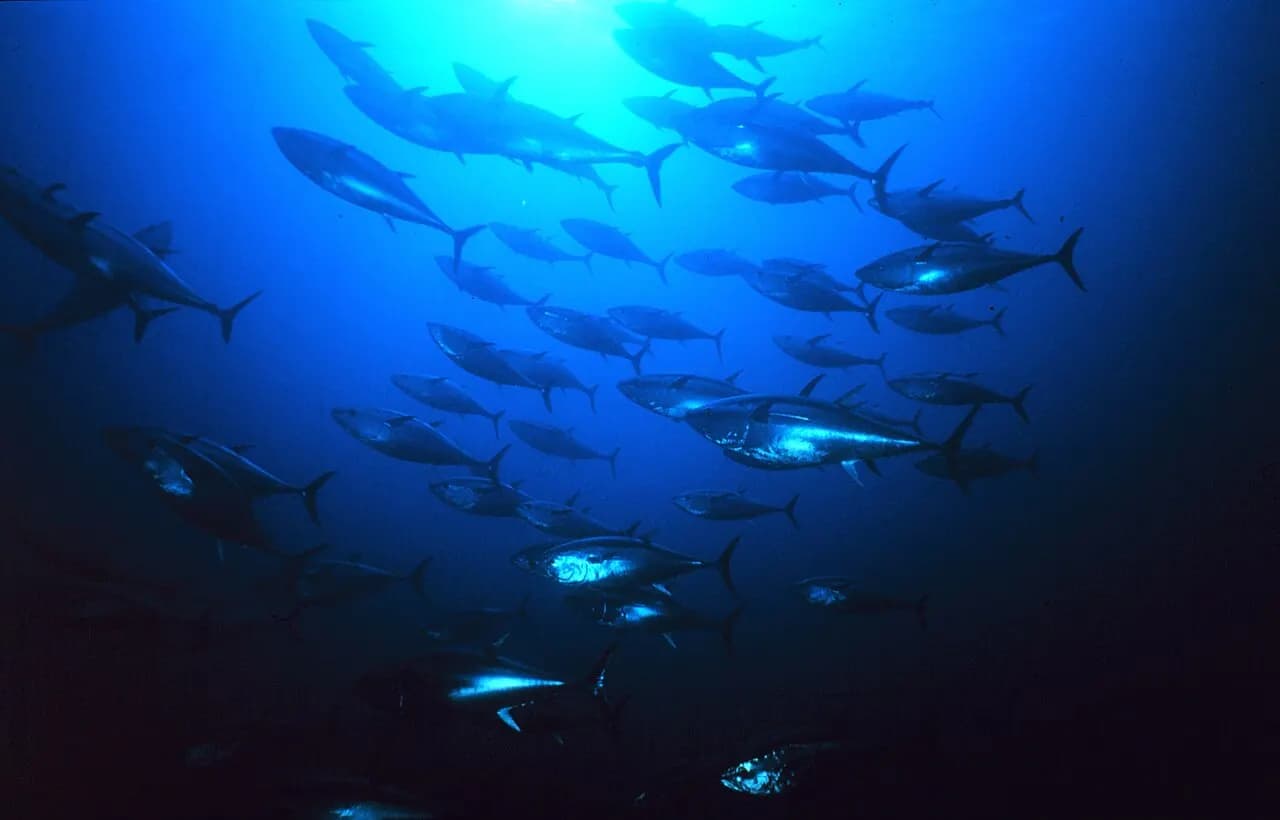
Bluefin tuna (Thunnus thynnus) feed in the Atlantic for most of the year and enter the warm Mediterranean in spring to spawn. The Strait of Gibraltar is the only way in, and the shoals pass close to the Cádiz shore. An almadraba is a fence across that route.
The design described in the ICCAT manual on trap fisheries has two parts. A long wall of net, the rabera, runs out from the coast for about a nautical mile. A tuna that meets it does what fish do with a wall: it swims along it, looking for a way round. The wall leads it into the cuadro, a rectangle of net about 205 metres long and 50 metres wide, anchored parallel to the coast in 45 to 50 metres of water and divided into three or four chambers. The last one is the copo, the chamber of death. The mesh tightens as the fish go further in, from about 60 centimetres in the wall to 30 in the chambers and 6 to 8 in the copo.
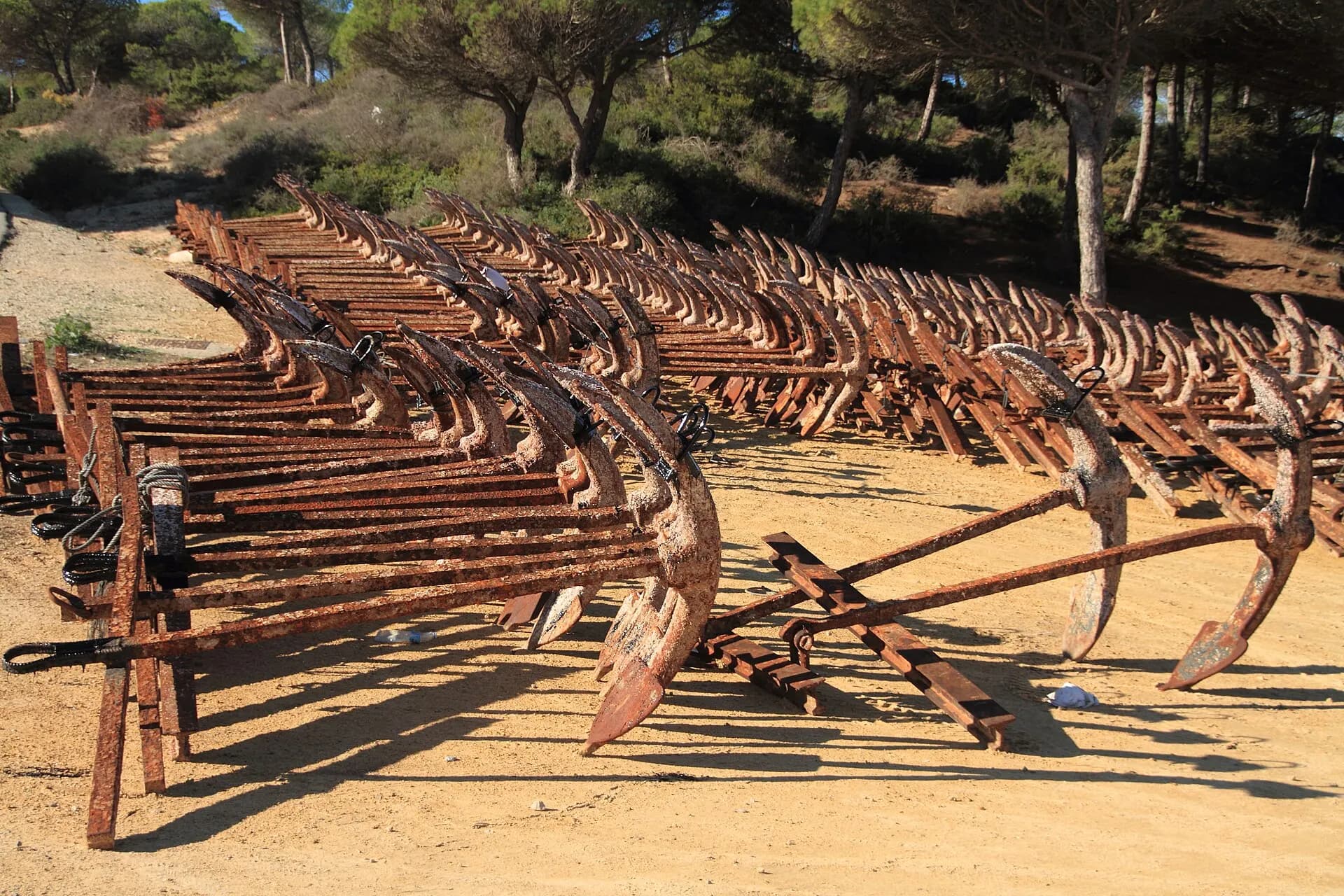
There is no bait, no hook and no boat chasing anything. The nets are made taller than the sea is deep, by up to 30 per cent, so that the currents of the Strait cannot press them flat. The whole structure is laid in spring and lifted again when the season ends. Out of season the steel anchors that hold it to the seabed lie in rusty rows on the ground at Conil, which is how many visitors meet the almadraba without knowing it.
The levantá and the ronqueo
When enough fish have gathered in the copo, the boats close a square around it at first light, usually between six and seven in the morning, and the crews raise the floor of the net until the tuna are at the surface. The fish are big. In the catches measured for ICCAT in the early 2000s, most were between 1.65 and 2.40 metres long, and the average was about 2.07 metres. This is the levantá, the Andalusian way of saying levantada, the lifting.
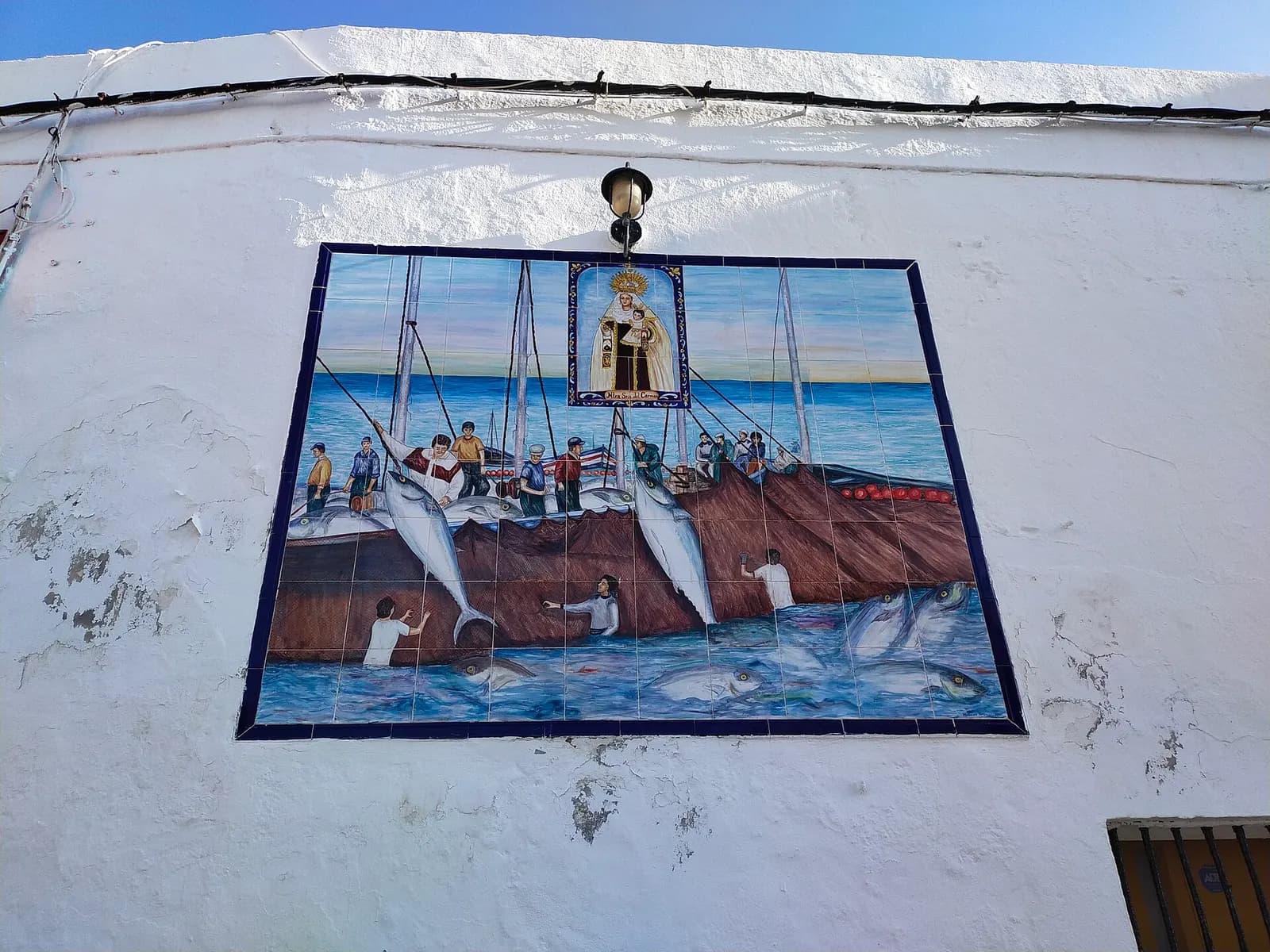
On land the fish are taken apart in the ronqueo. The name comes from the sound the knife makes as it runs along the spine, a noise like snoring, and it is written that way into the official rules of the protected Mojama de Barbate, the salt-cured tuna loin of the town. The same rules show how finely a tuna is graded: the top category of mojama, Extra, can only come from the inner loin, the part that touches the backbone.
Three thousand years of tuna on the Strait
The Phoenicians who founded Gadir, today's Cádiz, fished tuna here, and the city's mint put the fish on its coins. The Romans made it an industry. At Baelo Claudia, a Roman town on the beach at Bolonia in the municipality of Tarifa, the stone vats where tuna was salted and garum, the fermented fish sauce of the empire, was made are still there, a few steps from the forum and the theatre. The Junta de Andalucía runs it as an archaeological site that anyone can walk round.
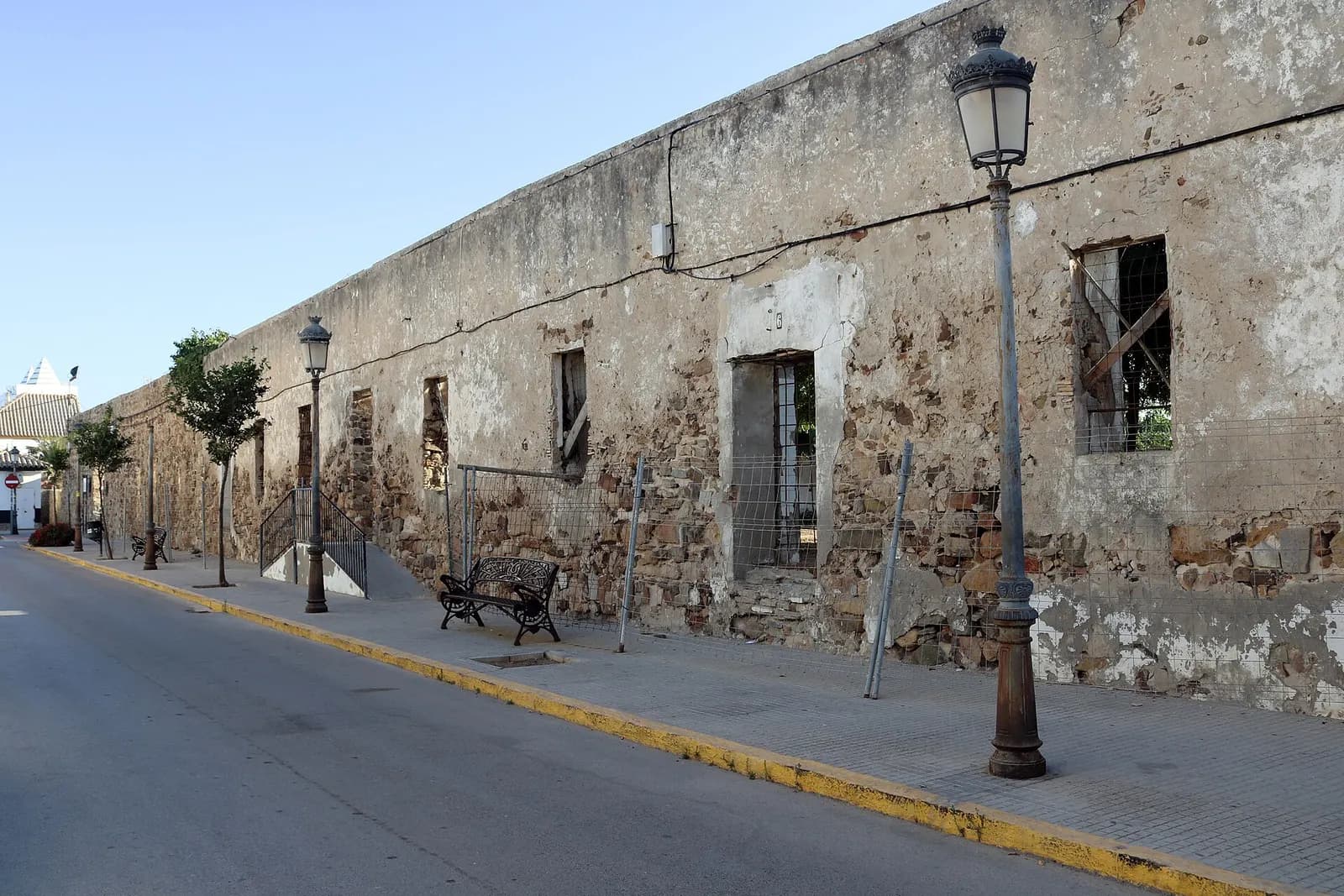
In 1294 King Sancho IV gave Alonso Pérez de Guzmán, the knight who had held Tarifa against a siege, the right to set almadrabas. His descendants, the dukes of Medina Sidonia, kept the privilege of trap fishing from the Guadiana river to the coast of the kingdom of Granada until a decree of 1817 handed the traps to the fishermen's guilds, and the decree that protects their fortress at Zahara as a monument says their fisheries at Zahara and Conil were the most productive in Europe for centuries. That fortress, built to run the fishery and known as the Castillo de las Almadrabas or the Palacio de las Pilas, stands half in ruins in the middle of the village. In Conil their tuna factory, La Chanca, is now a cultural centre.
The figures from those centuries are hard to believe. The ducal ledgers, studied by the historians José Antonio López González and Juan Manuel Ruiz Acevedo in a paper for ICCAT in 2012, show seasons around the middle of the 16th century, 1549, 1552, 1556 and 1558 among them, in which the almadrabas of Conil and Zahara together took more than 100,000 tuna. Zahara alone averaged 35,268 fish a season over the 51 years of that century with records. Both were still almadrabas de tiro, nets cast from rowing boats when a lookout on a tower spotted a shoal and then hauled in, a method that let most of the fish swim past.
Zahara also had a reputation. In La ilustre fregona, published in 1613, Cervantes sends one of his young heroes through every grade of roguery until he graduates as a master in the almadrabas of Zahara, which he calls the finibusterrae of the picaresque, the end of the world for rascals. The seasonal crews of the fishery were not a choir. One theory, repeated by the Cádiz tourist board, even traces the Spanish word cachondeo, a riotous good time, to the parties held after a good levantá on the banks of the Cachón, the stream that reaches the sea at Zahara.
The monk who never saw a tuna
By the 18th century the fish had thinned out and the duke wanted to know why. In 1756 Martín Sarmiento, a Benedictine scholar, wrote him a report. Sarmiento admitted in the text that he had never seen a whole tuna or a tuna fishery, and worked from books and one conversation with a former superintendent of the almadrabas.
His conclusion has aged well. In the old days, he wrote, more than 130,000 tuna were caught; now barely 68. He rejected the excuses of his time one by one: the passing of the years, the Portuguese traps further west, the noise of the bay of Cádiz, and a rumour that the fish had gone because someone refused to pay a certain alms. That last one, he wrote drily, was physically nothing and morally small. The cause was people. "The way of catching a lot is the worst way of fishing," he concluded, and his remedy was to stop setting the traps when the tuna came to spawn.
The 20th century repeated the pattern. Between 1929 and 1971, under the Consorcio Nacional Almadrabero, a monopoly shared by the state and the trap companies, the almadraba of Barbate averaged 15,414 tuna a year. Between 1975 and 2010 it averaged 2,495.
Why the bluefin nearly disappeared, and how it came back
Sarmiento's warning came true on an industrial scale. Between 1998 and 2008 the fleets of the eastern Atlantic and the Mediterranean took more than 50,000 tonnes of bluefin a year, far above the official limits, according to estimates collected by the Marine Stewardship Council. The almadrabas, which only catch what swims past, watched the shoals thin out in their own nets.
In 2006 the International Commission for the Conservation of Atlantic Tunas (ICCAT), which sets the rules for the species, agreed a 15-year recovery plan that began in 2007: shorter seasons, observers on board, a minimum size of 30 kilos and catch limits that fell to 12,900 tonnes a year from 2011. It worked. By 2017 the eastern stock was no longer considered overfished, and in 2021 the IUCN moved Atlantic bluefin from endangered to least concern.
In November 2025, at its annual meeting in Seville, ICCAT raised the limit for the eastern Atlantic and the Mediterranean by 19.3 per cent, to 48,403 tonnes a year for 2026 to 2028, almost four times the low point. Spain's share is 7,938.81 tonnes a year, 1,155 more than in 2025, under a royal decree approved in April 2026. Almost a quarter of it goes to the almadrabas.
The new argument: who gets the tuna
Recovery did not end the quarrel, it changed the subject. The almadrabas present themselves as the oldest and least aggressive way to catch bluefin, and say they get too small a slice. In 2025 the traps of Conil, Zahara and Tarifa closed their season with 1,402 tonnes only after buying unused quota from other fleets, and the manager of their producers' organisation told Europa Press that the problem was not the fish: "atunes hay", there are tuna. The same season had been thrown into doubt by a strike of fisheries inspectors, who must be there to validate the catch. For 2026 the official allocation gave the four Cádiz traps about 1,640 tonnes to begin with, and a resolution at the end of May added another 179.57 tonnes for all the almadrabas of Spain. Further north, Chiclana wants its own almadraba back: in April 2026 Spain's fisheries secretary met its mayor to talk about bringing back the one at Sancti Petri.
There are other claimants. The orcas of the Strait follow the bluefin, and the Spanish environment ministry, which lists this small population as vulnerable, describes its movements as tied to the tuna. Since the summer of 2020 some of these orcas have been interacting with boats, mostly sailing yachts, and the government now advises sailors to keep out of a marked area of the Strait and the Gulf of Cádiz from April to August, which is to say the tuna season. A prehistoric cave at Atlanterra, near Zahara, is known locally as the cave of the orcas; the Cádiz tourist board reads it as proof that people here noticed very early that the orcas arrive with the tuna.
How to see the almadraba in Cádiz
The tuna pass from April to June, and the four villages time their festivals to the catch. Each has its own tuna week or ruta del atún between late April and mid-June, with bars competing for the best tuna tapa and public ronqueos. In 2025, according to the Cádiz provincial tourist board, Barbate cut tuna in a tent at the fishing port, Zahara in a tent at the old ducal fortress and Conil in the Plaza de Santa Catalina. The dates move every year and each town hall announces them in spring.
The levantá itself happens out at sea at first light, and it is a working morning, not a performance. What anyone can see at any time of year is the setting:
- The anchors at Conil, and La Chanca, the dukes' old tuna factory.
- The Castillo de las Almadrabas in Zahara, with the Cachón stream beside it.
- The salting vats of Baelo Claudia at Bolonia, between Zahara and Tarifa.
- The tuna weathervanes and statues that every one of these villages has put up.
- The old watchtowers along the coast, built to warn of Barbary pirates and, according to the tourist board, to spot the shoals as well.
Out of season the coast eats its tuna frozen, tinned or as mojama, loin salted and dried in the wind. Ask what you are buying. The protected name Mojama de Barbate certifies where and how the loin is cured, not where the fish was caught: its rules accept wild yellowfin, and wild bluefin of more than 150 kilos, from any ocean. Some of it is almadraba tuna. Some of it has never seen the Strait.
Other coasts still catch their tuna one fish at a time, like the pole-and-line boats of the Canary Islands, where bluefin is only an occasional catch among five species. And anyone on this stretch of the province of Cádiz on 2 August 2027 will be close to the middle of the band of the total solar eclipse, with more than four minutes of darkness at Barbate and Tarifa. More of the south is in our pages on Andalusia.
According to Sarmiento, the duke's almadrabas caught 68 tuna in a season in the 1750s. In 2025 three of their successors landed 1,402 tonnes and asked for a bigger quota.
Questions
- What is an almadraba?
- An almadraba is a fixed maze of nets anchored near the coast to catch Atlantic bluefin tuna as they migrate through the Strait of Gibraltar. A long wall of net leads the fish into a set of chambers, and the last one is lifted to the surface. Four almadrabas still work in Cádiz, off Barbate, Zahara de los Atunes, Conil de la Frontera and Tarifa.
- When is the almadraba season in Cádiz?
- The almadrabas of Cádiz fish from April to June, when bluefin tuna pass the Strait of Gibraltar on their way into the Mediterranean to spawn. Barbate, Zahara, Conil and Tarifa hold their tuna weeks between late April and mid-June, and each town hall sets the dates every spring.
- What is the ronqueo of the tuna?
- The ronqueo is the cutting up of a bluefin tuna by hand on the coast of Cádiz. The name comes from the snoring sound the knife makes as it runs along the backbone. Public ronqueos are part of the tuna weeks in the almadraba villages each spring.
- Is Atlantic bluefin tuna still overfished?
- Eastern Atlantic bluefin tuna was heavily overfished in the 1990s and 2000s, but a recovery plan agreed by ICCAT in 2006 cut the catch limit to 12,900 tonnes a year from 2011. By 2017 the stock was no longer considered overfished, and in November 2025 ICCAT raised the limit to 48,403 tonnes a year for 2026 to 2028.
- Is mojama made from almadraba tuna?
- Not always. Mojama is tuna loin salted and dried in the wind, a speciality of the coast of Cádiz. The protected name Mojama de Barbate certifies where and how it is cured, and its rules accept wild yellowfin, and wild bluefin of more than 150 kilos, from any ocean, so some of it comes from the almadraba and some does not.
- Can visitors watch the almadraba in Cádiz?
- The levantá, when the tuna are lifted from the net, happens out at sea at first light and is a working morning rather than a show. Visitors can watch public ronqueos during the spring tuna weeks and see the almadraba anchors at Conil, the Castillo de las Almadrabas in Zahara and the Roman salting vats of Baelo Claudia.