Vic market: eleven centuries of Saturdays and a sausage cured in fog
Vic, Osona, Barcelona//History/10 min read
Vic has held its market on the same unpaved square since at least 911, and cures its famous llonganissa in the fog that fills the plain around it.
 Written with by Eduardo Peire
The Vic market is a street market held every Tuesday and Saturday in the Plaça Major of Vic, the capital of Osona, about 70 kilometres north of Barcelona. A market on this square is documented since 911, which makes the Saturday shop in Vic one of the oldest regular habits in Catalonia. The town's other claim to fame hangs in drying rooms around it: llonganissa de Vic, a dry-cured pork sausage protected by the EU and cured in the fog that sits on the Plana de Vic for much of the year.
How old is the Vic market?
Older than the square around it. According to the Catalunya Romànica volumes of the Enciclopèdia Catalana, the market place, called the Mercadal, first appears in writing in 911, in the will of Count Guifré II, which mentions a field in Vic next to the market. Earlier still, in 889, the Frankish king Odo granted Bishop Gotmar a third of the tolls of the markets of the region. The record of the consecration of the cathedral, in 1038, makes clear that these were the markets of Vic and Manresa.
Medieval Vic had two masters. The big weekly market, held on Saturdays then as now, was the bishop's. A smaller one, the Quintana, ran on Tuesdays, Thursdays and Fridays on a square that is now part of the Plaça Vella, and that square belonged to the Montcada family until 1224. Even the Mercadal was split: the houses of its eastern arcade were Montcada property, while the vaults in front of them were the bishop's. Shoppers today cross that feudal frontier somewhere between the fruit and the salt cod.
Why the Plaça Major has never been paved
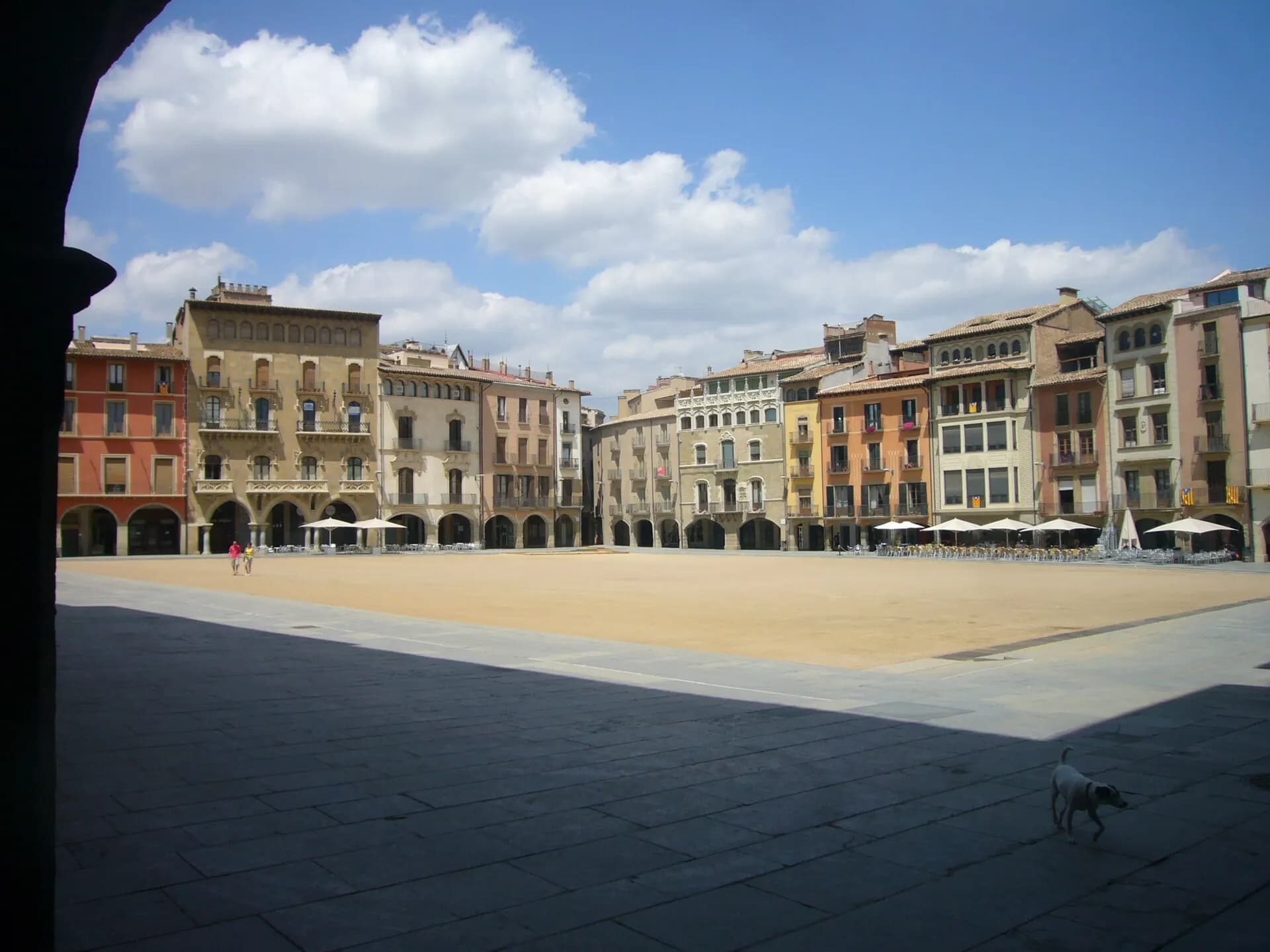
The walking route published by the town council says the square began as an open esplanade where a market was held long before anyone built a house on it. Houses went up around it in the 12th and 13th centuries, with arcades against the weather, and the rules of the time required the arches to be high enough for a man on horseback to ride through. The buildings above them now run from medieval to baroque and early 20th century modernisme.
The centre has never been cobbled or asphalted. It is a wide floor of beaten earth framed by stone pavements, and on market days the stalls stand on the same ground they have used for more than a thousand years. The council calls it one of the most singular squares in Catalonia. In one corner stands a statue of El Merma, the best loved of the town's capgrossos, the big-headed figures that dance at its festivals.
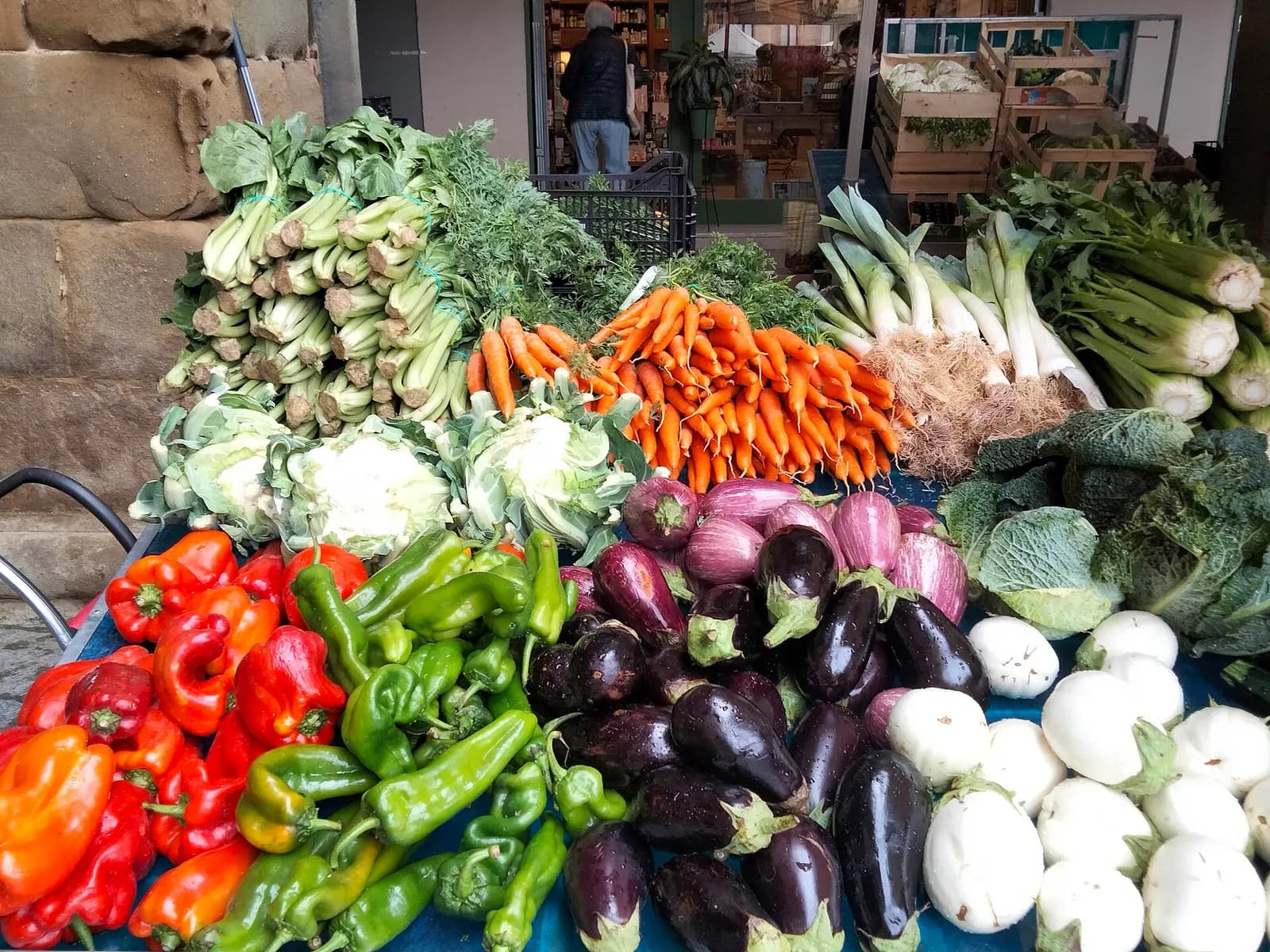
According to Vic's tourist office, the Tuesday and Saturday markets fill the Plaça Major, the Rambla del Carme and the Rambla del Passeig, with stalls of local produce, flowers, crafts and poultry alongside clothes and household goods. On a Saturday that means salt cod and salted sardines, crates of vegetables and cages of ducklings. It is a working market, not a show for visitors, which is exactly why it is worth getting up for.
What is llonganissa de Vic?
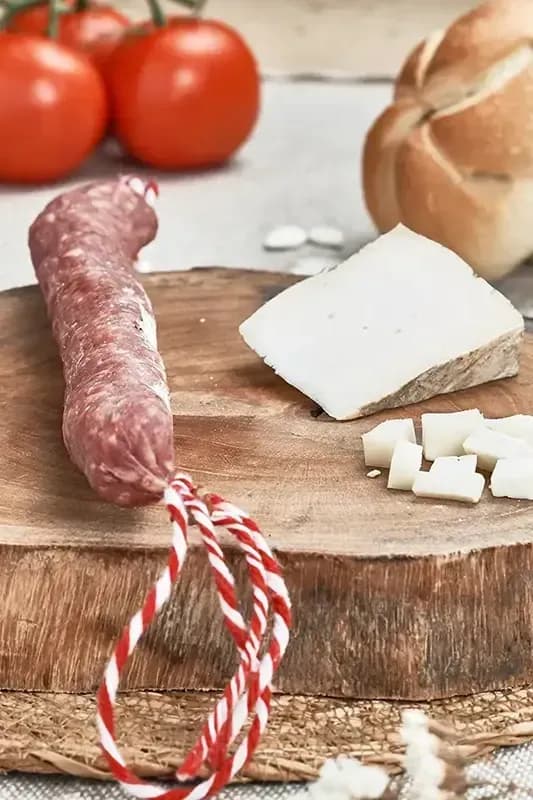
Llonganissa de Vic is a dry-cured sausage made from lean pork, pork fat, salt, black pepper and a little sugar, stuffed into natural casing and hung to cure for at least a month. Its official EU name has two halves, Salchichón de Vic / Llonganissa de Vic, because llonganissa is the Catalan word for what Spanish calls salchichón. The regulatory council dates the first written references to it to 1456, and the EU registered the name as a Protected Geographical Indication (PGI) in December 2001.
The rules are short and strict. The single document of the PGI in the EU's Official Journal names pepper as the only spice, so there is no paprika, no garlic and no fennel. The meat must be selected lean pork from the ham, the shoulder and other top cuts. Besides sugar and salt, the only extras allowed are the maker's own starter culture, the usual curing salts (nitrites and nitrates) and ascorbic acid. Pieces of 200 to 300 grams must cure for at least 30 days, heavier ones for at least 45. Every step from mincing to curing must take place in 28 municipalities of the Plana de Vic, from Aiguafreda in the south to Sant Pere de Torelló in the north, and eight firms are registered to make it.
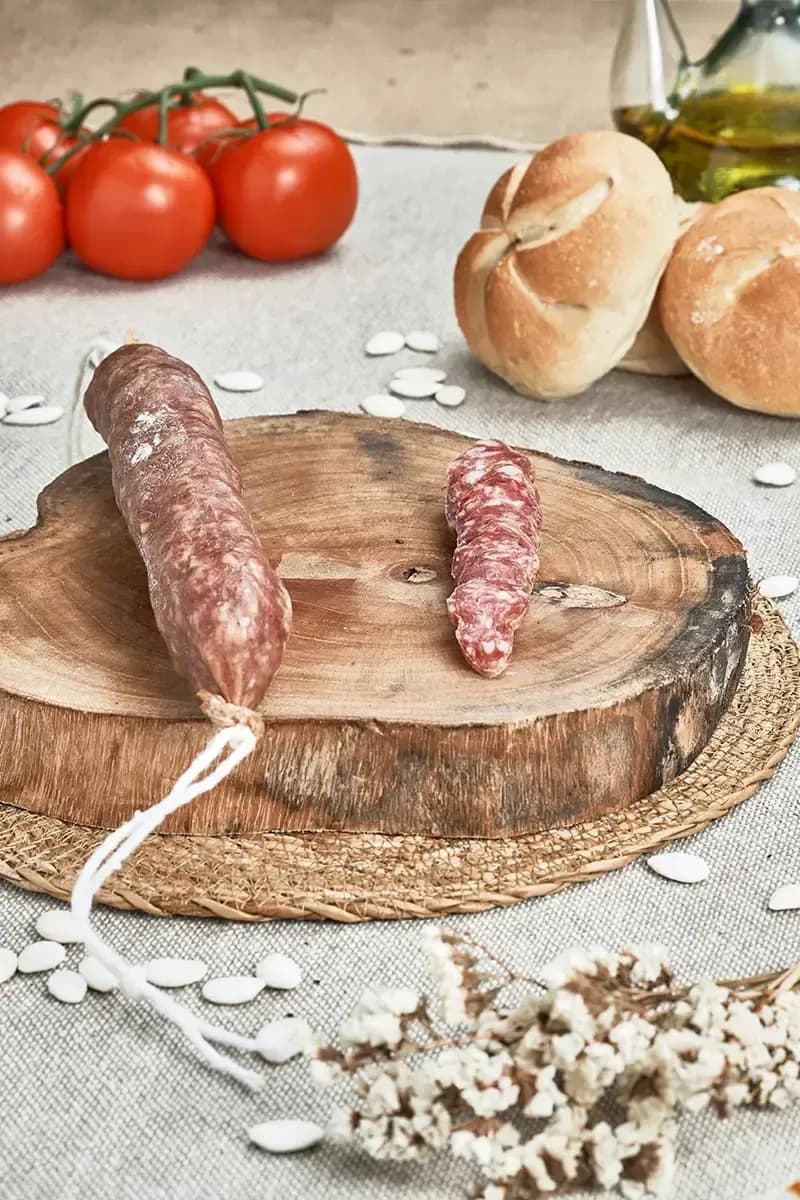
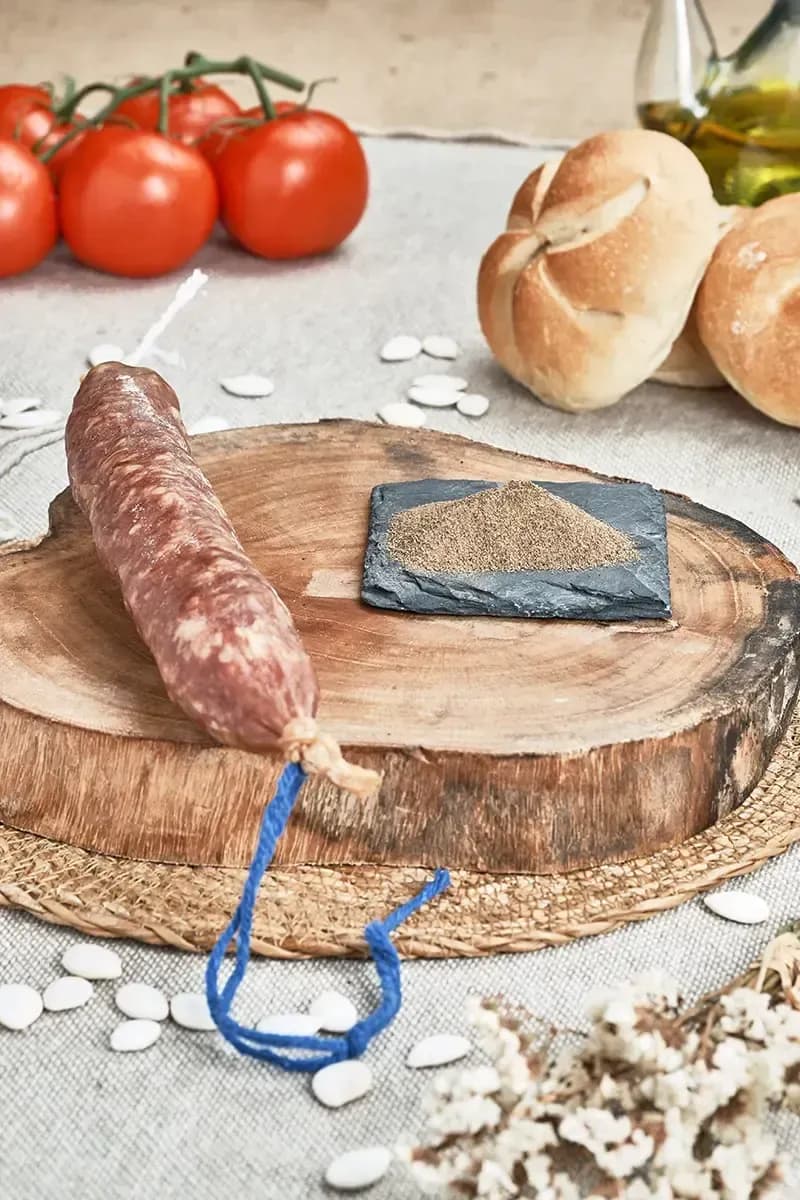
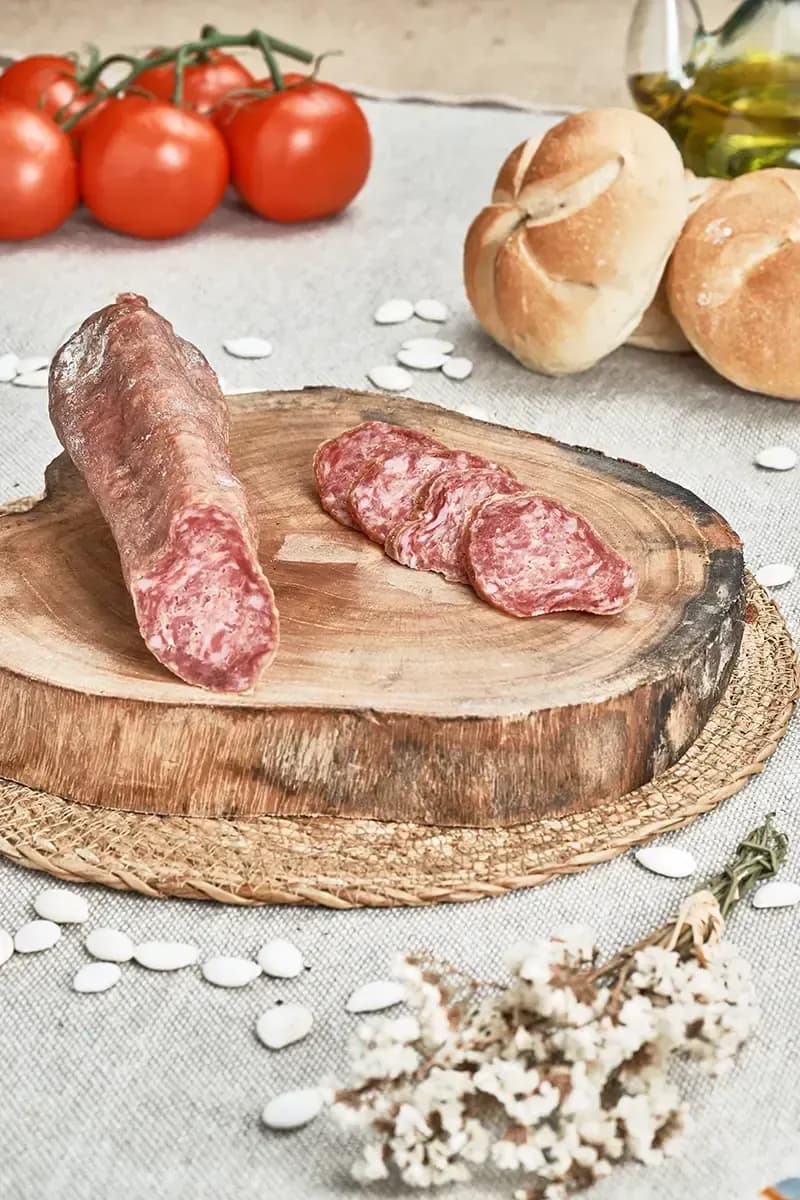
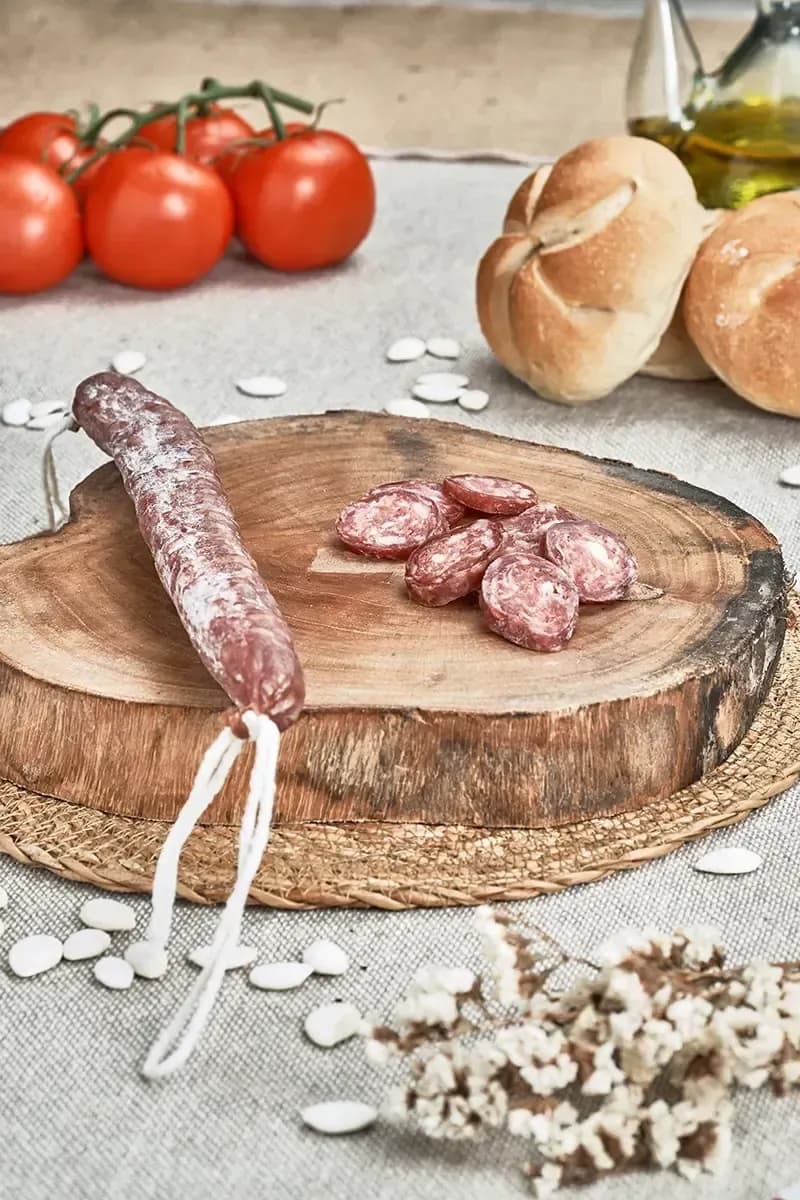
You can see the result before you taste it. The casing wrinkles tight against the meat as it dries, a white bloom of mould grows on the skin and slowly turns purplish brown, and a slice shows deep red meat dotted with small cubes of white fat and whole black peppercorns. Fuet, the thin sausage sold all over Catalonia, is a relative: thinner, and not covered by this PGI.
The newest change is a technical one. An amendment published by the EU in January 2025 widened the accepted acidity of the finished sausage: the pH may now run from 5.0 to 6.7, instead of 5.3 to 6.2. The text says the change touches neither the name nor the link with the area.
Why the fog of the Plana de Vic matters
The Plana de Vic is a basin between 400 and 600 metres above sea level, closed in by the Guilleries, the Montseny, the Collsacabra and the Lluçanès. When high pressure settles over Catalonia, cold air slides into the plain and stays there. The PGI file records temperature inversions in which the plain can be as much as 20 °C colder than the land around it, and mist or fog on an average of 225 days a year.
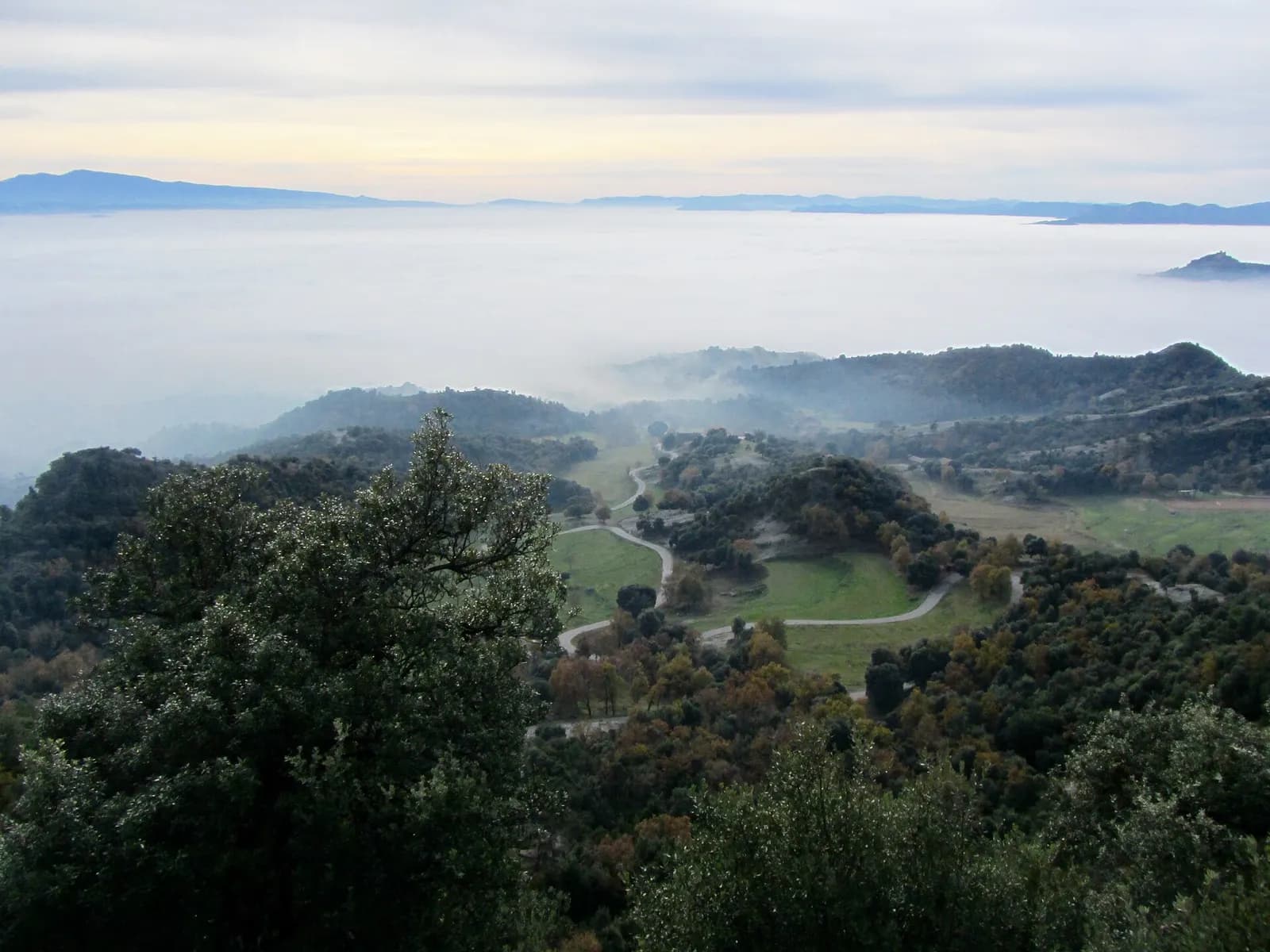
For people who live there, this means a great many grey mornings. For a sausage hanging in a drying room, it is the point. Cool, damp, still air lets the moulds and bacteria of the place work on the meat slowly, and the producers' case for the PGI rests on that local flora and on reputation. The regulatory council's television advert calls the sausages Fills de l'aire, children of the air. The file also cites an article in the newspaper El Porvenir of 29 May 1867 on the sausages of Vic, and records that King Alfonso XIII was a fan.
Before there were factories, llonganissa was a farmhouse product. The PGI file says it was made in the homes of local farmers as a way of keeping the best meat of the pig. The farmhouses, the masies, are still scattered across the plain. The fog is still free.
A plain with close to a million pigs
The animal behind the sausage is also Osona's biggest problem. Osona and the neighbouring Lluçanès hold close to a million pigs, and in late 2025 VilaWeb counted 709 pig farms in Osona, on old boundaries that still took in most of the Lluçanès, second in Catalonia only to the Segrià. The slurry from those farms is spread on fields that cannot use all its nitrogen, and the rest seeps into the aquifers. In March 2026 the public broadcaster 3Cat reported that the Grup de Defensa del Ter, which has sampled the springs of Osona and the Lluçanès for 25 years, found 44% of 172 springs polluted by nitrates. The average was 145 milligrams per litre, almost three times the recommended maximum of 50. The worst, the Font de la Gana in Calldetenes, one of the 28 PGI municipalities, measured 509 milligrams.
The PGI does not solve this, and does not try to. It rules on where and how the sausage is made, not on where the pig was raised: the file says plainly that there are no requirements on feed. Buyers who care about that question have to ask it themselves.
Then came a new worry. On 28 November 2025 the Catalan government confirmed African swine fever in two wild boar found dead at Cerdanyola del Vallès, just north of Barcelona: the first cases in Spain since 1994. Exports of pork outside the EU were halted, and according to Ara buyers such as China were ready to limit their ban to the province of Barcelona, which includes Osona. By 1 October 2026 the Spanish agriculture ministry counted 400 infected wild boar in 13 municipalities and not a single case in farmed pigs. The disease does not affect people, but it showed at the spring fair: the Mercat del Ram of March 2026 went ahead without pigs or cattle, as a health precaution.
The Mercat del Ram and the rest of the year
The Mercat del Ram is one of the oldest fairs in Vic and the town's way of declaring spring open. It runs over the weekend of Palm Sunday, Diumenge de Rams, just before Holy Week. Its best-known part is the livestock and farm machinery fair, and palm leaves for the processions are sold alongside it. The 2026 edition, from 27 to 29 March, drew close to 125,000 visitors according to the organisers and the council, with horses and foals on show but no pigs or cows.
The other big crowd comes on the long weekend around 8 December, the Immaculate Conception, when the old centre turns into a Mercat Medieval, a modern costume fair that the tourist office says draws more than 100,000 visitors. People who come for the food rather than the costumes may prefer an ordinary Saturday in winter, when the fog may well be sitting on the plain and the stalls are the ones that are there every week.
What else to see in Vic and Osona
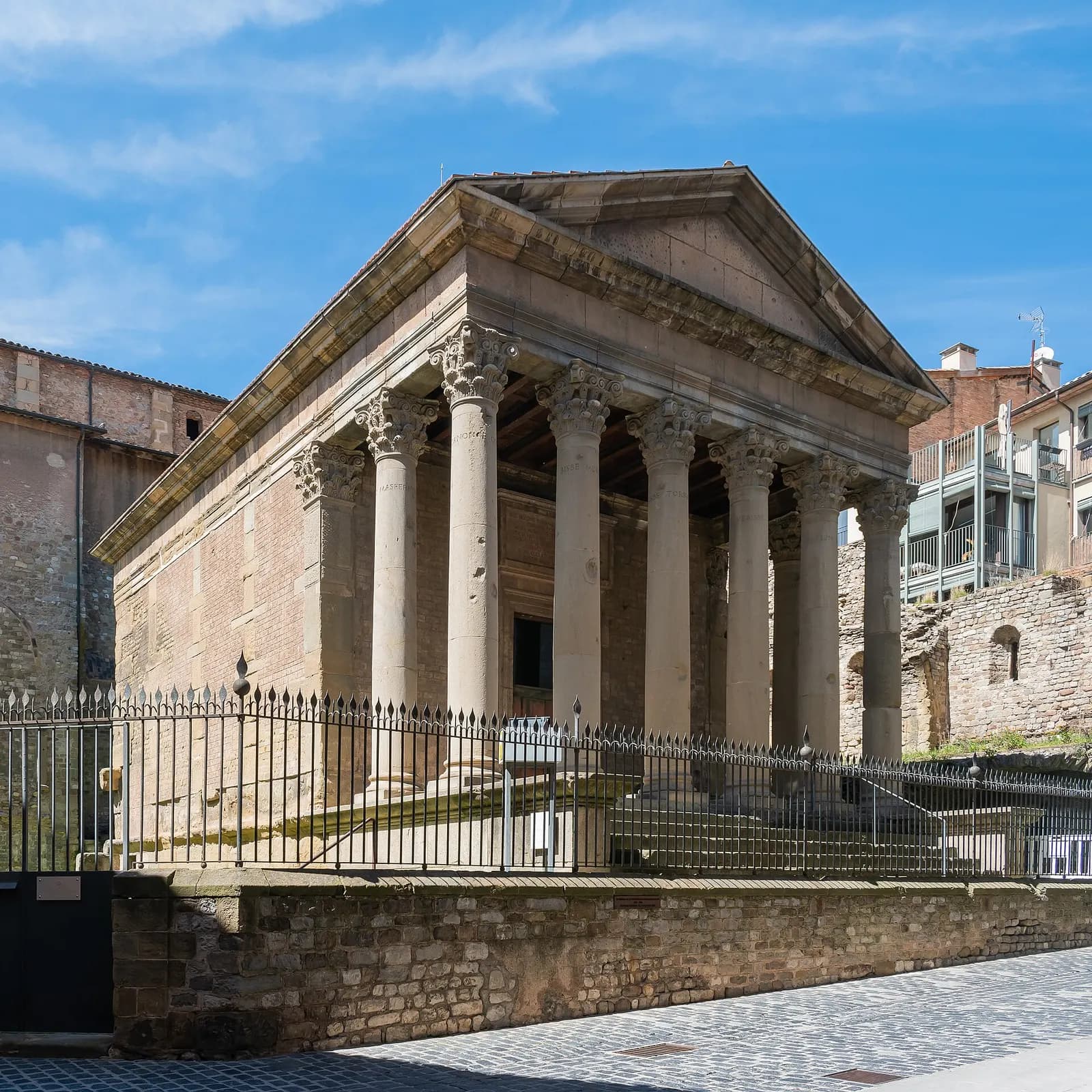
Vic hid a Roman temple for centuries. Built in the 1st or 2nd century AD, when the town was called Ausa, it was swallowed by the medieval castle of the Montcada family, whose courtyard was flanked by the temple's walls. The Patronat d'Estudis Osonencs, which looks after it, says the remains came to light in 1882, when the old castle was being demolished. The colonnade was restored in 1930 and the pediment and roof in 1957, and the temple has been a protected monument since 1931.
The cathedral of Sant Pere keeps a Romanesque bell tower and crypt and a Gothic cloister, and its walls carry large murals by the painter Josep Maria Sert. Next door, the MEV (Museu d'Art Medieval, the old Episcopal Museum of Vic) holds more than 29,000 pieces, with Catalan Romanesque and Gothic painting and sculpture at its core. A wet Saturday is well spent there after the market.
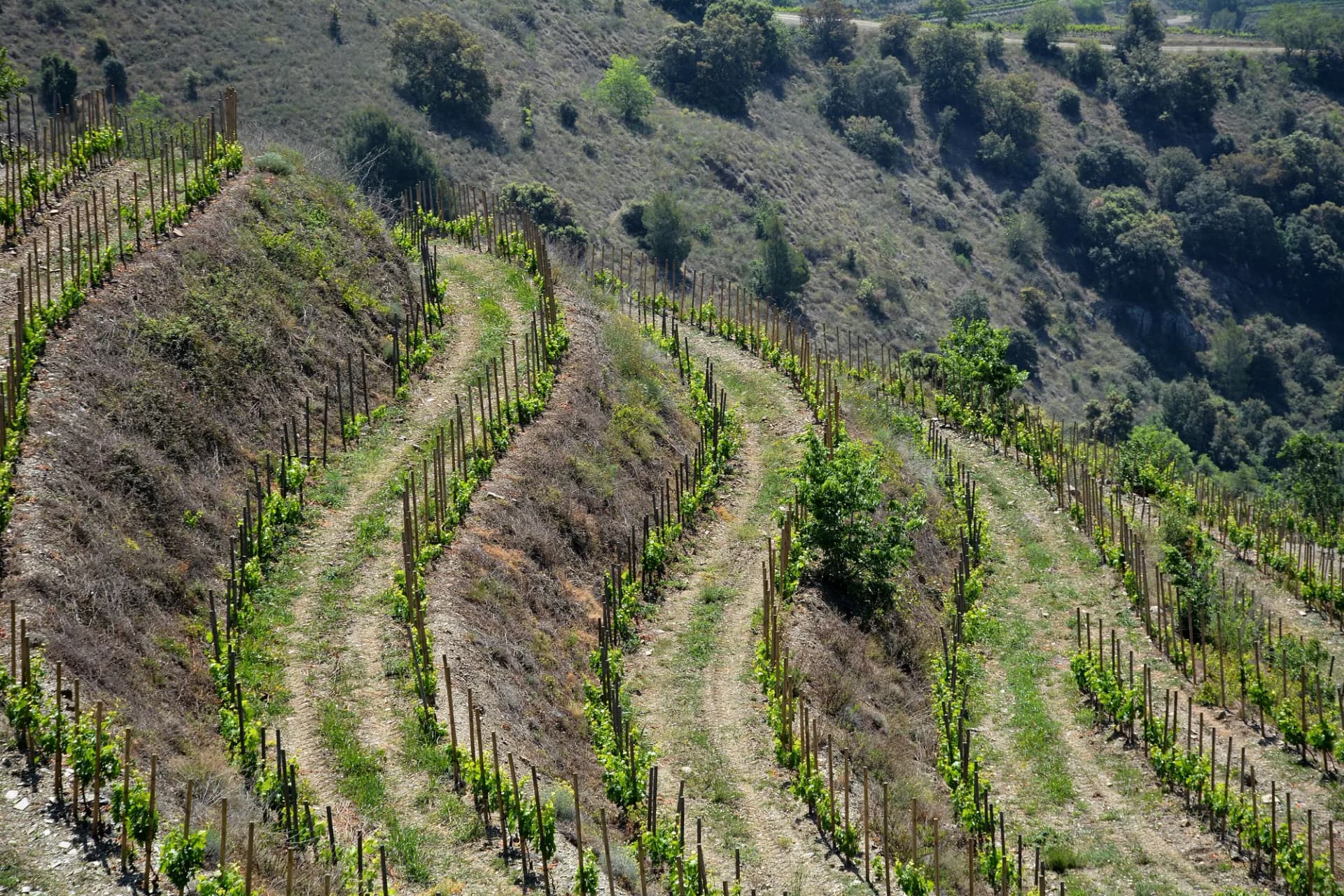
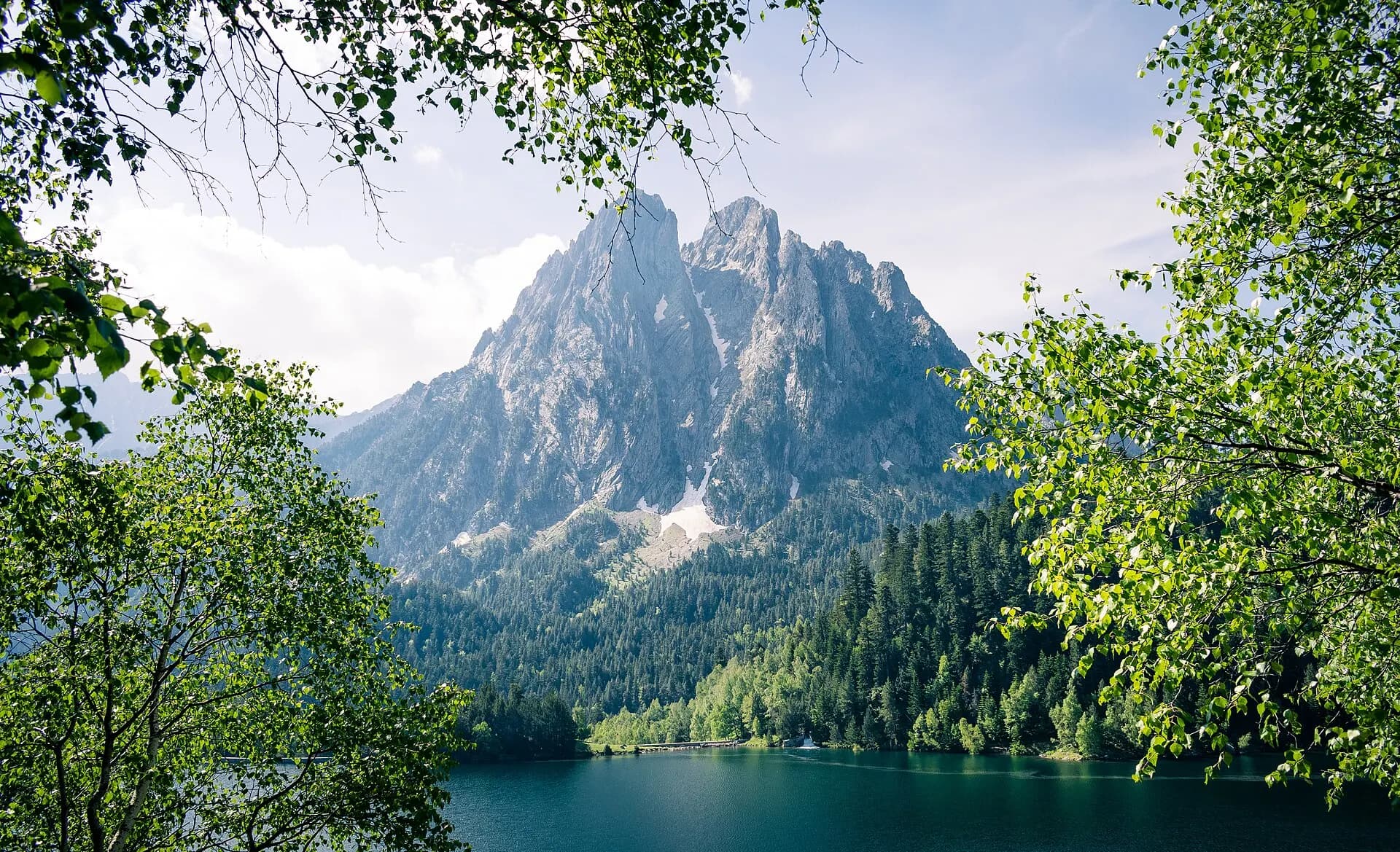
Outside the town the plain ends abruptly. To the north-east rise the cliffs of the Collsacabra, to the east the forests of the Guilleries and to the south-east the Montseny. The roads up are short and steep, and the villages at the top are worth the effort of finding on a map. There is more on the region in our pages on Catalonia and the province of Barcelona.
Getting there takes some patience for now. Since 7 October 2025 the R3 commuter line from Barcelona has been partly closed south of La Garriga for track-doubling works, with buses on the closed stretch, and the reopening date has already slipped once. Check Rodalies before setting out.
How to buy and eat llonganissa de Vic
Look at the label before the price. Genuine llonganissa de Vic carries the PGI name and logo, the EU PGI symbol and a numbered label issued by the regulatory council. It may be sold whole or sliced and packed, and the slicing can be done outside the area. A sausage called simply llonganissa without that label may be very good, but it is a different promise.
Catalans eat it in thin slices, with bread rubbed with tomato and olive oil (pa amb tomàquet), in a mid-morning sandwich or at the start of a meal. A whole piece keeps better than a sliced one. Which charcuterie or market stall sells the best is a matter of local loyalty, and it is the kind of argument a visitor should hear in person.
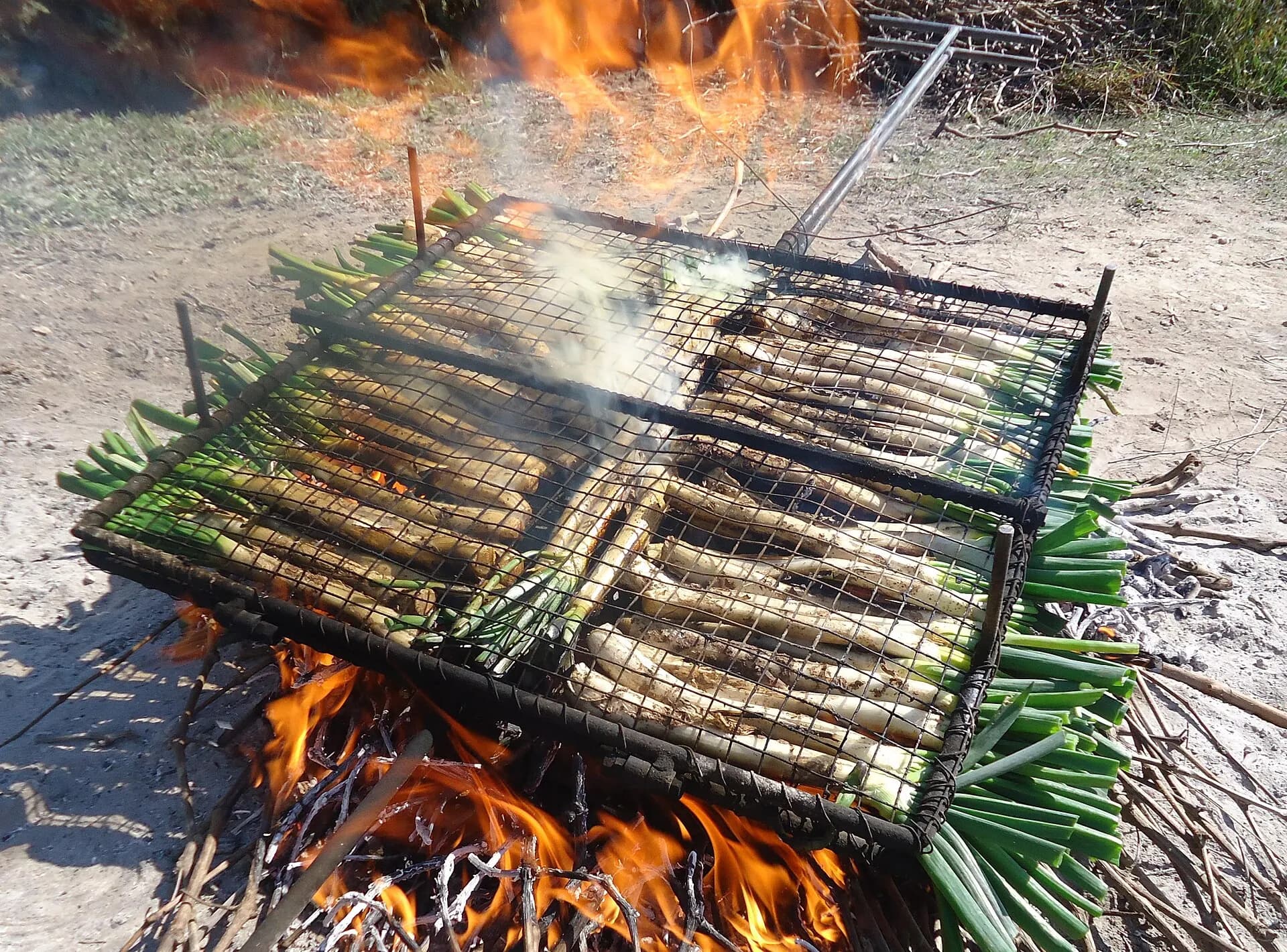
For anyone heading south through Catalonia in winter, the calçotada of Valls is the other great Catalan ritual of the cold months, and Mallorca's sobrasada shows how differently an island cures its pork.
The square in Vic still has no paving. Eleven centuries of Saturdays have not changed that.
Questions
- When is the market in Vic?
- The Vic market is held every Tuesday and Saturday in the Plaça Major, the Rambla del Carme and the Rambla del Passeig. Saturday's is the historic main market, held on the same square since the Middle Ages, and a smaller Sunday market of fresh produce runs in the Passeig de la Generalitat.
- How old is the Vic market?
- The market square of Vic, historically called the Mercadal, is first documented in 911, in the will of Count Guifré II. The arcaded houses around today's Plaça Major were built around the market in the 12th and 13th centuries, and the centre of the square has never been paved.
- What is llonganissa de Vic made of?
- Llonganissa de Vic is made from lean pork, pork fat, salt, black pepper and a little sugar, stuffed into natural casing. Its PGI rules allow no other spice, and pieces must cure for at least 30 days, or 45 days if they weigh more than 300 grams.
- What is the difference between llonganissa de Vic and fuet?
- Llonganissa de Vic is a thicker dry-cured sausage protected as a PGI and made only in 28 municipalities of the Plana de Vic, seasoned with black pepper alone. Fuet is a thinner Catalan cured sausage that is not covered by that PGI.
- Why does fog matter for llonganissa de Vic?
- The Plana de Vic lies between 400 and 600 metres high and is closed in by mountains, so cold air and mist settle there on about 225 days a year. The PGI file links this cool, damp climate and its local microbial flora to the aroma and flavour of llonganissa de Vic.
- Is llonganissa de Vic made from pigs raised in Osona?
- Not necessarily. The PGI Llonganissa de Vic requires the sausage to be made and cured in the Plana de Vic, but it sets no rules on where the pigs were raised or what they ate.