Galician mussels: the rafts of the Ría de Arousa and how they work
Ría de Arousa, Pontevedra and A Coruña//Products/9 min read
Two thirds of Galicia's mussel rafts float in one estuary. The idea is eighty years old, runs on plankton and rope, and has just had three of its thinnest years.
 Written with by Eduardo Peire
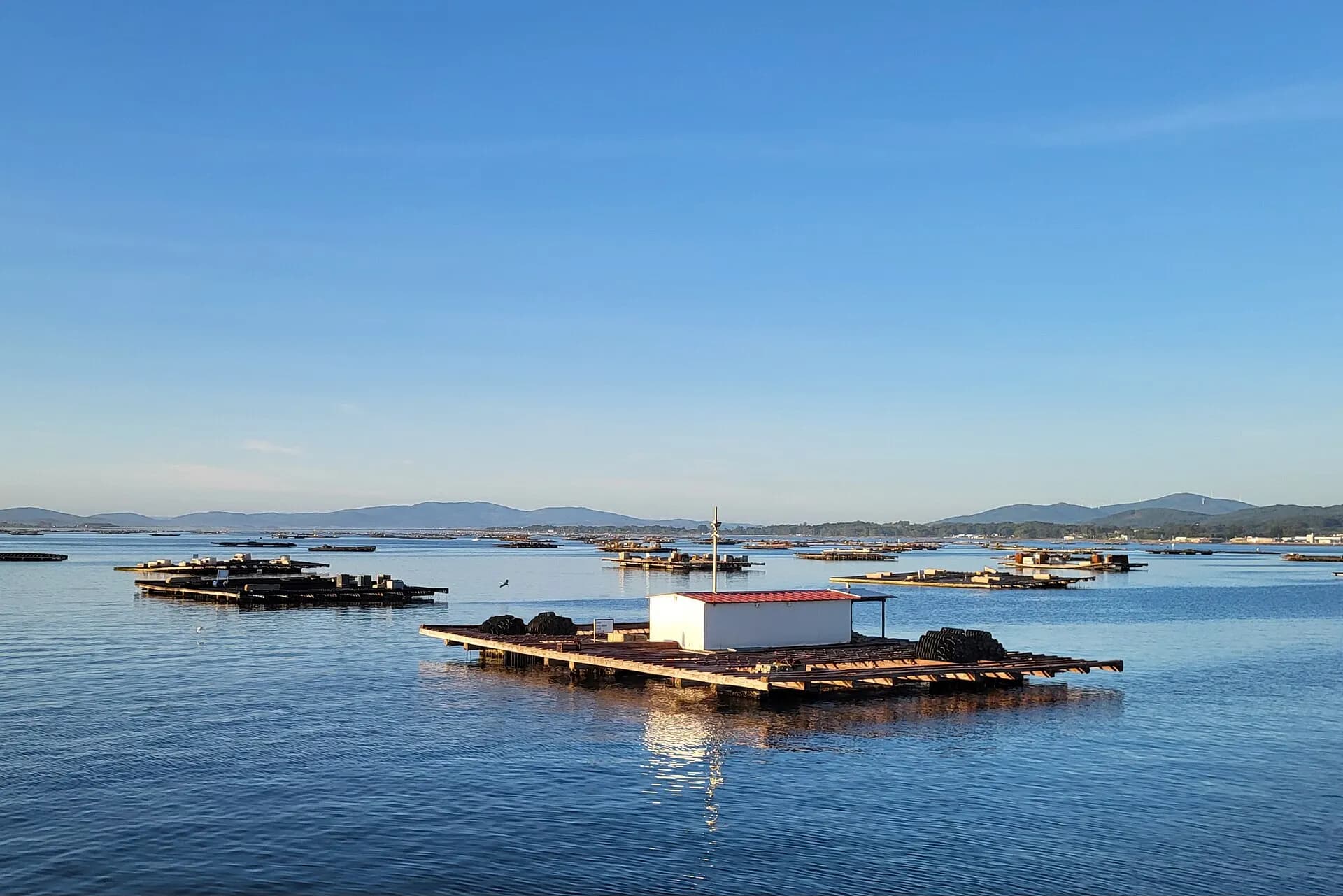
Galician mussels grow on ropes that hang into the sea from floating wooden rafts called bateas, and two out of every three of those rafts are moored in a single estuary, the Ría de Arousa, which the province of Pontevedra shares with A Coruña. Galicia has 3,387 bateas, 2,319 of them in Arousa, according to the regulatory council of the Mexillón de Galicia PDO. In 2025 they produced 177,639 tonnes of mussels, and the growers were paid, on average, 70 cents a kilo for them at first sale, according to the Xunta's aquaculture data.
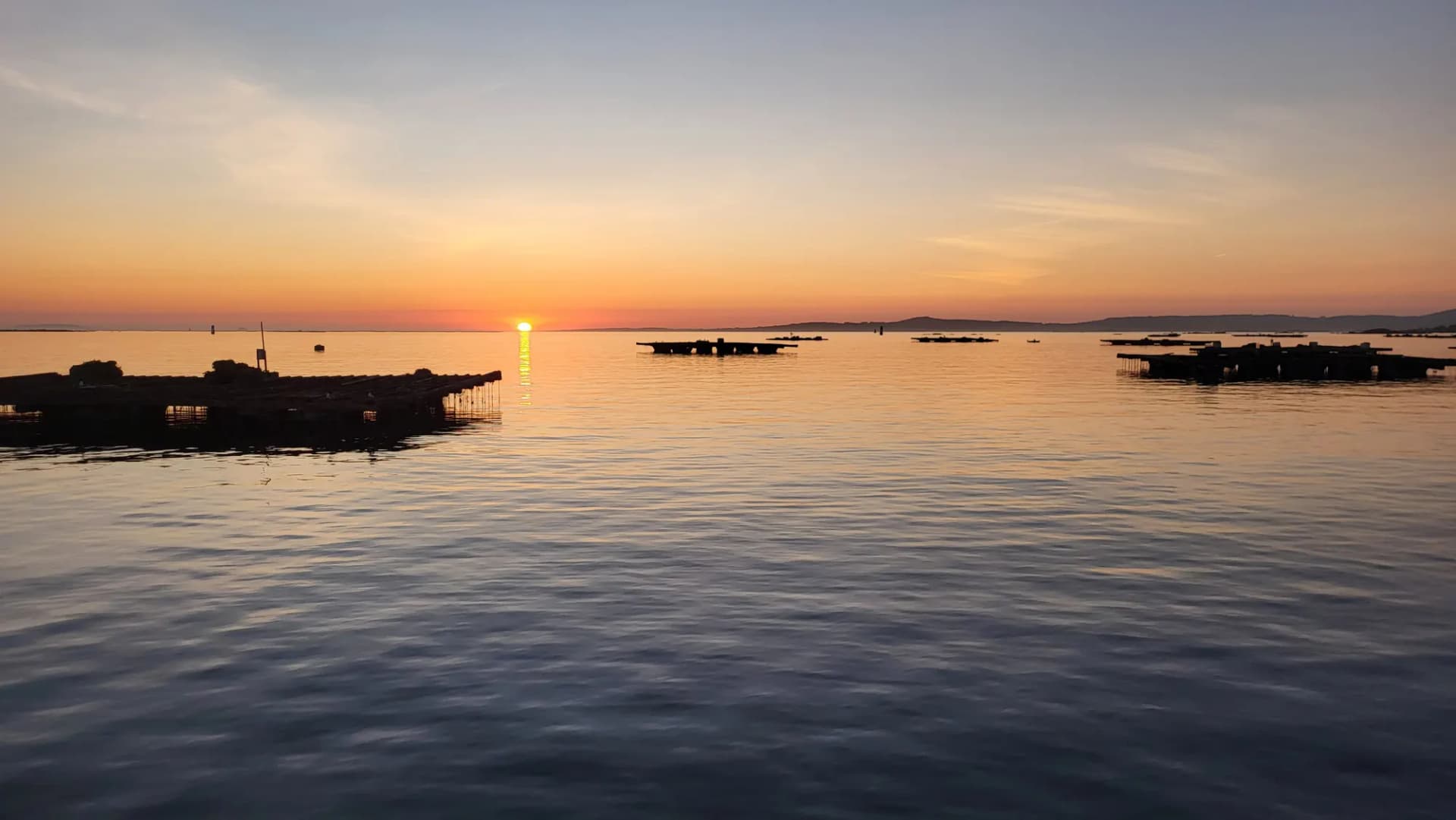
Seen from A Curota, the mountain at the southern end of the Barbanza range, the ría looks as if someone had laid out a game of dominoes on the water: hundreds of dark rectangles in loose rows, with small boats moving between them. Each rectangle is a farm with no soil, no feed and no fence. The sea does the feeding, and in a good year it is very generous. In a bad year it closes the shop.
What is a batea, and where did it come from?
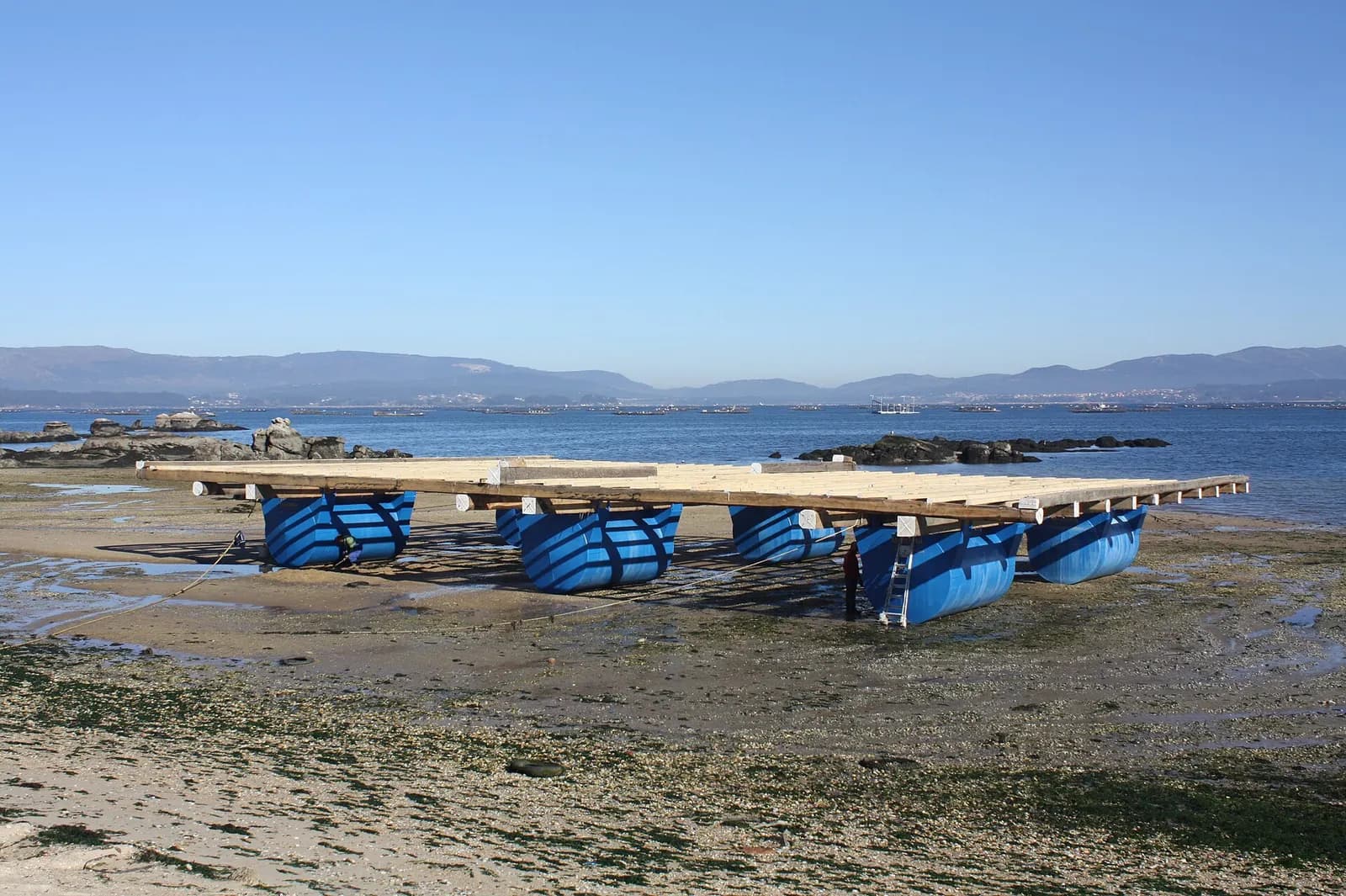
A batea is a grid of wooden beams, usually eucalyptus, laid over floats and held in place by one or two chains running down to heavy concrete blocks on the seabed, the mortos, literally "the dead ones". From the grid hang the ropes, and on the ropes grow the mussels. There is no cage and no pen. The rope is the farm. The rules are tight even so: a batea may cover at most 500 square metres and carry at most 500 ropes, none longer than 12 metres, according to a guide by the Xunta's institute for health and safety at work.
The idea arrived in Galicia within living memory. The council's history starts in 1869, when the naturalist Mariano de la Paz Graells described mussels grown on wooden trestles at Carril, near Vilagarcía, in old oyster beds. A floating raft was tried in Vigo in 1932 and abandoned. The first batea of Arousa went into the water in 1945, built by Viveros del Rial with a single wooden float and ropes of esparto grass. The year after, there were ten in the port of Vilagarcía. Vigo followed in 1949, then Cambados, O Grove, Bueu, Redondela and A Pobra do Caramiñal in 1954, Sada in 1955 and Muros in 1956.
The rafts then changed their materials but not their shape. Wooden floats were sheathed in cement, some growers used the hulls of old boats, and these gave way to floats of polyester, or of iron coated in it. Nylon took the place of esparto. Today the 3,387 bateas sit in 44 marked polygons along the coast. After Arousa come Vigo and Baiona with 498, Pontevedra with 343, Muros and Noia with 122 and Ares and Betanzos with 105.
Why the rías are so good for mussels
The Galician mussel, Mytilus galloprovincialis, eats by filtering seawater, up to eight litres an hour according to the council, and keeping the plankton. So the question is not how to feed it but where to put it, and the Galician rías are unusually well stocked. The reason is upwelling. When the north wind blows along the coast, it pushes the warmer surface water out to sea, and cold water full of nutrients rises from the deep to take its place. The plankton bloom on those nutrients, and the mussels hanging in the middle of it have nothing to do but eat.
Arousa adds size and shelter. It is the largest of the rías, 26 kilometres long and about 230 square kilometres in area, up to 65 metres deep, fed by two rivers, the Ulla and the Umia, and closed at its mouth by islands and headlands. That combination of fresh water, ocean water and calm is what turned a single raft in 1945 into more than two thousand.
How Galician mussels grow on a rope
The cycle starts with the seed, the mexilla: young mussels a centimetre or two long. Growers scrape it off the rocks of the open coast, or catch it on collector ropes hung from the rafts between April and September, where the larvae settle on their own. On the rocks, an order of 2000 allows the scraping between 1 December and 30 April, never at weekends or on holidays, but the Xunta moves the dates when the seed is late. In the 2025 to 2026 season, its office in Vigo delayed the start to 2 January so that the young mussels could settle, and later stretched the end twice, to 30 June.
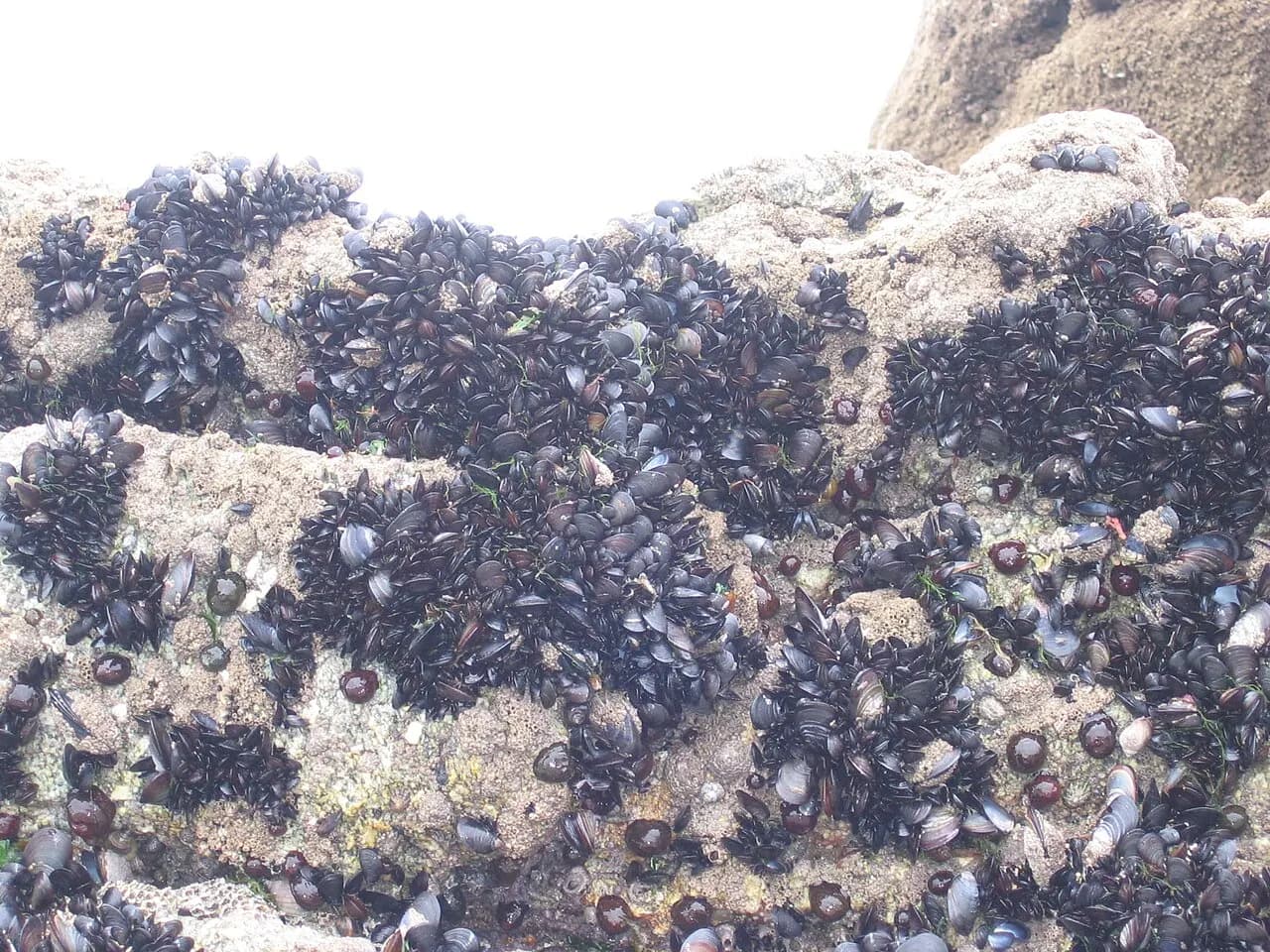
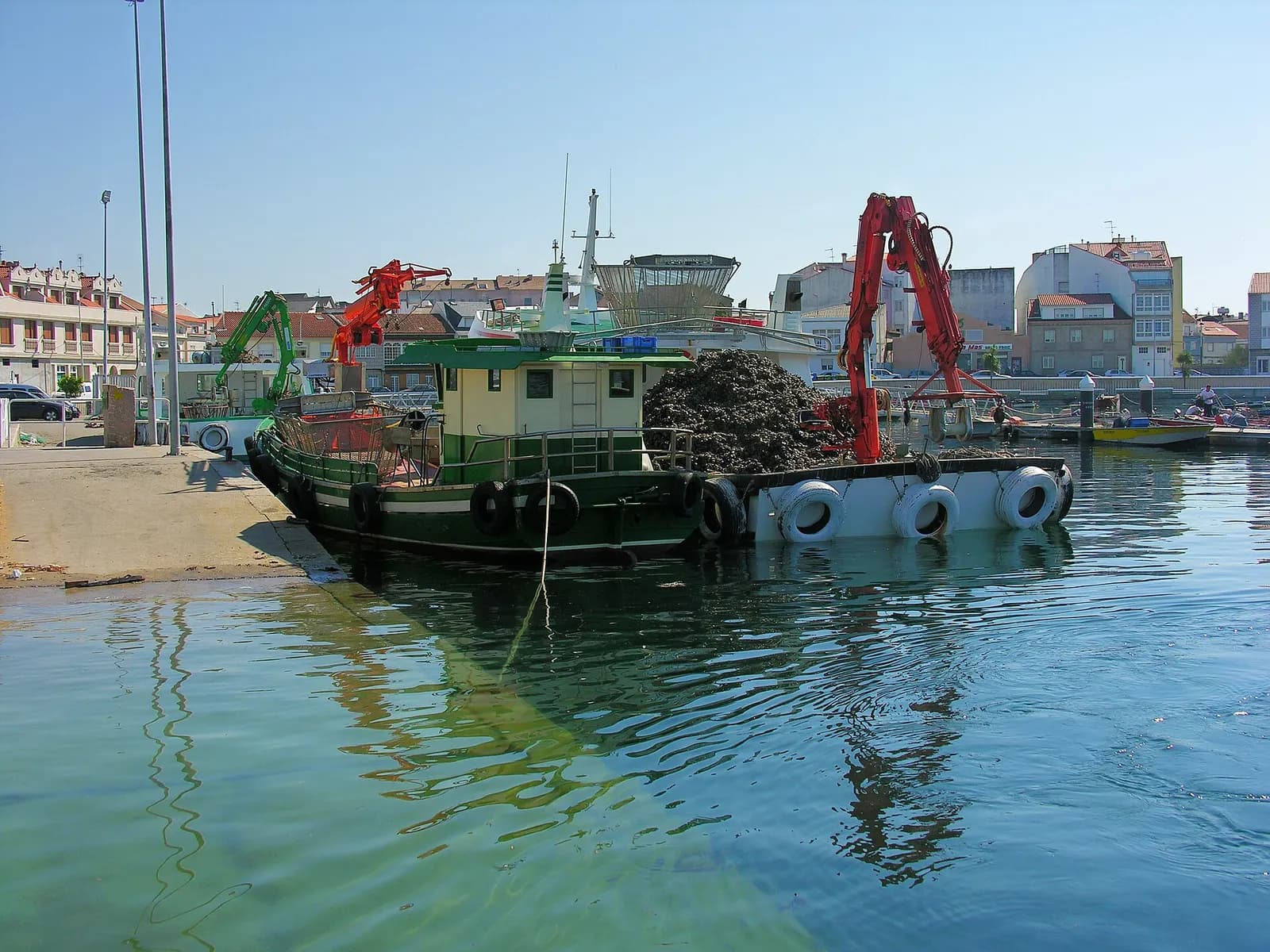
The seed is then wrapped around a rope with a thin biodegradable net, a job called the encordado, and the rope goes back under the raft. Small pegs pushed through the rope every 40 centimetres keep the clumps from sliding off. The net rots away and the mussels attach themselves to the rope with their own threads. After four to six months, when they have reached about five centimetres, the crowded ropes are pulled up and their mussels shared out among two or three new ropes, the desdoble, so that each one has room to grow. The harvest comes roughly a year after that, when a boat moored alongside lifts each rope out with its crane and strips it.
The rocks are not an endless supply, and the mussel growers are not alone on them. Young percebes settle on the same rocks as the seed, so in the areas covered by the percebe plans the Xunta's fisheries service keeps 17.62 per cent of the coast for percebes alone and leaves the rest open to seed collection. That is one reason the percebeiros of the Costa da Morte and the mussel growers have long argued about who scrapes where.
Red tides and three hard years
The weak point of a farm that eats whatever the sea brings is that sometimes the sea brings something toxic. Certain microscopic algae produce toxins that mussels accumulate without harm to themselves, and when they bloom, often turning the water reddish, harvesting has to stop. Galicians call it the marea vermella, the red tide. A public laboratory in Vilaxoán, INTECMAR, samples the water and the mussels and updates the state of every production area each day. A closed area stays closed until the mussels test clean.
In 2025 the closures were long. The council could not certify any fresh mussels until 29 September, and in November and December practically every area was shut. On 12 November only seven of the production areas of Arousa were open and 18 were closed, Diario de Arousa reported. The council's own list of the hardest moments since it was founded includes the red tides of 2005 and 2013, the sinking of the Prestige tanker in 2002 and the free trade agreement between the European Union and Chile.
Production has dropped. Galicia harvested 278,694 tonnes of mussels in 2018 and 219,699 in 2022, then fell to 178,065 tonnes in 2023 and has stayed close to that since, with 177,639 in 2025, according to the Xunta. In April 2025 a study by researchers of the CSIC, Spain's national research council, warned that after fifteen stable years the crop had dropped sharply in 2023 and again in 2024, to levels last seen at the end of the twentieth century, and pointed to warmer water, acidification and changes in upwelling, as Diario de Arousa reported. The average first-sale price has gone the other way: between 41 and 46 cents a kilo through most of the 2010s, 72 in 2024 and 70 in 2025.
What the Mexillón de Galicia label means
The regulatory council was set up in November 1995, after three years of intense red tides had wrecked prices and shaken the sector, and the European Union registered Mexillón de Galicia as a protected designation of origin in 2007. The council describes it as the first sea product in Europe to get a PDO. The seal goes on fresh mussels, and processed ones made with them can carry an "Elaborado con" version. Since 2024, the council's September 2026 bulletin notes, EU rules also protect the name when it is used as an ingredient in a processed product.
The seal covers a fraction of the crop. In 2025 the council certified 20,462,672 kilos of mussels, 9 per cent more than in 2024, from 2,044 rafts, about 60 per cent of the total, according to its March 2026 bulletin. Most of it, 18.5 million kilos, went to the processing industry and only 1.9 million kilos were sold fresh. Arousa supplied 15.1 million kilos, and the three ports that landed most were A Pobra do Caramiñal, A Illa de Arousa and Vilanova de Arousa. October was the busiest month.
The council's bulletins are also frank about what has changed in the water. Small mussels went from 40,800 tonnes in 2005 to a record 117,500 in 2018, while medium mussels have stayed between 23,000 and 43,000 tonnes since 2004. And in 2025, after three thin years, only 23 per cent of the Galician crop went to canning, while local firms short of mussels at home bought imported ones, above all the Chilean chorito, to supply their customers.
A Illa de Arousa and the mussel ports
The best way to understand the rafts is to see the boats come in. A Illa de Arousa, the island in the middle of the ría, linked to the mainland by a road bridge, is one of the three busiest ports for certified mussels, with more than 3.1 million kilos in 2025. The harvest boats tie up there with their cranes and their loads, and from the quay the mussels go either to the depuration and dispatch centres, where fresh mussels are purified, sorted and packed, or in bulk to the processing industry.
The other half of the view is from above. The viewpoint of A Curotiña, on the summit of A Curota above A Pobra do Caramiñal, looks out over the Rías Baixas and the mussel rafts among the islands of Arousa, as Turismo de Galicia describes it. In summer, Rianxo, A Illa and Vilanova each hold a mussel festival; the dates change every year, so check with each town hall before planning around one. The south shore of the ría is on our Pontevedra page, the Barbanza shore on our A Coruña page, and the rest of the region on our Galicia page.
How to buy and cook Galician mussels
Fresh mussels should be alive, with closed shells or shells that close when tapped, and they should go into the pot the day they are bought. Those with the PDO seal carry the council's logo with the European PDO symbol on the bag or the label. The season is not fixed: mussels are harvested all year, but every area can close at short notice for red tide, and in 2025 the autumn months were both the busiest and the most interrupted.
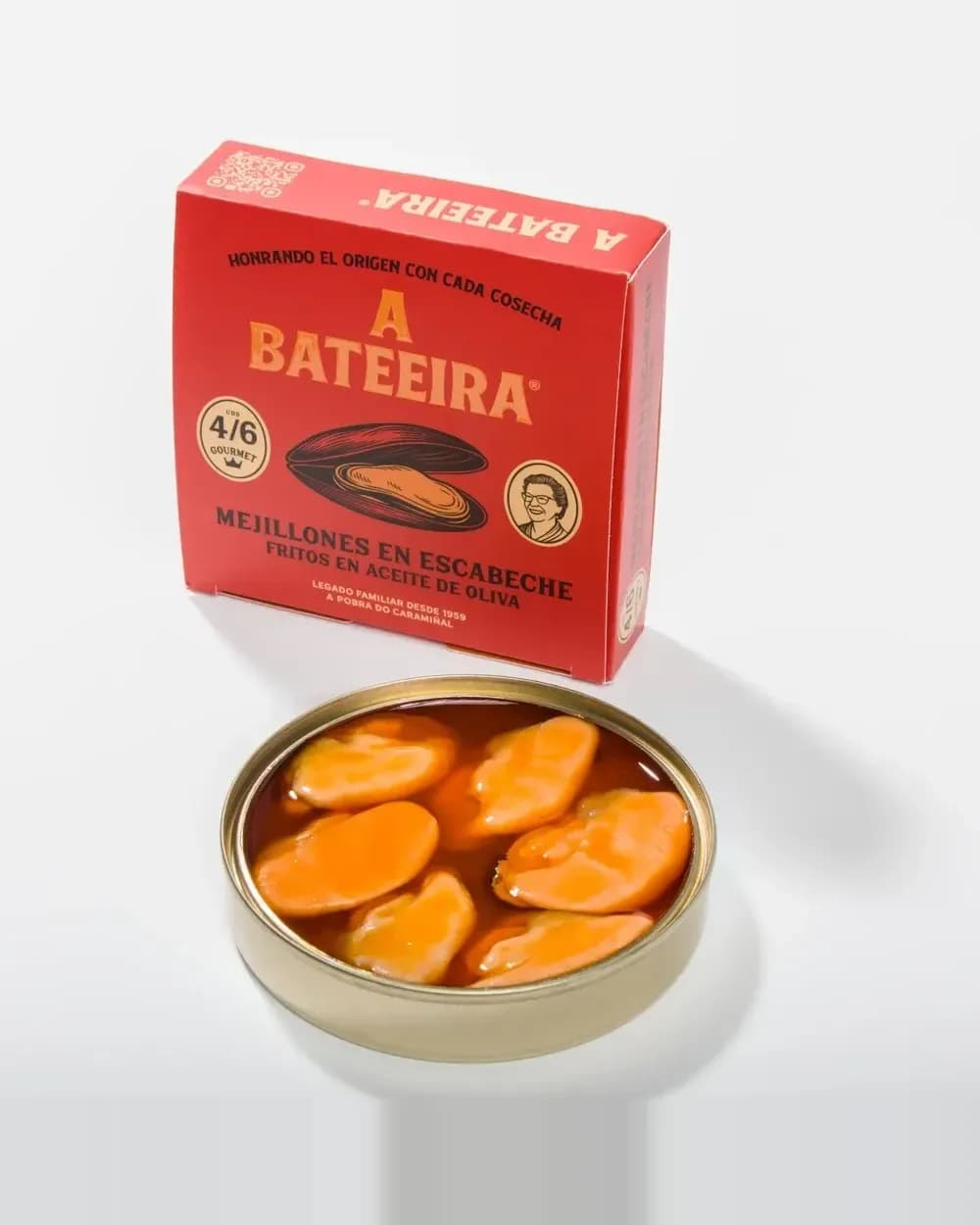
Cooking them is simple, which is part of the point. Rinse them, pull off the beard, the tuft of threads with which they held on to the rope, and steam them in a covered pot with no more than a splash of water until they open. Galicia's other classic is mussels in escabeche, cooked and then kept in a pickle of oil, vinegar and spices. That is the way much of the processed crop ends up in a tin, although in 2025 more of the tins than usual were filled from Chile.
Questions
- Why are Galician mussels grown on rafts?
- Galician mussels are grown on ropes hanging from floating wooden rafts called bateas because the rías are deep, sheltered and rich in plankton, which the mussels filter from the water. Hanging them in the water keeps them off the seabed and lets them feed all day. The first batea of the Ría de Arousa went into the water in 1945, and Galicia now has 3,387 of them, each at most 500 square metres with at most 500 ropes.
- What is the Mexillón de Galicia PDO?
- Mexillón de Galicia is the protected designation of origin for mussels grown on bateas in the Galician rías. Its regulatory council was founded in 1995 and the EU registered the name in 2007. In 2025 it certified 20.5 million kilos from 2,044 rafts, about 60 per cent of all bateas, and its logo goes on the bag or the label.
- When are Galician mussels in season?
- Galician mussels are harvested all year, but any production area can close at short notice when toxic algae bloom. In 2025 the busiest month for certified mussels was October, while in November and December almost every area was closed by red tide. INTECMAR, the Galician laboratory for marine quality control, publishes the state of each area every day.
- What is a red tide and what does it mean for mussels?
- A red tide, or marea vermella in Galician, is a bloom of microscopic algae that produce toxins. Mussels filter them and accumulate the toxins, so the affected areas are closed to harvesting until tests show the mussels are clean again. INTECMAR samples the water and the mussels and publishes which areas are open each day.
- Where can you see the mussel rafts of Arousa?
- The best view is from the viewpoint of A Curotiña, on the mountain of A Curota above A Pobra do Caramiñal, which looks over the Ría de Arousa and its rafts. At sea level, the ports of A Pobra do Caramiñal, A Illa de Arousa and Vilanova de Arousa are where most certified mussels are landed.
- How do you cook Galician mussels?
- The simplest way is the Galician one: rinse the mussels, pull off the beard and steam them in a covered pot with a splash of water until they open. The other classic is mussels in escabeche, cooked and kept in a pickle of oil, vinegar and spices, which is how much of the processed crop is sold.