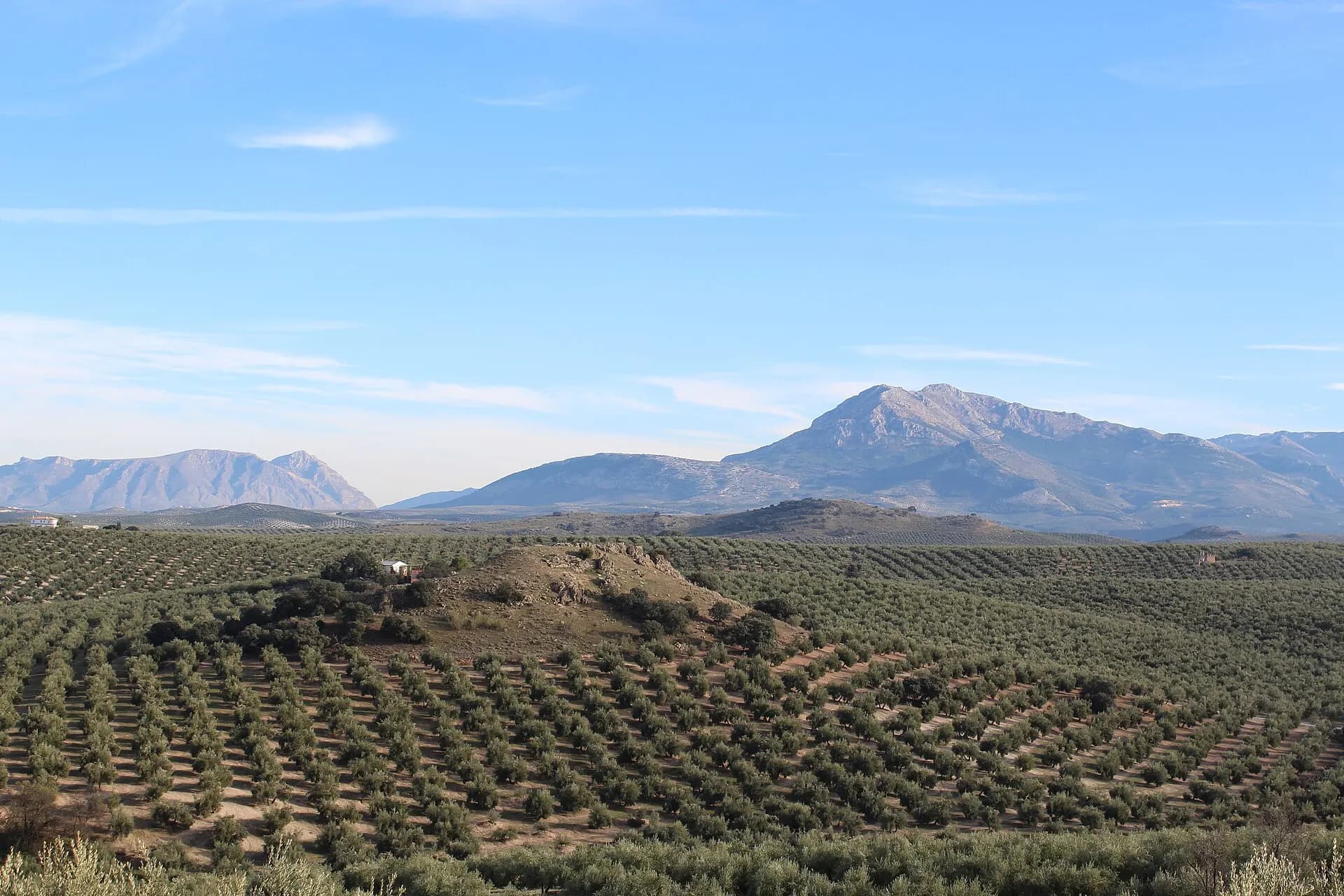
The dehesa of Extremadura: Iberian pigs, acorns and the four ham labels
Sierra Suroeste, Badajoz//History/10 min read
Almost 1.5 million hectares of Extremadura are oak pasture kept open by people. Each winter its acorns decide which Iberian pigs earn the black or red label.
 Written with by Eduardo Peire
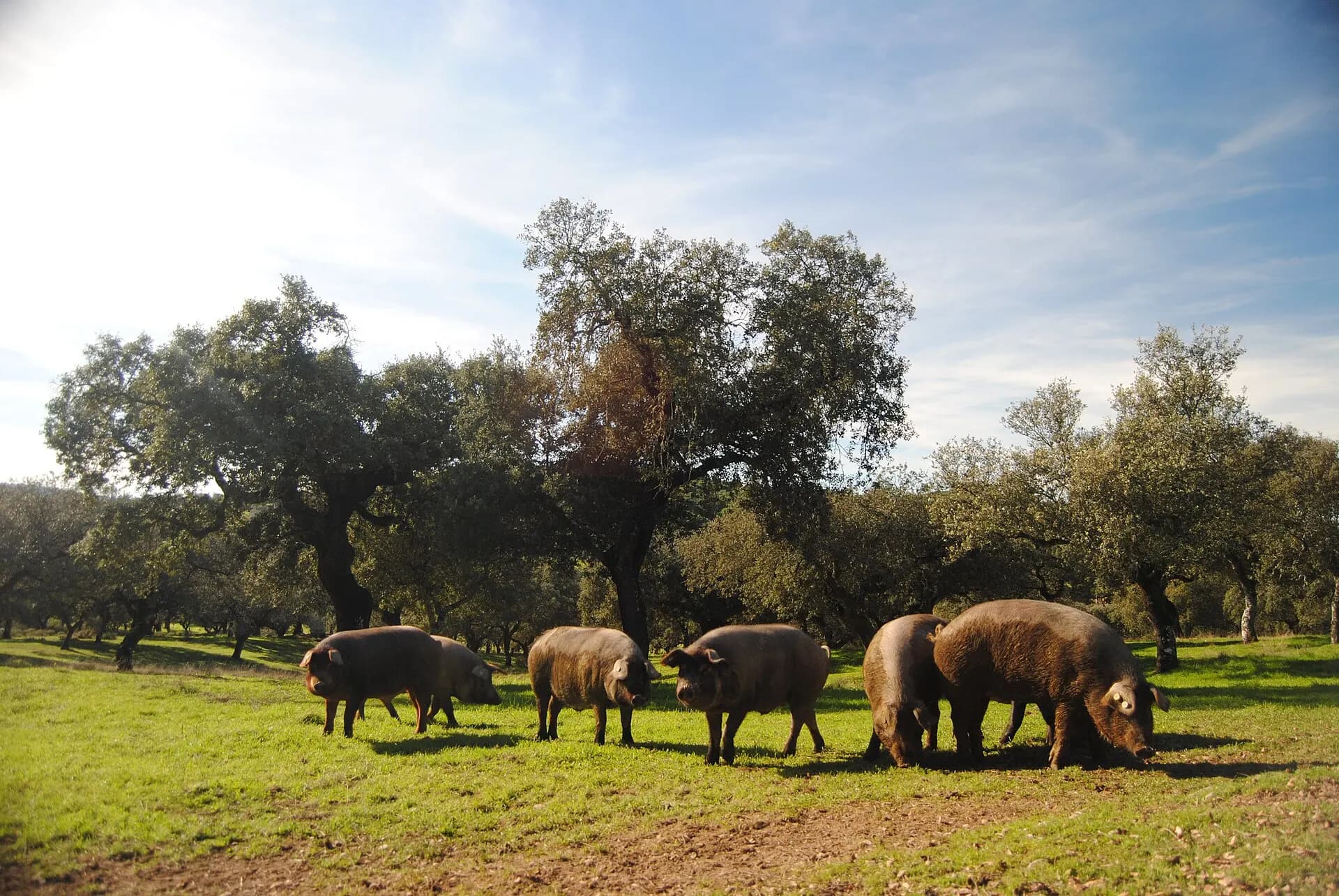
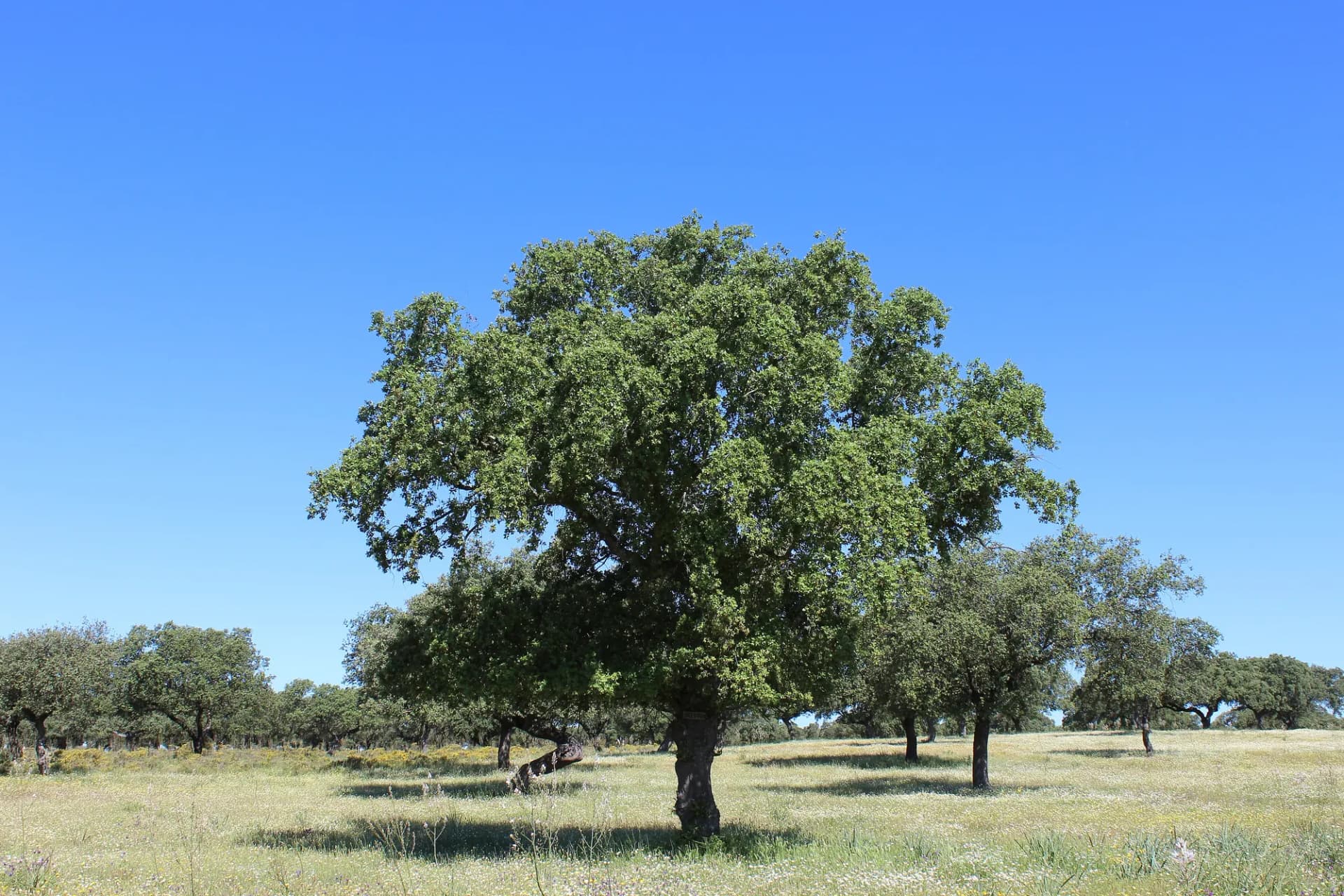
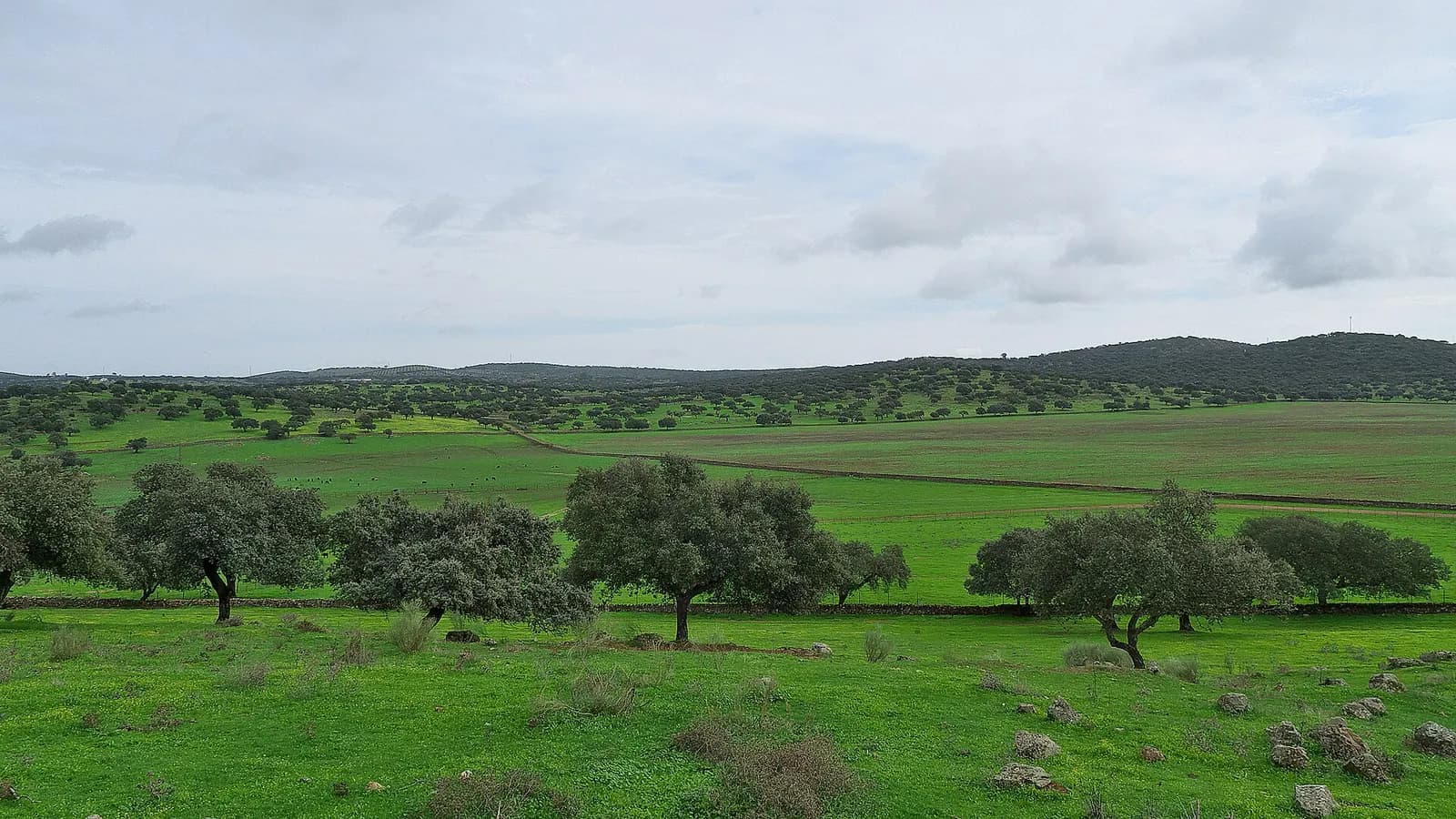
A dehesa is pasture scattered with holm oaks and cork oaks, kept open by people and their animals, and it is where Iberian pigs eat acorns before they become the top grade of Spanish ham. Dehesas cover more than four million hectares of south-west Iberia, and Extremadura has the largest share, almost 1.5 million hectares, according to the region's agricultural research centre, CICYTEX. The pigs are the famous part. They are also the part that stays the shortest time.
Most Ibérico ham never comes near a dehesa. In 2024, two out of every three Ibérico hams tagged in Spain carried the white label, which means the pig was raised on feed in an intensive farm. Only about one in six came from a pig fattened on acorns, and that share is settled each winter under the oaks, by rules that count the trees, weigh the pigs and put every plot on an official map.
What is a dehesa?
A dehesa is neither a forest nor a field. Spain's Ibérico quality standard, Real Decreto 4/2014, defines it as continuous pasture with Mediterranean trees, mostly oaks of the genus Quercus, run mainly for livestock grazed in the open. The human work that keeps it going has to be plain to see, and there must be at least ten productive oaks per hectare on average. The trees are mostly encina (holm oak) and alcornoque (cork oak), with some quejigo (Portuguese oak). The word comes from the late Latin defensa, defence or prohibition: land closed off and kept for grazing.
The definition is a reminder that a dehesa lasts only while someone works it. Left alone, it fills with scrub. Grazed too hard, it loses its young oaks. CICYTEX lists what comes out of it: livestock, crops, cork, honey, firewood and charcoal, game, fish raised in the ponds and drinking pools, mushrooms and tourism. The regulatory council of the local ham names its three classic residents as the Iberian pig, the Merino sheep and the Retinta cow.
Extremadura once tried to make good management compulsory. Its Ley 1/1986 sobre la Dehesa treated any estate with more than 100 hectares fit for open grazing as a dehesa and made owners declare it in a special register. If an estate carried less than 80 per cent of the livestock it could support, or gave less than 80 per cent of the cork it could, the regional government could impose an improvement plan. Owners who ignored it faced a tax on badly run dehesas and, in the last resort, expropriation. The Constitutional Court rejected a challenge to those articles in 1993. The tax was abolished in 2002.
What is the montanera?
The montanera is the acorn season, and the law sets its rules down to the kilo. Pigs that will give de bellota (acorn-fed) ham enter the dehesa between 1 October and 15 December, in batches with an average weight of 92 to 115 kilos. They must stay more than 60 days, eating only acorns, grass and whatever else the dehesa offers, with no feed added, and put on at least 46 kilos in that time, about three quarters of a kilo a day. Slaughter runs from 15 December to 31 March, and the pig has to be at least 14 months old.
The law also counts the trees. How many pigs a plot can take depends on how much of the ground the oak crowns cover: 0.25 pigs per hectare where they cover up to a tenth of it, rising in steps to 1.25 where they cover more than 35 per cent. Each year, before the pigs go in, the inspection bodies judge how many acorns there are, and in a poor year the numbers go down. Every plot used must appear in the montanera layer of SIGPAC, the official map of Spanish farm parcels, so the canopy can be checked from above as well as on the ground.
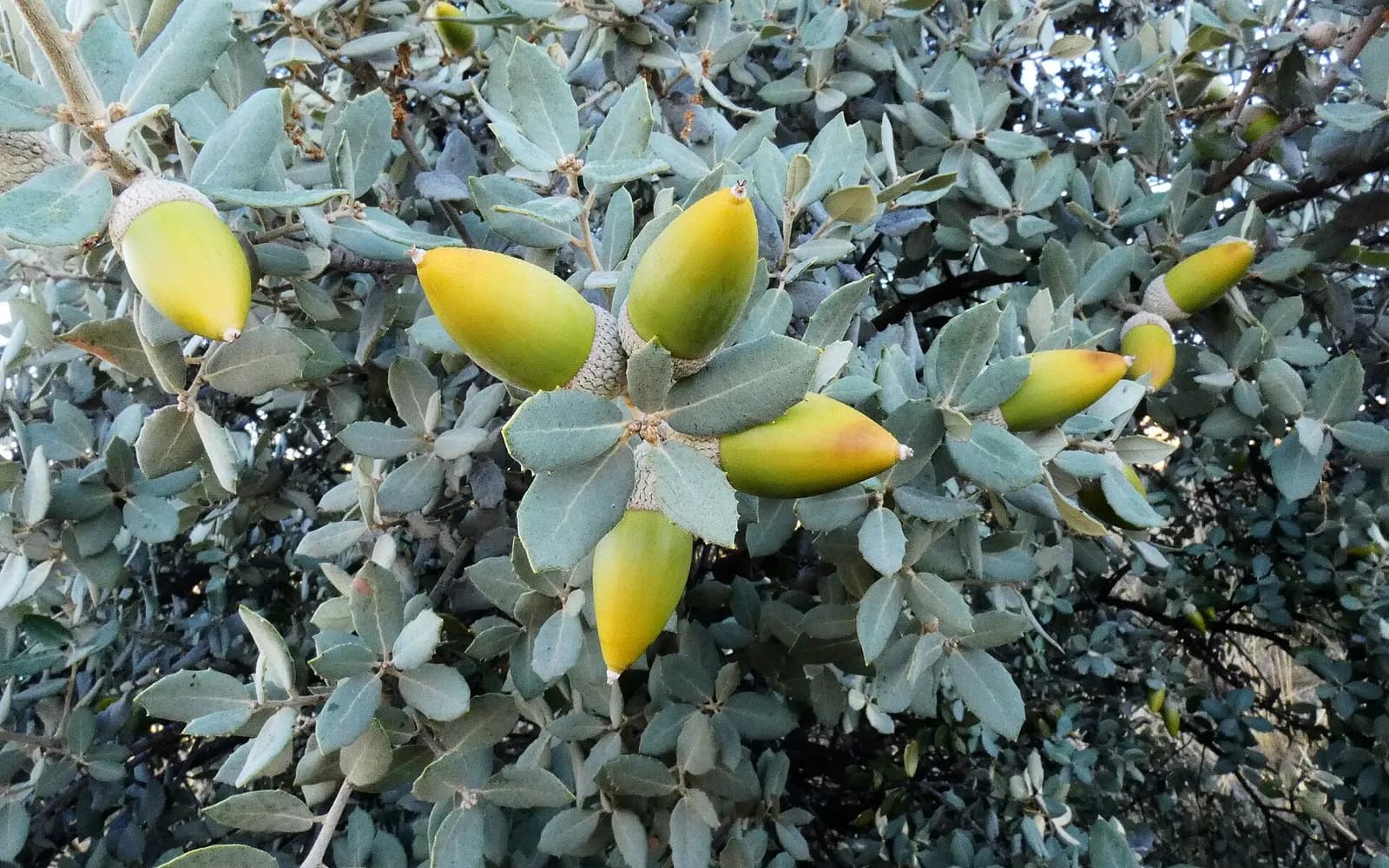
The local PDO is stricter. Its specification asks its acorn-fed pigs to put on at least 52 kilos in the montanera, six more than the national minimum, and its regulatory council speaks of two to six hectares of dehesa for each pig. That is a lot of ground for one animal, and the acorns do not fall all at once: the specification says they ripen from November to February, depending on the weather of each year. A montanera pig spends its last winter walking from tree to tree.
What do the black, red, green and white labels on Ibérico ham mean?
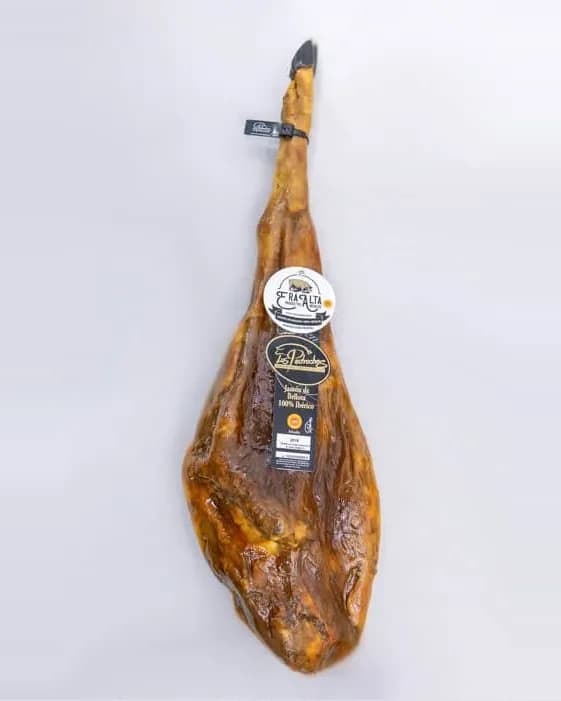
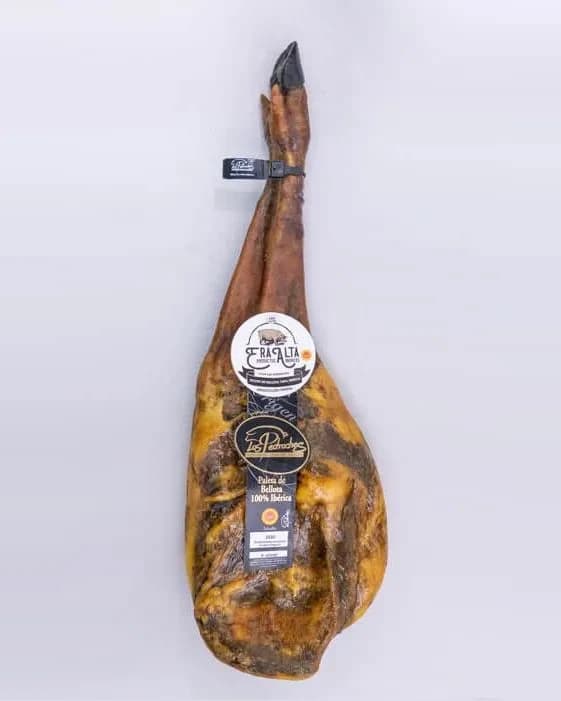
Every Ibérico ham and shoulder made under the Spanish standard gets a numbered seal at the slaughterhouse, and its colour says how the pig lived. The seals are handed out by ASICI, the interprofessional body of the Ibérico pig sector, which keeps count of every one. Shops and restaurants must leave the seal on the leg, so the colour of a ham being carved on a bar counter is there for anyone to check.
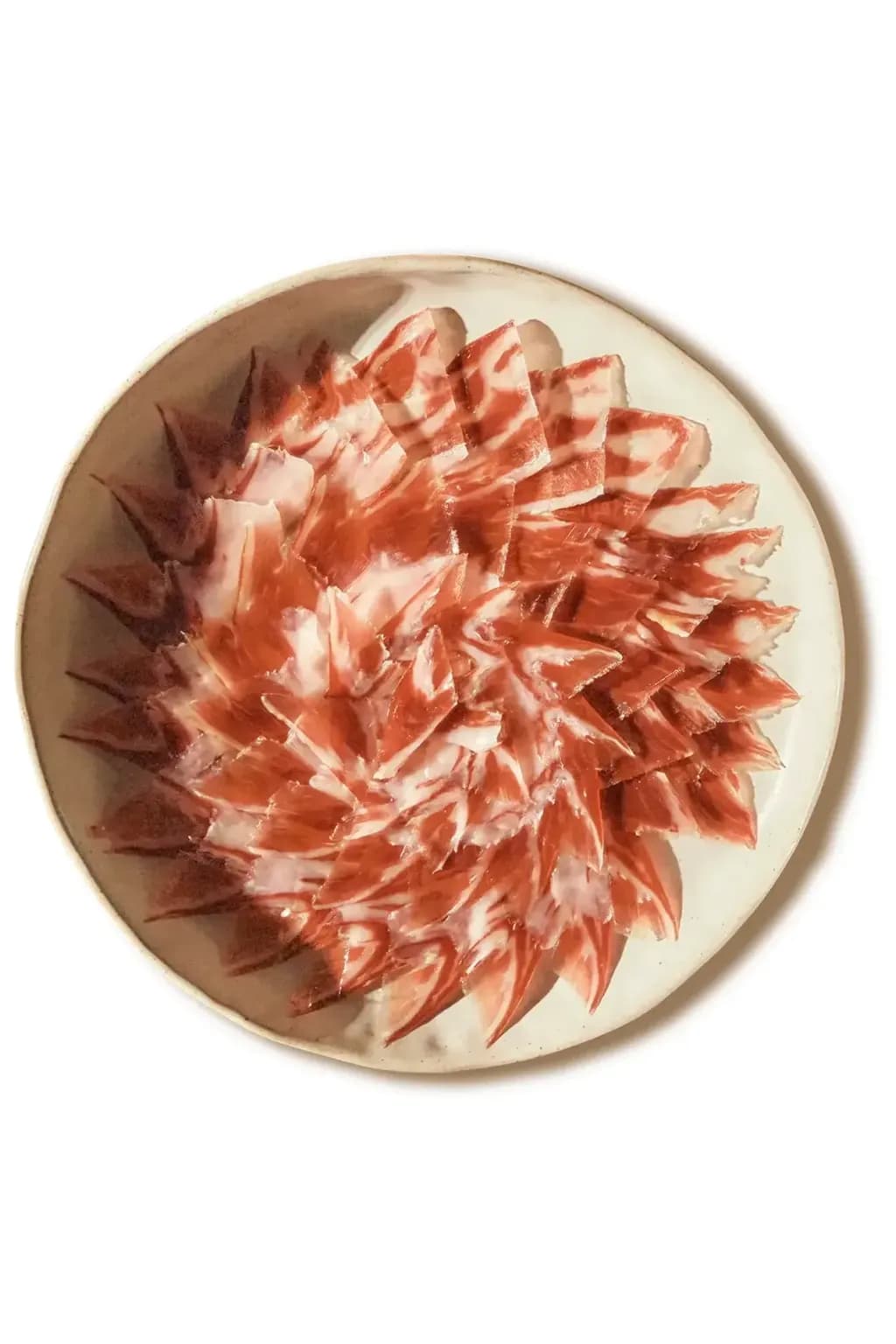
- Black: de bellota 100% ibérico. Acorn-fed, from a pig whose parents are both purebred Iberian and entered in the breed's herd book. Only this label may use the words pata negra (black foot).
- Red: de bellota ibérico. Acorn-fed, from a pig that is 50 or 75 per cent Iberian, crossed with Duroc, the only other breed the rule allows. The percentage has to be printed on the label.
- Green: de cebo de campo ibérico. Fed mainly on cereals and legumes, but outdoors, with at least 100 square metres for each pig over 110 kilos, at least 60 days on that farm and a minimum age of 12 months.
- White: de cebo ibérico. Fed on cereals and legumes in an intensive farm, with at least 2 square metres for each pig over 110 kilos and a minimum age of 10 months.
The 2024 figures from ASICI show where the volume is. Of 6,630,175 Ibérico hams tagged that year, 4,416,317 were white, 66.6 per cent of the total. Green came next with 16.1 per cent, black with 11 per cent and red with 5.8 per cent. Since the seals began in 2014, ASICI has counted 58.53 million Ibérico hams, and almost as many shoulders.
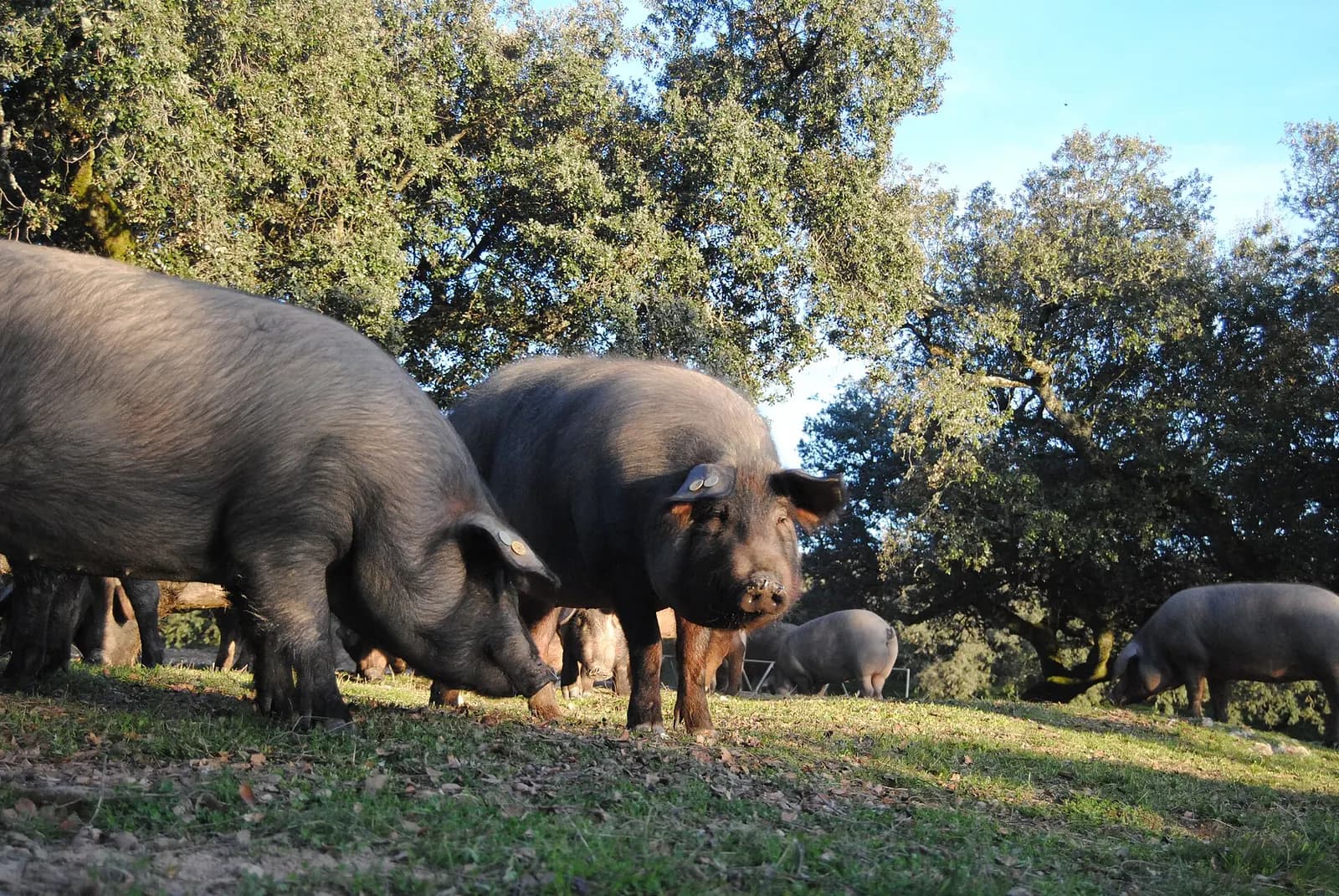
The decree is strict about words, too. The terms dehesa and montanera, and any name, logo or picture that refers to acorns or to the dehesa, are reserved for acorn-fed products, so a white-label ham cannot put an oak on its packaging. The words recebo and ibérico puro, common before 2014, are banned. Curing has minimums as well, counted from the day the leg goes into salt: 600 days for a ham under 7 kilos, 730 days for a heavier one and 365 days for a shoulder.
What is the PDO Dehesa de Extremadura?
Dehesa de Extremadura is one of the four Ibérico ham PDOs in Spain, with Guijuelo, Jabugo and Los Pedroches. Its regulatory council started in 1990, and the European Union registered the name as a protected designation of origin in 1996. A change to its specification, approved by the EU in June 2024, leaves only 100 per cent Iberian pigs, in two categories, acorn-fed and cebo de campo, so its hams never come from a crossbreed. The pigs must come from registered farms in Extremadura, and slaughter and curing must happen inside the region.
Its cebo de campo pigs eat feed, but they spend at least 90 days in the field before slaughter, at no more than 15 pigs per hectare, more than six times the space the national rule asks for. Their feeders must stand more than 100 metres from the drinking troughs, which keeps even the grain-fed pigs walking. In the curing houses, the hams stay in salt for about a day per kilo, at 1 to 5 °C.
It is a small part of a big trade. According to the trade journal Alimarket, the PDO certified 18,216 pigs in the 2023 to 2024 season, when ASICI recorded 592,275 acorn-fed pigs across Spain and Portugal. At a meeting of the PDO's operators in Zafra in September 2026, the regional government put the scheme at about 2,000 farms. Of the 35 companies on the regulatory council's list, 26 are in the province of Badajoz, most of them in small towns of the south such as Azuaga, Fregenal de la Sierra, Higuera la Real, Jerez de los Caballeros and Monesterio.
Extremadura as a whole weighs more than its PDO. In the montanera that ended in March 2026, ASICI counted 598,090 acorn-fed pigs, 3 per cent more than the season before. Of those, 220,485, or 37 per cent, came from Extremadura, second only to Andalusia. Almost two in three were 100 per cent Iberian.
What threatens the dehesa?
The first problem is age. CICYTEX names ageing trees and the lack of young ones to replace them as one of the main problems the dehesa faces. Many of the oaks that feed today's pigs are old, and an oak grown from an acorn takes years to give a useful crop.
The second is seca, the drying disease, which CICYTEX attributes to Phytophthora cinnamomi, a water mould that lives in the soil and rots the roots of holm oaks and cork oaks until the tree withers and dies. The same organism is on the IUCN list of the 100 worst invasive alien species in the world. CICYTEX maps how the disease spreads and is selecting trees that survived where their neighbours died, to breed oaks that resist it.
The third arrived with less noise. In November 2026, CICYTEX reported a study of clearwing moths, the sésidos, by its forestry engineer Adrián J. Montero-Calvo and Luis M. Torres-Vila of the regional plant health service. The larvae live inside the stems, branches and roots of living trees, digging galleries for several years. From 2020 the two ran pheromone traps at 38 sites, plus a connected trap that reports each catch as it happens, and found 19 species in Extremadura, four of them on oaks. The severe damage that set them looking was in young oaks, in new plantations and in the gaps replanted to thicken old dehesas. In other words, in the trees that were supposed to fix the first problem.
At its La Orden research farm, CICYTEX is also testing grafted holm oaks in irrigated rows and hedges, like a modern olive grove, so the trees grow faster and give more acorns. It is an experiment, and an odd one to explain to anyone who thinks an acorn just falls from a tree.
Then there is African swine fever. Spain confirmed it on 28 November 2025 in wild boar at Cerdanyola del Vallès, near Barcelona, at the other end of the country. By 12 November 2026 the weekly count stood at 429 positive samples, all from wild boar in the province of Barcelona. The Ministry of Agriculture publishes biosecurity guidance for outdoor farms, where a fence is all that stands between a pig and a wild boar. That describes every farm in this story.
When can you see Iberian pigs in the dehesa?
The middle of the montanera, from November to February, is the best time. In October the season is only starting, and by April the acorn-fed pigs have gone to the slaughterhouse. The south of the province of Badajoz, around Jerez de los Caballeros, Fregenal de la Sierra and Higuera la Real, has many of the PDO's companies, and the country roads between those towns run through dehesa for long stretches.
Almost all of it is private farmland. The pigs are seen from the road or from public tracks, through a fence. A gate is closed for a reason, and a pig in the middle of its acorn season has better things to do than meet visitors.
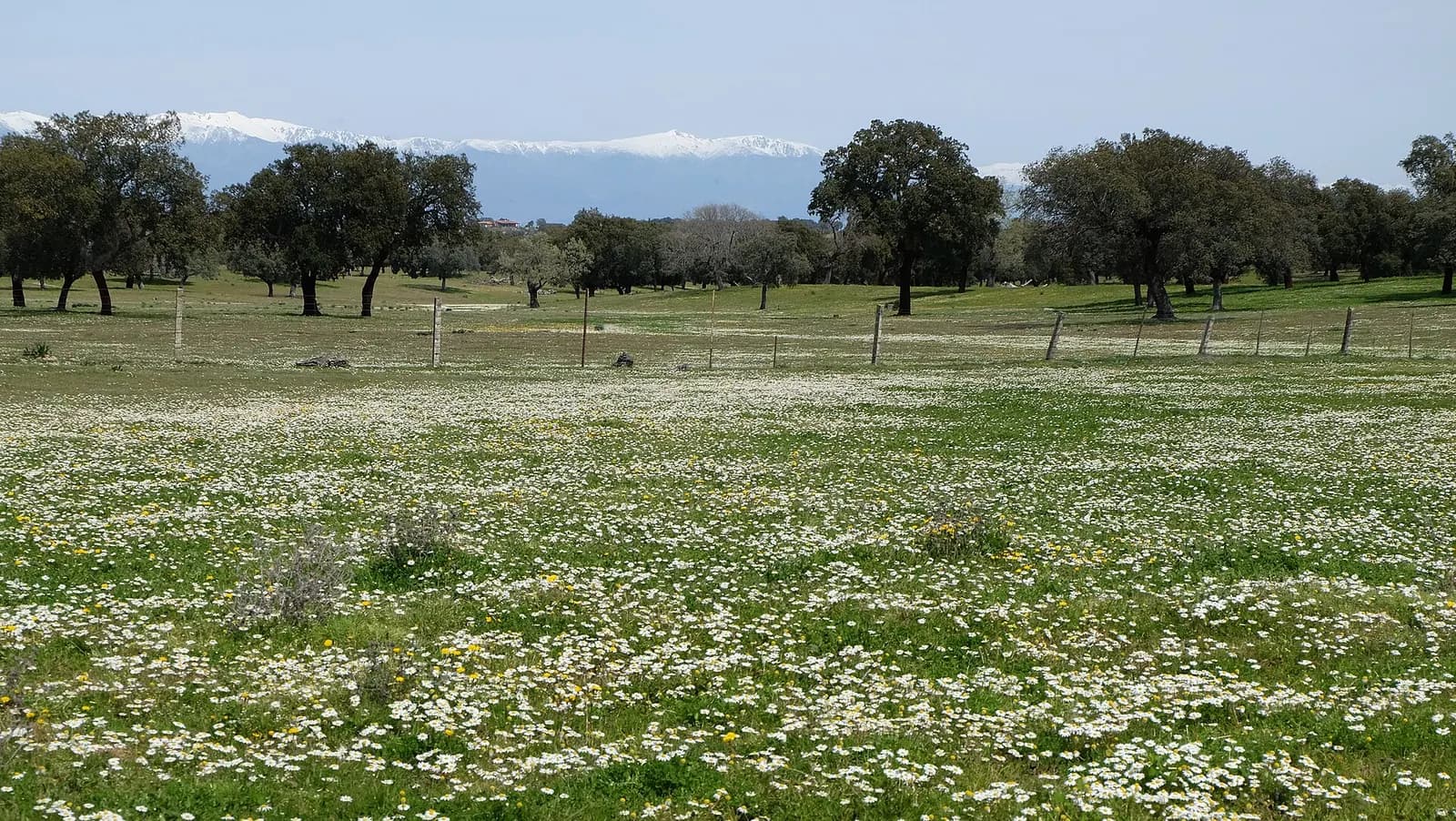
In spring the grass is high, the dehesa fills with flowers and the season turns to birds. To the north, in the province of Cáceres, Monfragüe has one of the largest black vulture colonies in the world, in cork oak and holm oak woods, where the vultures build their nests on top of the trees. Further north, in La Vera, oak wood is burnt to dry the peppers for pimentón de la Vera. More about the region is on the Extremadura page.
In October the gates open for the next batch. The inspectors go in first, to see how many acorns there are.
Questions
- What is a dehesa?
- A dehesa is a Mediterranean pasture with scattered oaks, mostly holm oak and cork oak, made and kept open by people for livestock, cork and firewood. Spain's Ibérico quality standard asks for at least ten productive oaks per hectare on average. Dehesas cover more than 4 million hectares of Spain and Portugal, almost 1.5 million of them in Extremadura.
- When do Iberian pigs eat acorns in the dehesa?
- Iberian pigs eat acorns in the montanera, which runs from autumn to the end of winter. Under Spain's Ibérico standard, acorn-fed pigs enter the dehesa between 1 October and 15 December, spend more than 60 days on acorns and grass with no feed, gain at least 46 kilos and are slaughtered between 15 December and 31 March.
- What do the black, red, green and white labels on Ibérico ham mean?
- On Ibérico ham, black means acorn-fed and 100 per cent Iberian, the only ham that may be called pata negra. Red means acorn-fed and 50 or 75 per cent Iberian, crossed with Duroc. Green means grain-fed outdoors (cebo de campo) and white means grain-fed on an intensive farm (cebo), which was two thirds of all Ibérico hams tagged in 2024.
- What is the PDO Dehesa de Extremadura?
- Dehesa de Extremadura is one of Spain's four protected designations of origin for Ibérico ham, registered by the EU in 1996. Since an amendment approved in 2024 it certifies only 100 per cent Iberian pigs, acorn-fed or cebo de campo, from registered farms in Extremadura, slaughtered and cured inside the region.
- What is killing the oaks of the dehesa?
- The oaks of the dehesa suffer from age, too few young trees and seca, a root rot of holm and cork oaks caused mainly by Phytophthora cinnamomi. In November 2026 Extremadura's research centre CICYTEX also reported clearwing moth larvae boring into oaks, with severe damage in young trees and replanted areas.
- Where can you see Iberian pigs in the dehesa in Extremadura?
- In Extremadura, the south of the province of Badajoz, around Jerez de los Caballeros, Fregenal de la Sierra and Higuera la Real, has long stretches of dehesa along its country roads. Acorn-fed pigs are there from October to March, best from November to February. Almost all the land is private, so they are watched from roads and public tracks.