Costa Blanca climbing in winter: Ifac, Puig Campana and the rules
Calp, Finestrat, Polop and Sella, Alicante//Activities/7 min read
From November to March, climbers from the north trade dark afternoons for warm limestone above the sea. The rock is protected, and so are the falcons.
 Written with by Eduardo Peire
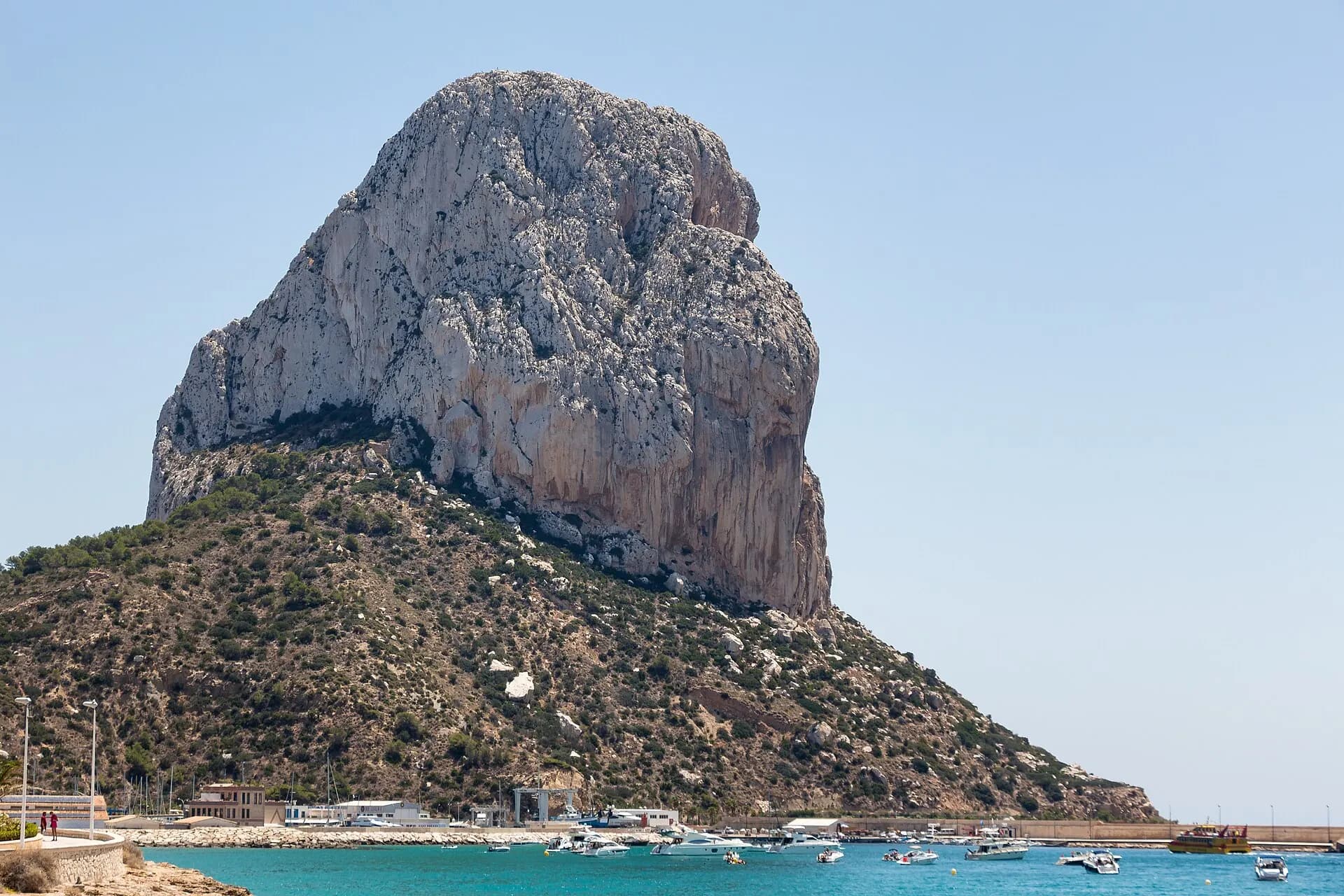
Costa Blanca climbing is a winter habit. From November to March, climbers from the north of Europe come to the province of Alicante for limestone that is warm enough to touch, short but sunny days and crags within sight of the sea: the Penyal d'Ifac in Calp, the Puig Campana above Finestrat, the Ponoig at Polop and the valley of Sella. Much of the rock is protected land, and the rules matter. On the Penyal d'Ifac the north-north-west face is closed to climbing in April, May and June while peregrine falcons breed, no new routes may be bolted, and the path down from the top needs a booking.
The reason for the season is in the numbers. At the weather station of Alicante, near the coast, AEMET's averages for 1981 to 2010 give a mean daily maximum of 17 °C in January, 181 hours of sun in the month and fewer than four days of rain. Even December, the darkest month there, averages 164 hours of sun, and March already has 227. In July the mean maximum is 30 °C. A south face in July is a griddle.
Why do climbers come to the Costa Blanca in winter?
Northern climbers have the same problem every winter: the rock at home is wet, frozen or in the dark. In Oslo or Stockholm the midwinter sun sets around three in the afternoon. The Costa Blanca has the opposite problem in summer, so its climbing calendar runs against the calendar of the beach. The federation's own pages say it: it advises against climbing at Redován, in the south of the province, in the summer months because of the heat, and calls the Puig Campana good for climbing almost all year because of its climate.
The climbing is varied. There are short bolted sport routes on small crags, long routes of several hundred metres on big walls, aid climbing under roofs, and a few lines where the sea is right below you. Almost all of it is on limestone, which the Valencian climbing federation, FEMECV, describes again and again as of very good quality.
The weather is not always kind. AEMET's normals put the wettest months in September and October, with 56 and 47 millimetres of rain in Alicante. Inland crags are higher and colder than the coast, and in January a north face can stay cold all day while the south side of the same mountain is warm.
The Penyal d'Ifac: a natural park you can climb
The Penyal d'Ifac, the Peñón de Ifach in Spanish, is the rock that every photograph of Calp contains. The federation's page on it describes a tombolo that runs almost a kilometre into the sea and rises to 332 metres. It became a natural park in 1987, and its management plan of 1993 allowed climbing as a traditional activity, with conditions. The federation holds it up as the proof that climbing and a natural park can live together.
There are three main sectors, on the north, west and south faces, about 68 routes in all, and the south face has the longest, up to 450 metres. Besides free and aid climbing, the federation lists psicobloc there: climbing low above the sea without a rope, with the water to catch you. The descent from the top is by the normal path down the north side, which the Diputación de Alicante's climbing guide, Senderos de la roca, calls beautiful and slippery. There is a drinking fountain on the seafront path that leads to the foot of the south face.
The conditions are set out in article 23 of the management plan, summarised in a rules sheet published by FEMECV:
- On the north-north-west face, no climbing in April, May or June, while peregrine falcons breed.
- On the south face, climbing on existing routes is allowed as long as the park management is told in advance which route you plan to climb.
- No new routes. Rebolting an existing route needs permission.
- The park's director can restrict climbing, totally or for a time, to protect or restore the ecosystem.
The path down is the Ruta Roja, which runs from the visitor centre through a tunnel of more than 50 metres to the summit. The management plan caps it at 300 visitors a day, so every walker going up and every climber coming down needs a booking. The park's page explains how it works: online only, from nine days before up to the same day if places remain, personal and non-transferable, and an officer can ask to see it. The park recommends mountain boots, water and clothes for the season, and advises against taking children beyond the tunnel, because the path is dangerous.
The rock also gives its name to a rare cliff plant, the Silene d'Ifac, Silene hifacensis, which has its own recovery plan. According to the local press, the 2023 count across the region found 57 populations and 1,292 plants, and in 2024 a move from endangered to vulnerable was proposed. It grows on rock faces, which is one more reason not to clean new lines.
People have lived around the rock for a long time. The Diputación's guide lists remains of prehistoric, Iberian, Phoenician and Roman cultures on the isthmus and around it. At the foot of the rock are the ruins of a Roman fish-salting works, known locally as the Baños de la Reina, the Queen's Baths, and the old salt pans of Calp, where migrating birds stop on their way. The same guide, unusually for a climbing guide, also recommends the local rice: arròs del senyoret, made with fish and seafood that come already peeled, named after the gentlemen who liked to eat their rice without getting their fingers dirty.
Puig Campana and the Ponoig
Inland from Benidorm, the Puig Campana rises north of Finestrat in a pyramid of rock that FEMECV gives as 1,408 metres high. Its name comes from its shape, like a bell. Its south-west-facing walls hold about fifty routes, averaging 400 metres and reaching 900 by the federation's figures, and the most famous follows the Espolón Central, the central spur. A notch on its summit ridge carries a legend: the knight Roland cut it with one blow of his sword, and the piece of rock fell into the sea as the island of Benidorm. Climbers fill their bottles at the Font del Molí, by the car park, whose water the people of Finestrat say has properties of its own.
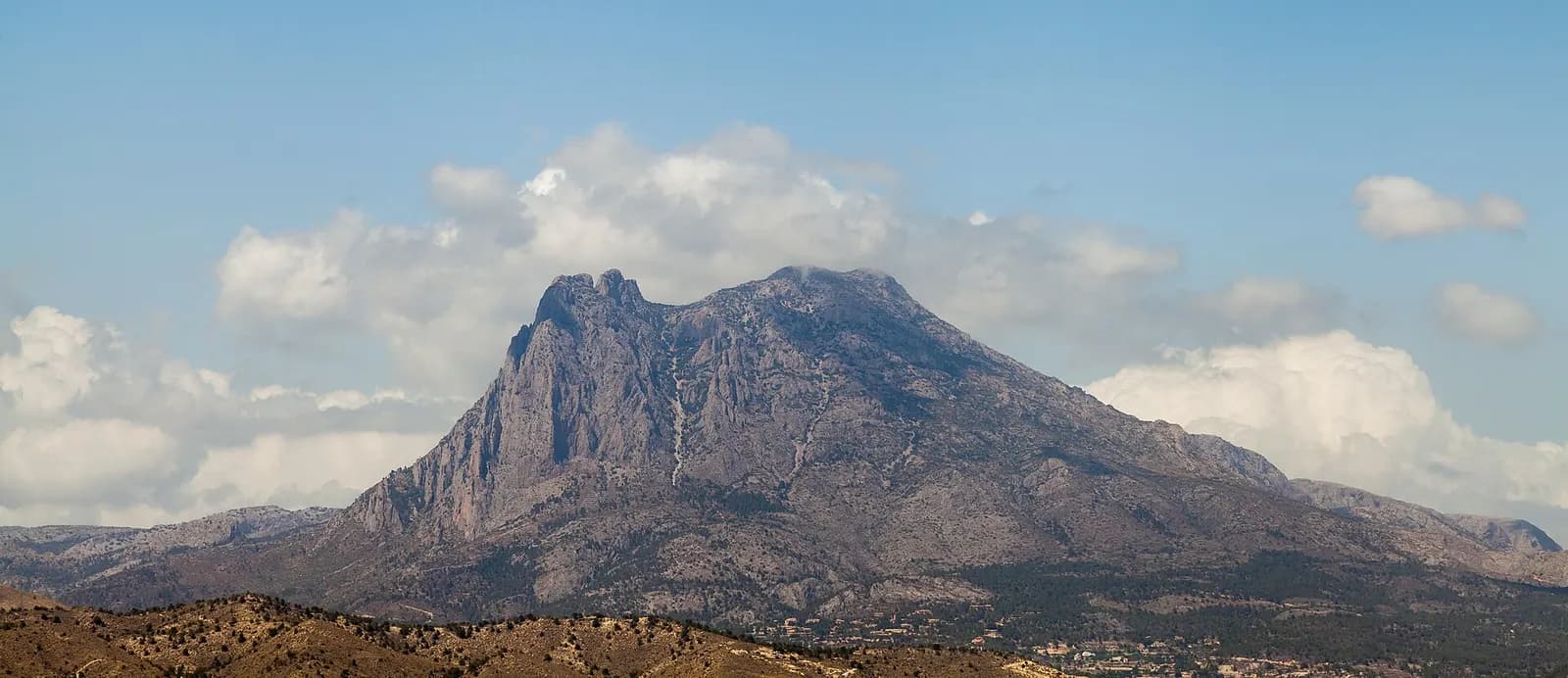
North of it, above Polop, is the Ponoig, also called the Sleeping Lion for its profile. It reaches 1,181 metres, with walls up to 600 metres high, six main sectors and about 105 routes. The Tozal de Levante, on its left, has 300 metre walls under a great roof, and most of its routes need a section of aid climbing to get past it.
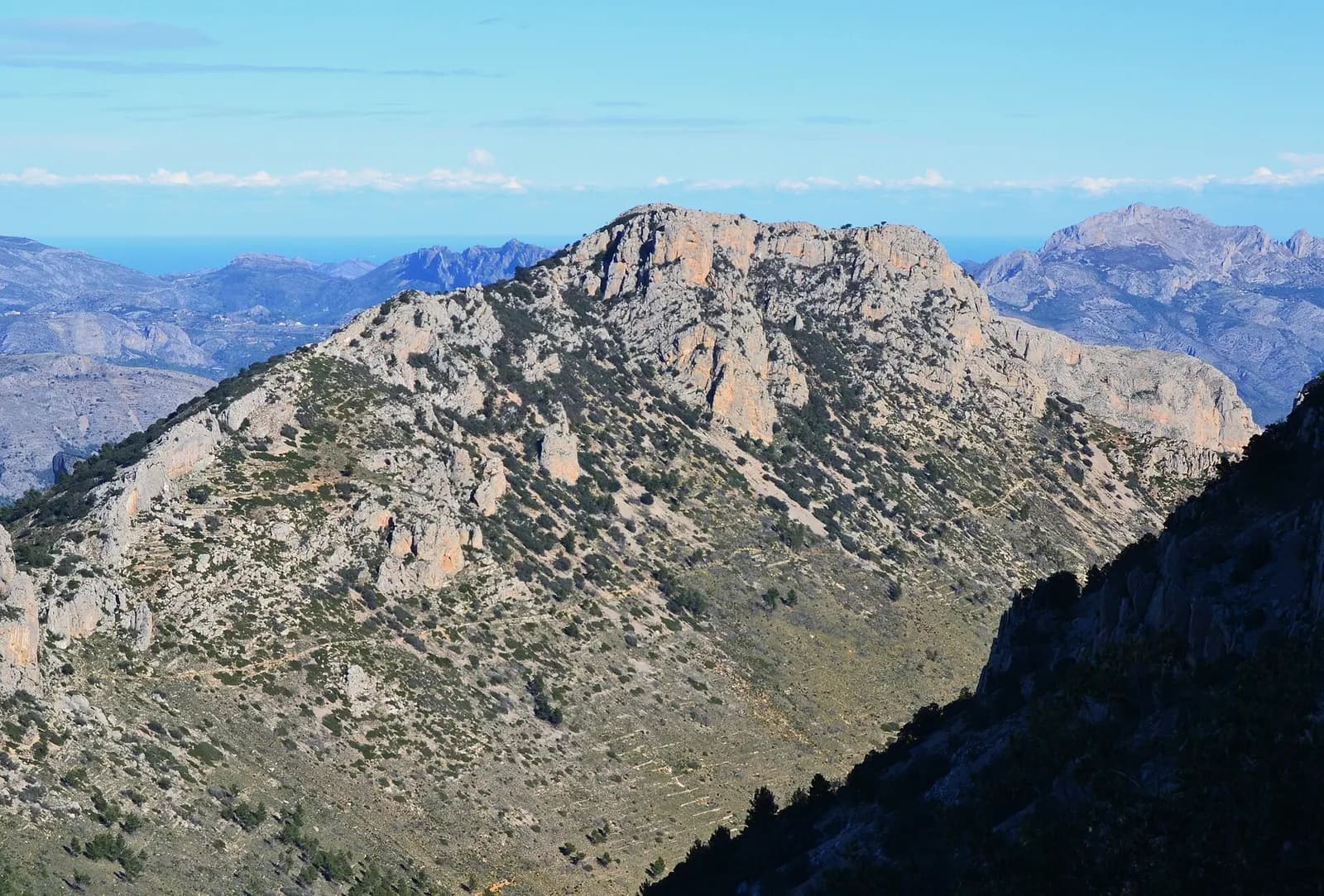
These are mountains, not crags by the road. A long route on the Puig Campana or the Ponoig is a mountain day in the short light of midwinter, and it needs an early start, a headlamp in the rucksack, enough water and a plan for the descent.
Sella and the rest
The village of Sella, in a valley inland from Villajoyosa, sits below long limestone walls lined with bolted sport routes, a different kind of day from the big mountains.
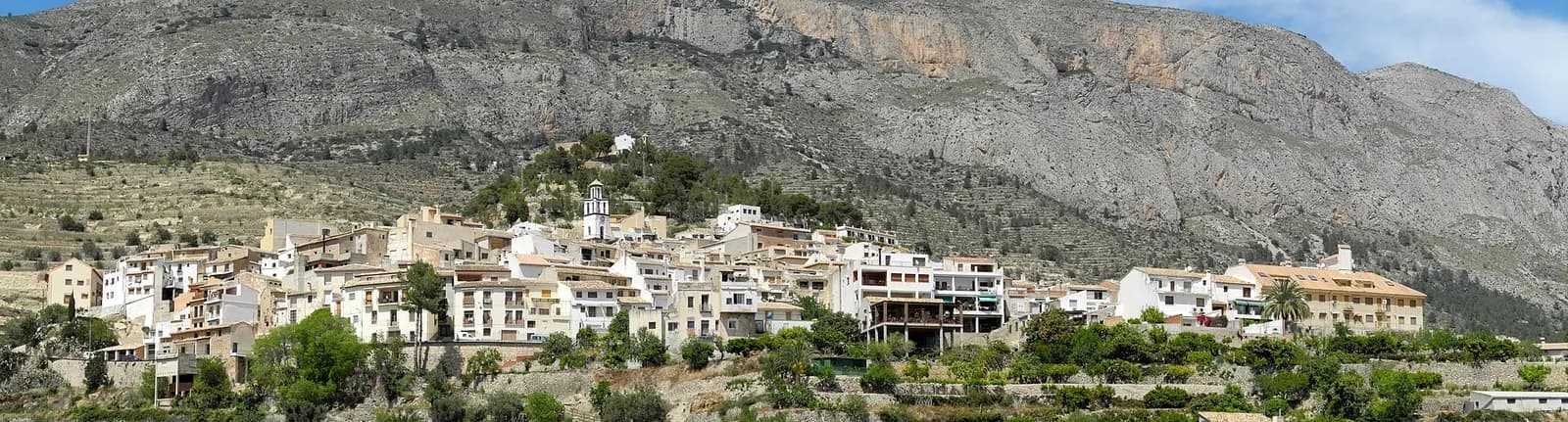
The province has many more crags, from the coast to the mountains around Onil, and the federation keeps a list of climbing areas with access and rules for each. The Cabeçó d'Or, above Busot, has around 150 routes and walls of 300 metres. El Rut, at Redován, has around 80 single-pitch routes on dark, grippy limestone, bolted mostly by the local mountain club. There are also vías ferratas, protected routes with steel cables and rungs, near several towns. They need a harness, a helmet and a proper via ferrata lanyard, and they are not a walk.
Nesting closures and the rules you need to check
The Ifac falcons are not an exception. At Penyes Roges, a group of limestone pillars in a pine wood near Onil with about 40 sport routes, climbing is banned from March to June for nesting. At the Cabeçó d'Or the federation asks climbers to stay off the sport sector, El Desplome, from January to June because birds of prey nest there, which takes in the second half of the winter season. Some of these are legal bans and some are requests, and the dates can change from one year to the next, so a crag that was open last winter may be closed this spring.
Before each trip, check the current rules for each crag on the FEMECV site and, for the Penyal d'Ifac, on the park's page. Keep to existing routes, do not add bolts, keep away from nests, and take the litter home, including the tape. In an emergency in Spain, call 112. A climbing trip is also a good reason to check that your insurance covers climbing abroad, including rescue.
More of the region is in our pages on the Comunitat Valenciana and the province of Alicante. On a rest day, the hill town of Xixona, inland from Alicante, makes the turrón of Christmas, and in mid March Valencia burns its Fallas.
The Penyal d'Ifac has been a natural park since 1987, and since 1993 nobody has been allowed to bolt a new route on it. Whatever you climb there, someone climbed it first.
Questions
- When is the best time for climbing on the Costa Blanca?
- From November to March. In Alicante, AEMET's averages for 1981 to 2010 give a mean daily maximum of 17 °C in January and about 30 °C in July and August, so summer is too hot on sunny faces. September and October are the wettest months. Inland and higher crags are colder than the coast.
- Can you climb on the Penyal d'Ifac?
- Yes, on existing routes and under the rules of the natural park. The north-north-west face is closed in April, May and June for nesting peregrine falcons, the park must be told in advance which route you plan on the south face, new routes are banned and rebolting needs permission. The park's director can restrict climbing at any time.
- Do you need a booking to climb the Penyal d'Ifac?
- You need one for the normal path to the summit, the Ruta Roja, which climbers use to come down, because the park limits it to 300 visitors a day. Bookings are made online only, from nine days before up to the same day if places remain, are personal and can be checked by an officer.
- Are there climbing closures for nesting birds on the Costa Blanca?
- Yes, and they change. Besides the Ifac falcons, climbing at Penyes Roges near Onil is banned from March to June, and at the Cabeçó d'Or above Busot the climbing federation asks climbers to keep off the sport sector from January to June. Check the current rules for each crag on the site of the Valencian climbing federation, FEMECV, before you go.
- How high is the Puig Campana and how long are its routes?
- The climbing federation gives the Puig Campana, above Finestrat, as 1,408 metres high, with about fifty routes on its south-west-facing walls, averaging 400 metres and reaching 900. The best known climbs the Espolón Central. These are mountain routes: start early, carry a headlamp and water, and know your descent before you leave the ground.