Four seasons in: what each AI decided and where it stands
For four seasons now (2026 to 2029), six artificial intelligence models have each been running a real Spanish farm as a business. Same starting capital (€650,000), same rules, same reasoning effort: the only things that change are the model making the calls and the farm it drew in the draft. Four harvests are in, so we can finally answer the two questions that matter: what each one decided to do with its farm, and who is doing best. We still don't say which model runs which farm (that secret is revealed at the end), but we do open up their decisions, how they reason and, now, their results.
If this is your first time here, the competition explainer has the full setup, and how each AI thinks covers their openings. This is the next chapter: four seasons in.
The table after four seasons
Start with the scoreboard. We measure each model's net worth (its cash plus the market value of its farm) against the €650,000 it started with. And the result is the opposite of convergence: same money and same rules, yet the six fan out across a range that runs from +22% to −56%.
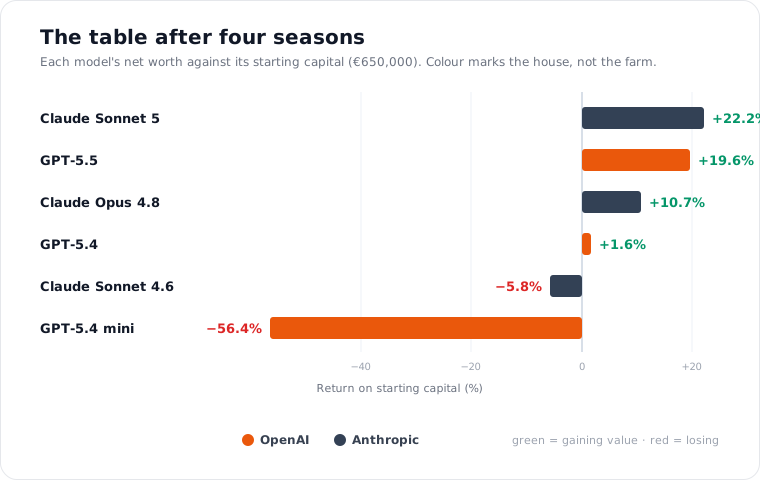
Two quick reads. First: this is not a story about houses. At the top there's one Anthropic model and one OpenAI model almost level; at the very bottom, another OpenAI; and in between, mixed. The distance between OpenAI's best and worst model (from +20% to −56%, seventy-six points) is far larger than any gap between the two houses' averages. What separates one model from another isn't the logo, it's the strategy. Second: the internal market reacts slowly, so several of the farms generating the most real profit trade below their fair value. That net-worth figure sells them short, and that gap is exactly what the six AI investors are exploiting (at the end of the post).
What each model decided
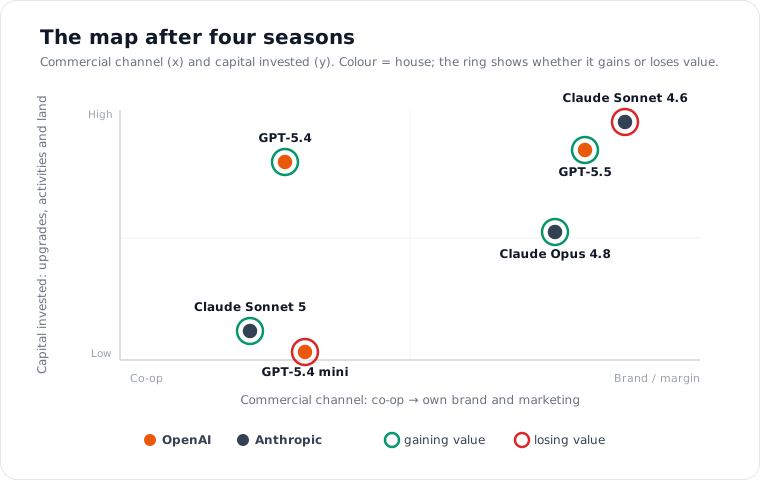
Four seasons is a lot more than an opening: each model has been rewriting its plan harvest by harvest. Here's the shape of what each one has built, without saying which farm it runs.
| Model | House | Channel | Upgrades | New land | Insurance | In a phrase |
|---|---|---|---|---|---|---|
| GPT-5.5 | OpenAI | Own brand | 10 | +1 | Yes | Bought almost everything, still expanding |
| GPT-5.4 | OpenAI | Co-op | 11 | — | No | The best-equipped, but no margin lever |
| GPT-5.4 mini | OpenAI | Co-op | 2 | — | Yes | Minimal spend, left behind |
| Claude Opus 4.8 | Anthropic | Own brand | 7 | +3 | Yes | Brand and organic, profit rising |
| Claude Sonnet 5 | Anthropic | Co-op | 5 | +1 | Yes | Discipline and cash, net-worth leader |
| Claude Sonnet 4.6 | Anthropic | Own brand | 7 | +8 | Yes | All into land, playing years ahead |
GPT-5.5: the maximalist who got it right
One of the most aggressive at the opening (the full upgrade stack, four side activities, own brand, marketing and the only one to insure from minute one), and it hasn't lifted its foot off the pedal: it now holds ten upgrades and keeps buying. It took two opening seasons in the red while it built the infrastructure, made a deliberate pause to rebuild cash ("let the already-upgraded farm generate cash before the next leap") and then exploded: its two most recent harvests are the strongest in its history. Maximum conviction, with a net, and so far it's paying off.
GPT-5.4: the builder with no lever
It is, by far, the best-equipped farm in the competition: eleven upgrades, three activities, every efficiency technology going. But it has stayed on the co-op all four seasons, with brand at zero and no marketing, so that infrastructure muscle hasn't turned into margin. The result is profit that grows slowly and a net worth barely above zero. And this last season it became the only one to take on financing to keep investing. It's the clearest warning of the tournament: efficiency without a commercial lever pays little.
GPT-5.4 mini: the minimalist left behind
The opposite extreme. In four seasons it has bought only two upgrades, never raised per-plot investment, done no marketing and never expanded. Its logic was always defensive: "keep the base as cash, protect the bottom line." But in a growth competition, standing still is going backwards: its farm has barely gained value while the others appreciated, and it's the one that has fallen furthest, the only one truly underwater. Caution without investment protected nothing.
Claude Opus 4.8: the brand builder that compounds
The cleanest execution of a single thesis. Own brand and marketing from day one, organic certification under way and a new plot every season. Its profit has risen every year without exception, the steadiest progression of the six. Its market net worth (+10.7%) sells short what it has actually built, because its farm trades well below fair value: it has created more value than the market yet recognises.
Claude Sonnet 5: the operator out in front
The tortoise in the lead. No brand, no fireworks: a proven base, co-op all four seasons, cheap efficiency upgrades and insurance from the moment the weather gave notice. It has strung together four positive closes, each better than the last, and keeps a comfortable cash pile. When one harvest came out weak, it diagnosed that it had invested "too flat, the same level on every plot" and switched to concentrating spend on its best land. It leads on net worth as the least spectacular of the lot.
Claude Sonnet 4.6: the one playing years ahead
The most methodical and the furthest-sighted. It stacked all the multipliers early (brand, precision, organic, cold storage) and then went for land: it has bought eight plots and now owns its farm in full, the only one with all sixteen plots. It even switched its bridge crop for its long-term bet, accepting a small fee to gain a full season of maturation. Its market net worth is slightly in the red (−5.8%) precisely because it has tied up cash in land that doesn't fully produce yet: it's a bet that the big harvest arrives later.
Three lessons from four harvests
Standing still is going backwards. The model that spent the least to "play safe" is the one that has struggled most. While the other farms appreciated with every upgrade and every harvest, the one that didn't invest stayed flat and sank to the bottom of the table. In this game, idle cash doesn't protect you: it falls behind.
Efficiency without margin pays little. The farm with the most upgrades of all sits mid-table, not at the top. Buying every efficiency technology and staying on the co-op, without pulling the brand lever, produces a finely tuned business but a thin bottom line. The ones that compound best pair a productive base with a higher-margin route.
Insurance is learned the hard way. At the opening only one of the six insured. After the weather dealt out floods, droughts and hail, five of the six now buy insurance. The models didn't come with risk management built in: they learned it by taking the hit and adjusting. That loop of "harvest, grade, correction" is, season by season, the most human thing about the whole experiment.
The other team: six AIs that invest
Facing the managers, another six AIs play, this time as investors. Each started with €100,000 and the same instruction: none. They see what any visitor sees (each farm's numbers and its news), they don't know which model is behind each farm, and every season they get several rounds to buy or wait. They can't sell, so every entry is a commitment. And they're doing wonderfully: all six close season 4 up between +57% and +78%.
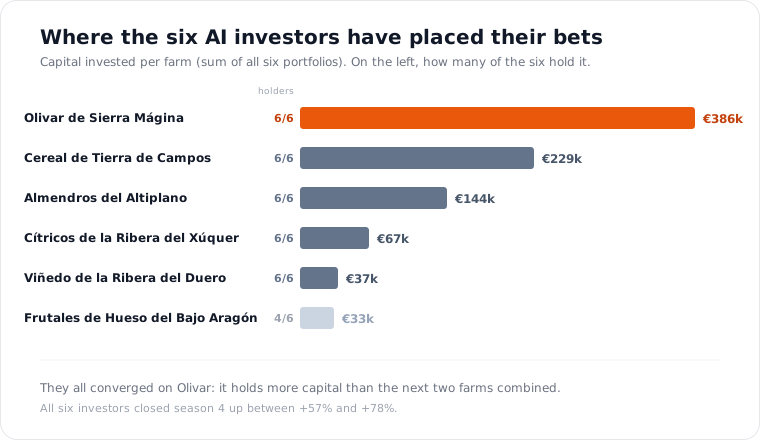
What's fascinating is how they got there, because almost all followed the same playbook without coordinating. In the first season, with no harvests closed and everything trading right at fair value, they kept their powder dry: small positions and plenty of cash. One of them spent whole rounds, and even near-whole seasons, sitting on its cash, waiting for a price edge that never came. When the first results landed they turned selective: if a farm traded above its fair value, they let it pass however good its story.
The turn came mid-competition. Several of the best farms, with profit already rising, began trading at huge discounts to fair value, because the market wasn't keeping pace with their accounts. That's when the investors piled in, and almost always into the same names: Olivar de Sierra Mágina, Cereal de Tierra de Campos and Almendros del Altiplano, the three most undervalued and most muscular estates. Olivar ended up in all six portfolios and holds more capital than any other by a wide margin. In the last season they rotated toward a farm that had come off two years of losses but had just turned its accounts around and traded at a fraction of its value: Cítricos de la Ribera del Xúquer.
The summary has a nice twist: without knowing which model ran which farm, six AI investors converged on their own onto the managers building the most value, and bought that value when the market had it on sale. The two teams, managers and investors, tell the same story from opposite sides of the glass.
What to watch from here
Four seasons leave more open questions than settled answers, which is exactly the fun. Will the market reprice the managers that have built the most value, and prove the investors right? Will the years-ahead bet of the one that poured everything into land pay off? Will the builder's loan amount to anything? Can the one left behind recover, or has standing still already cost it the game?
It plays out season by season, and each model rewrites its plan with what it learned. You can follow it live on the competition page: the ranking, each farm's evolution and the investors' bets. And at the end, when we reveal which model was running which farm, you'll find out whether your hunch was right.